2025 Michelin Recap — Insights from Comparing the Global Omakase Market

As a premise: what is Michelin actually evaluating?
The first thing to keep in mind is that Michelin does not evaluate popularity or sales—nor even taste alone.
In assessing a restaurant, Michelin places importance on the quality of ingredients, the skill of the cooking technique, the completeness and originality of the seasoning, and the consistent coherence of the cuisine as a whole.
This carries both advantages and disadvantages for sushi.
Sushi—especially authentic high-end sushi—is a cuisine whose value is difficult to convey without a cultural background and an understanding of sushi.
In other words, it is necessary to understand that Michelin tends to evaluate sushi only in cities where the context for measuring it has been established.
With this premise in mind, let us first look at the numbers.
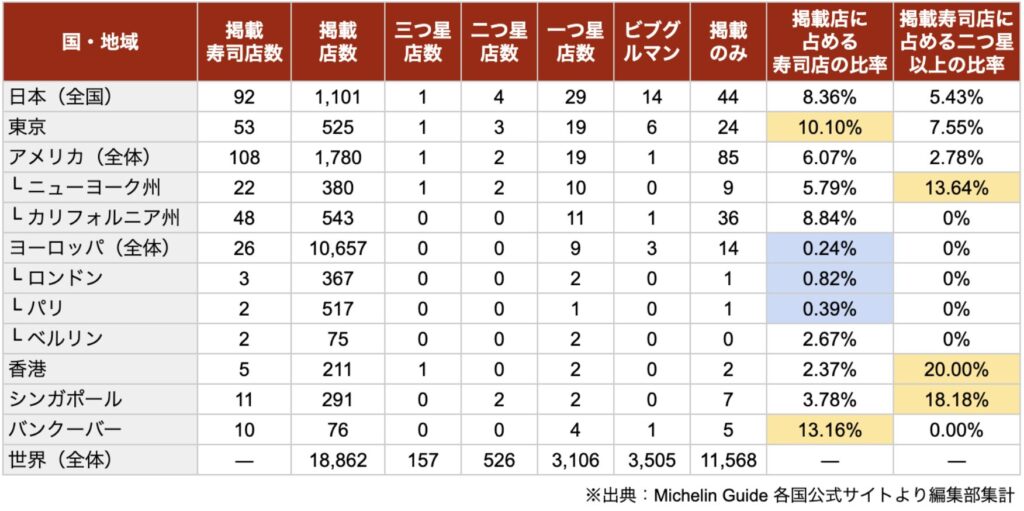
Regional Comparison of Michelin-Listed Sushi Restaurants (December 2025)
List of Two-Star and Above Sushi Restaurants by Country/Region
Japan
★★★
Harutaka (Tokyo)
★★
Sushi Shin (Nishiazabu) (Tokyo)
Sushi Kanesaka (Tokyo)
Sukiyabashi Jiro Roppongi (Tokyo)
Sushi Harumasa (Osaka)
United States
★★★
Sushi Sho (New York)
★★
Masa (New York)
Sushi Noz (New York)
Hong Kong
★★★
Sushi Shikon
Singapore
★★
Sushi Sakuta
Shoukouwa
What does the difference in the number of listed restaurants mean?
What the table above shows is that, on a global scale, sushi is by no means a category with many Michelin listings, yet in certain regions it has become a core part of the dining-out culture.
In Tokyo, Vancouver, and California, sushi accounts for more than 8% of listed restaurants, indicating that sushi has taken root as everyday high-end dining in these regions.
In Europe as a whole, on the other hand, despite the very large total number of listings, the sushi share is an extremely low 0.24%, making it visible in numerical terms that sushi is not positioned as a mainstream category within Michelin's evaluative axis.

SUSHI in Vancouver, where it has taken root as an everyday food
Turning to the share of restaurants with two stars or more, New York, Hong Kong, and Singapore stand out, and we can read from this that these regions have a market structure in which sushi tends to be evaluated not for sheer numbers but for its experiential value in the high-price range.
In addition, regions with many one-star sushi restaurants, such as California and Vancouver, have an established high-price market that accepts sushi above a certain standard, but the hierarchy of value and the criteria for evaluation have not yet fully solidified, so as a market for high-end sushi such as OMAKASE, they can be said to be still in a developing stage.
In regions such as London, Paris, and Berlin, where there are many listed restaurants yet none with two stars or more, it can be considered that the issue is not so much the quality of the sushi itself, but rather that there exists a structure in which the value of sushi is not readily shared as something worthy of the highest evaluation.
In this way, the distribution of Michelin stars is an indicator that reflects not only the popularity of sushi but also how a given region understands sushi and at what price range and in what context it consumes it; through the common language of Michelin, it brings to light the maturity and character of the world's high-end sushi markets.
Reading the market structure of each region
Now, let us look at the characteristics of the high-price sushi market in each region.
Japan
As the birthplace of OMAKASE and of sushi itself, it serves as the world's reference point, and sushi accounts for a high share of listed restaurants.
Sushi is not a special dish but a core part of the culinary culture, and because there are many points of comparison, a soil in which the precision of evaluation naturally rises has been formed, creating a structure in which restaurants with two stars or more are also more likely to emerge.
New York State
Sushi is consumed less as an everyday food than as an experiential luxury.
There is a thick layer of wealthy and global clientele able to support high-price courses exceeding USD 500, and the price itself functions as part of the value.
The share of restaurants with two stars or more is very high, and a distinguishing feature is that the aesthetic discernment and market environment to evaluate sushi as "the pinnacle of cuisine" are in place.
As a result, a select, elite-style high-end sushi market—limited in number but highly influential—has taken shape.
California
While the sushi share of listed restaurants is at a high level of 8.84%, the number of sushi restaurants with two stars or more is zero, and the evaluations are concentrated at one star.
This is thought to be because sushi has become an everyday food, with diversity, creativity, and casualness at the center of its market value.
The market scale is large, but it is a structure in which the "environment where the completeness of technique is competed over" that Michelin emphasizes is unlikely to arise, and the pressure to push high-end sushi up to two stars or more is weak.
Europe (overall)
In Europe, the listing share of sushi restaurants is overwhelmingly low at 0.24%. This does not mean that sushi restaurants do not exist, but it indicates that sushi is hardly incorporated as a mainstream category in Michelin's evaluations.
Nevertheless, there are a certain number of listed restaurants, and a high-price sushi market above a certain standard has been established.
What is noteworthy is that there are zero restaurants with two stars or more, and very few one-star restaurants. In Europe, we can see that the value of sushi has not yet reached the stage of being shared as "the pinnacle of cuisine."
Hong Kong
While the number of sushi restaurants itself is small, the share of those with two stars or more is very high.
The wealthy are concentrated here, and consumption behavior premised on the high-price range in dining out is clearly established.
Sushi is positioned not as an everyday food but distinctly as a high-end experience accompanied by status.
For this reason, even with a select few, ultra-high-end sushi is likely to take hold, and the market has a structure in which evaluations are concentrated at the top.
Singapore
Singapore, too, is a market with an urban dining-out structure close to that of Hong Kong.
Amid competition among multinational cuisines, high-price dining out is accepted as a given, and sushi is placed within that context as well.
Sushi is clearly recognized not as "one genre of Japanese cuisine" but as one of the options among high-end cuisines.
As a result, an environment in which sushi restaurants reaching two stars or more are likely to emerge has been established.
Vancouver
The sushi share of listed restaurants is very high, and sushi itself is deeply rooted in the region's dining-out culture.
On the other hand, no sushi restaurants with two stars or more have emerged, and the evaluations are concentrated at one star.
Sushi has taken root as a local food, with consumption volume, freshness, and approachability emphasized.
For this reason, it is difficult to evaluate it as a high-end experience accompanied by a sense of the extraordinary and tension, resulting in a structure that is unlikely to lead to the higher evaluations Michelin seeks.
The key to succeeding worldwide as OMAKASE
What has emerged from everything so far is that what the 2025 edition of Michelin reveals is not the superiority or inferiority of sushi itself, but the reality that the "market where sushi is evaluated" and the "market where sushi is consumed" do not necessarily coincide.
To succeed as high-end sushi, the completeness of taste, technique, and service alone is not enough; the soil of a market in which that value is understood, compared, and fairly evaluated is indispensable.
Whether high-end sushi takes hold depends, of course, on the craftsman's skill and the service, but even more so on the maturity of the high-end sushi market and the sharing of values. Taking root in a region or city equipped with the soil to be evaluated is precisely the key to succeeding across borders with OMAKASE.