What Is Edomae Sushi? The Origins and Characteristics of Edomae Sushi
The birth of sushi
Before talking about Edomae sushi, let us take a brief look at the history of sushi. Peering into its history makes the characteristics of Edomae sushi easier to understand.
First, sushi appears in Japanese literature beginning in the Nara period. Even though it was called "sushi," the sushi of that time was a kind of preserved food called "narezushi," made by pickling fish in rice or koji and fermenting it.
Narezushi is thought to have traveled from Southeast Asia to China and the Korean Peninsula, and to have been transmitted to Japan along with rice-cultivation culture. However, it differed greatly from today's sushi: only the fish was eaten, and the rice pickled together with it fermented into a mushy state and was discarded without being eaten.
From narezushi to hako-zushi and oshi-zushi
In the Muromachi period, a sushi called "namanare," in which the rice could be eaten without discarding it, was born.
With "namanare," fermentation was stopped just when the rice had acquired a sour taste, before the rice pickled with the fish dissolved, so that the fish and rice could be eaten together.
While "namanare" had a shorter shelf life, its fermentation period was shorter and the rice became edible. Sushi, which until then had been a "preserved food of fish," thus transformed into a "rice dish" in which the rice could also be eaten.
Eventually, sushi developed mainly in the Kansai region as hako-zushi and oshi-zushi, made by packing vinegared rice into a box, placing ingredients on top, and applying pressure. After that, maki-zushi, bo-zushi, battera sushi, and others spread in the Kansai region and came to be cherished as Kansai sushi.
The birth of Edomae sushi
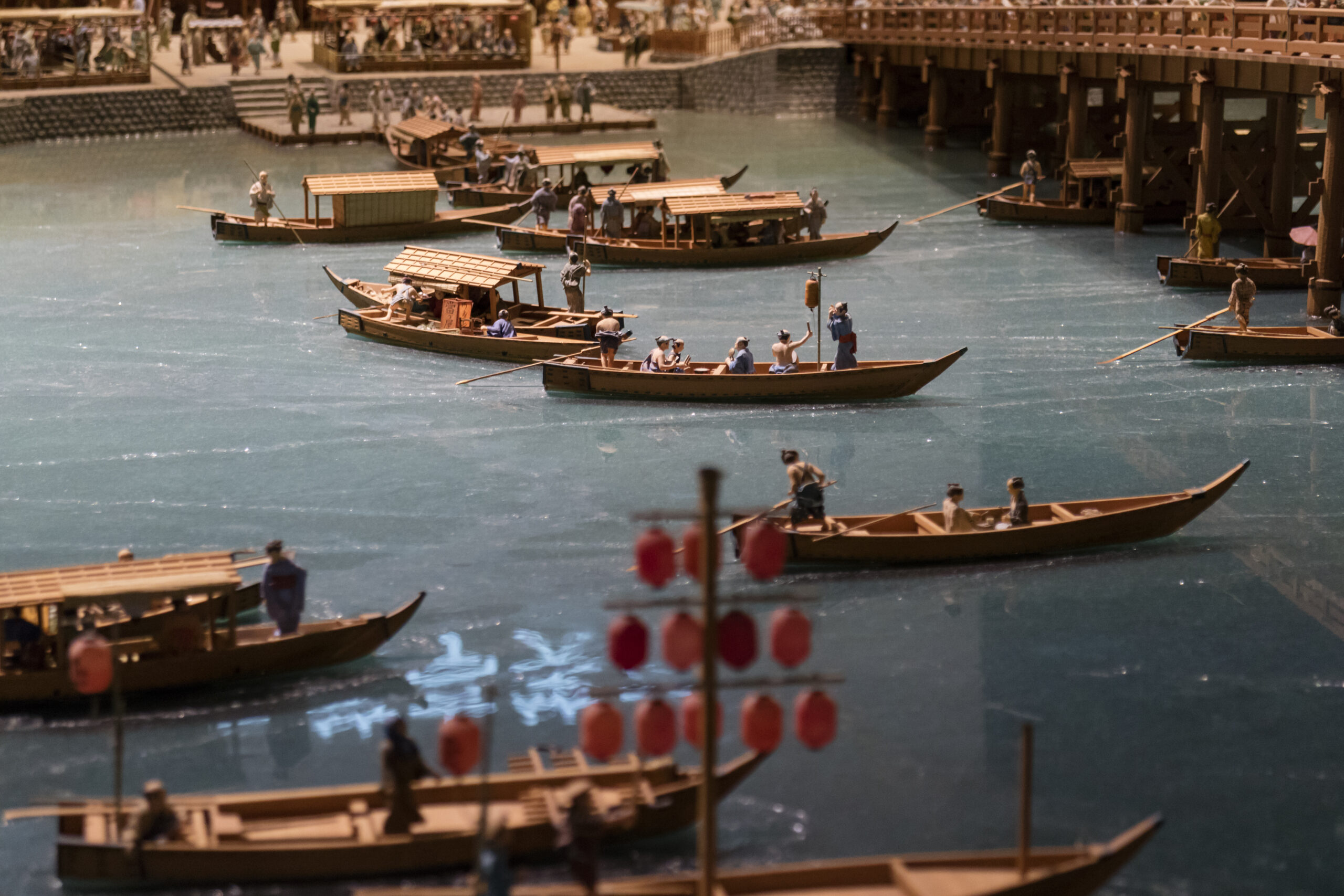
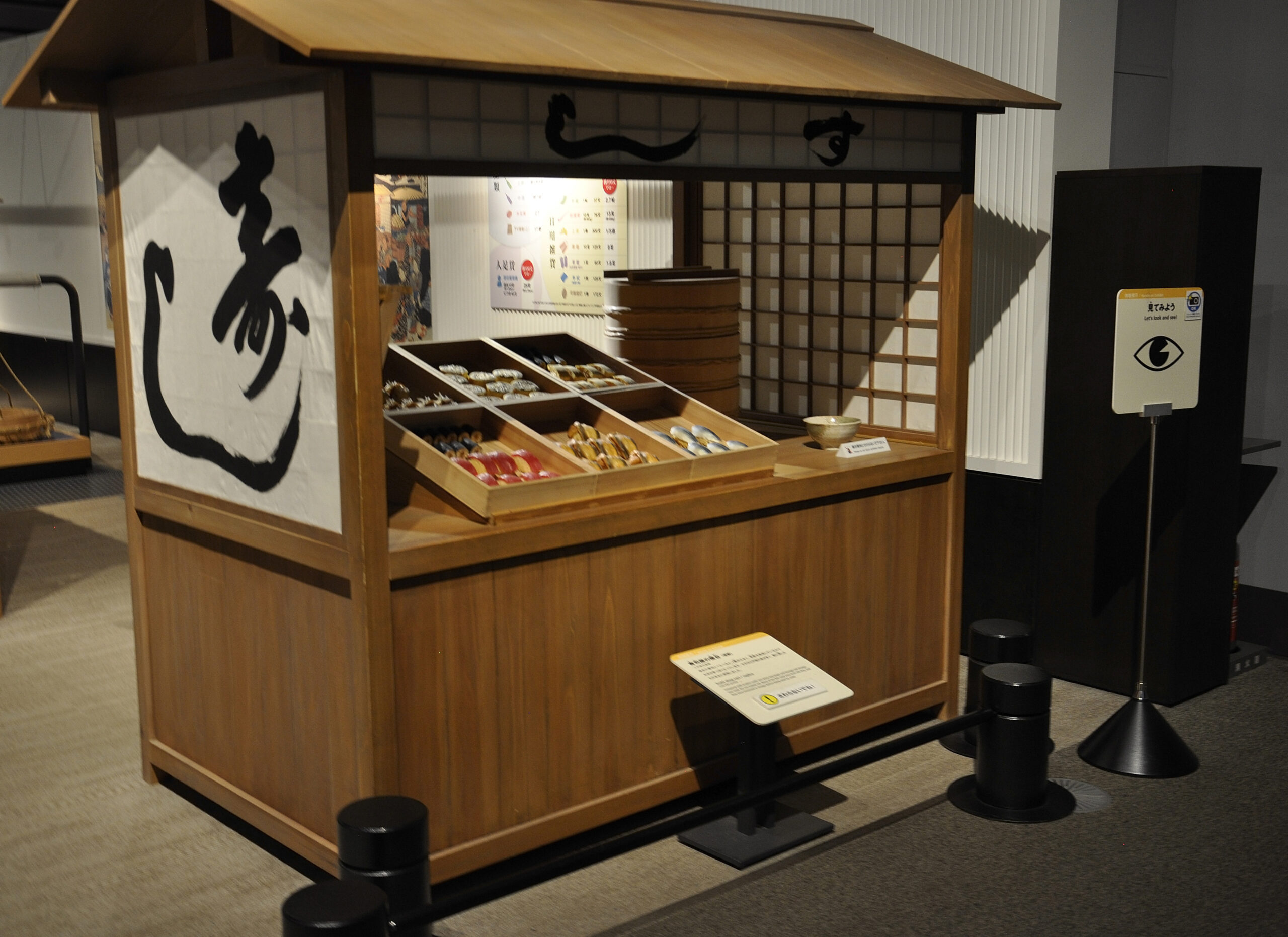
In the Edo period, the hako-zushi and oshi-zushi born in the Kansai region were transmitted to Edo as well, and by around 1680 sushi restaurants had appeared in the town of Edo.
Eventually, around 1810, Hanaya Yohei—who disliked the time required for pressing and pickling and the loss of the fish's fattiness—began selling nigiri sushi that could be eaten immediately after being shaped, like today's, under the name "nigiri-hayazuke."The reason a sushi restaurant's kitchen is called the "tsukeba" is that, at the time, making sushi was referred to as "tsukeru" (to pickle).
Yohei's "nigiri-hayazuke" took the world by storm as "nigiri sushi." Around the same time, many sushi restaurants, mainly in the food-stall style, were born throughout Edo. To distinguish it from "Kansai sushi" such as oshi-zushi, which had largely flourished in the Kansai region, it came to be called "Edomae sushi."
The Edomae sushi of that time was about 2.5 times the size of today's—roughly the size of a rice ball—and because kasu vinegar (red vinegar) was often used for the rice, the vinegared rice had a reddish tint. Even today, many sushi restaurants that adhere to traditional Edomae sushi use red vinegar.
The meaning of "Edomae"
Edomae sushi was thus born in Edo in a form different from the conventional narezushi and hako-zushi, and the "Edomae" of Edomae sushi derives, literally, from the use of seafood from the sea in front of ("mae") Edo.
However, the sea in front of Edo at that time refers to only a portion of the waters of Tokyo Bay, around the area in front of Edo Castle, and is thought to differ from today.
In the modern day, "Edomae" was defined in 2005 by the Fisheries Agency as the whole of Tokyo Bay, so in a narrow sense "Edomae" means "made with fresh seafood from Tokyo Bay."
Edomae sushi spreads nationwide
Edomae sushi was originally local sushi of Edo, but once it gained popularity in Edo, more sushi restaurants in Osaka—starting with "Matsu no Sushi"—also began adopting the nigiri sushi style.
In addition, in the Meiji period, the government adopted policies to spread the culture of Tokyo throughout the country, and along with this Edomae sushi spread nationwide.
Furthermore, events such as Tokyo's sushi chefs being evacuated to the provinces and opening shops due to the Great Kanto Earthquake and the Pacific War, and the postwar "consignment processing" system under which sushi restaurants became one of the few types of eateries allowed to operate, caused Edomae sushi to spread even further across the country.
Edomae sushi spread nationwide in this way, but it has regional characteristics.
For example, the vinegared rice at sushi restaurants in the Kansai region is made sweeter than that at sushi restaurants in the Kanto region. This is because Kansai sushi such as oshi-zushi, which spread in the Kansai region, used a large amount of rice relative to the topping, and a long time passed between making and eating it.
At the time, to keep the rice tasty until the last bite and to prevent the rice from drying out, more sugar was blended into the rice. As a legacy of this, the vinegared rice at Kansai sushi restaurants is still made sweeter today.
The vinegared rice at sushi restaurants in the Kanto region, where Edomae sushi—which has long tended to add seasoning to the toppings by curing or marinating them—is mainstream, is made lighter in flavor.
Also, toppings that characterize Edomae sushi include conger eel (anago), gizzard shad (kohada), and marinated tuna (zuke maguro), but among these, the one indispensable at Kanto-region sushi restaurants is tuna. How much tuna a restaurant handles can even affect its rank.
On the other hand, in the Kansai region, where fresh white-fleshed fish is easy to obtain, there is a tendency for many sushi restaurants to be particular about white-fleshed fish. Serving it in a way that lets you enjoy the flavor of the topping as it is is also a characteristic of Kansai-region sushi restaurants. You often see serving styles such as "please enjoy it as it is," which let you savor the natural flavor of the ingredients.
The characteristics of Edomae sushi
Edomae sushi thus spread nationwide over time, and the greatest characteristic of Edomae sushi lies in giving the sushi topping a bit of extra work—curing the fish with vinegar or salt, applying heat by simmering or grilling, or brushing on tsume (a sweet sauce).
This was wisdom as a preserved food, devised in the refrigerator-less Edo period to deliciously eat seafood that would otherwise spoil quickly, and it was the ingenuity of the craftsmen of the time.
Fish that spoil easily, such as mackerel, gizzard shad, and sillago—irresistible to lovers of shiny-skinned fish—are still often cured with vinegar today. This too is a traditional technique of Edomae sushi. It is said that at the time, horse mackerel, halfbeak, white-fleshed fish, shellfish, and others were also cured with vinegar before being eaten.
Today, methods of preserving fish have advanced, and it has become common to make nigiri sushi from fresh fish as is, but sushi restaurants that value tradition still serve Edomae nigiri that has been given that extra bit of work.
Edomae sushi, the revolutionary that overturned the concept of sushi
What did you think? The nigiri sushi we casually eat every day was originally a local Edo dish called Edomae sushi, but it could be called revolutionary sushi that overturned the concept of sushi up to that point.
It has now become one of the world's dishes representing Japan, and although some aspects differ from its original form, the desire of the people of Edo to eat sushi toppings such as seafood deliciously and stylishly will surely continue to be passed down to sushi lovers around the world in various forms.