Related Articles
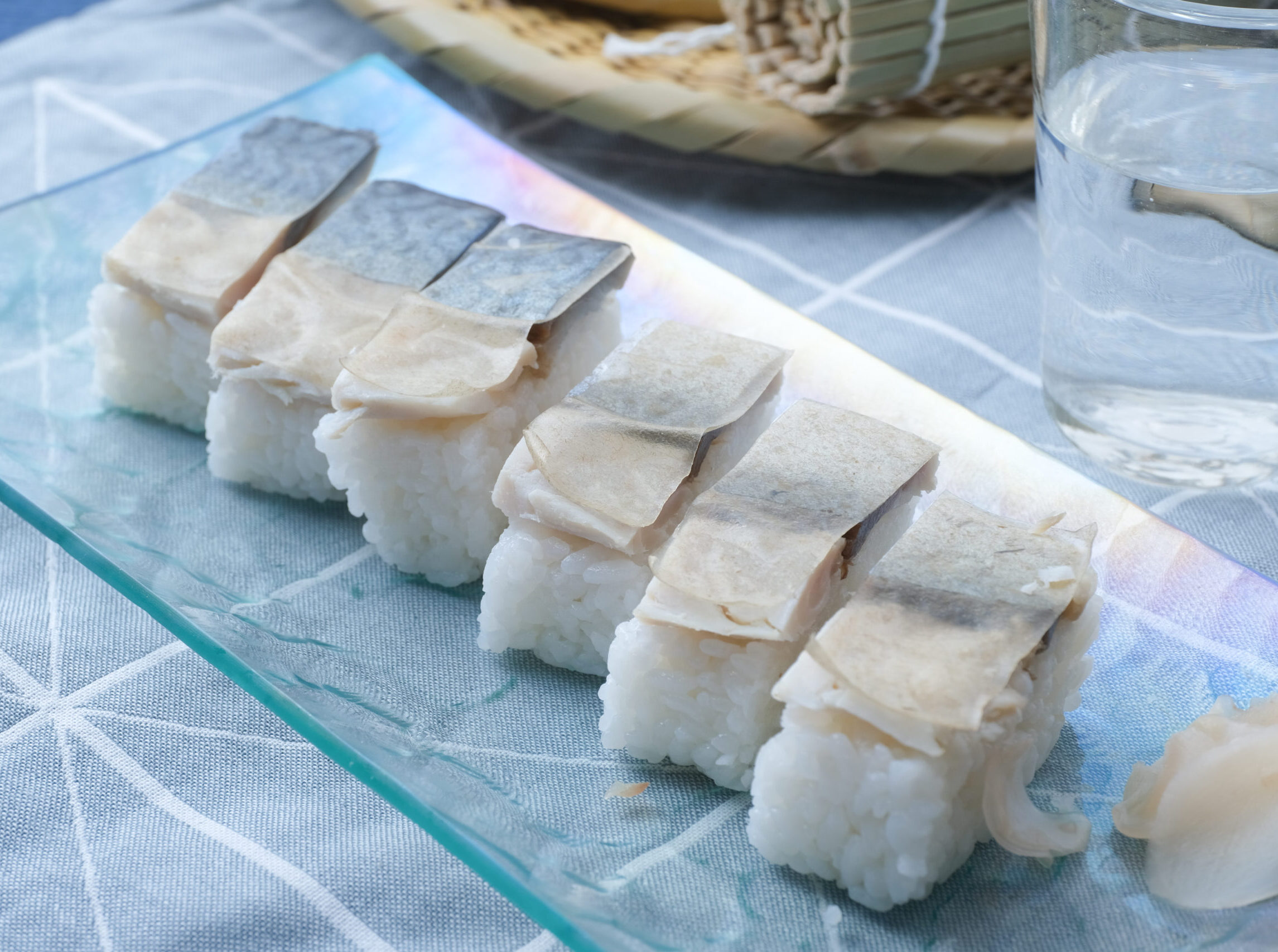
Battera is a type of pressed sushi in which thinly sliced mackerel, cured with vinegar, and shiraita-konbu (white sheet kelp) simmered in sweet vinegar are placed on top of vinegared rice, and it is generally molded using a square pressing mold to shape it.
Battera, said to have originated in Osaka, is said to have been devised by the Osaka sushi restaurant "Sushitsune," and it became established as Kansai-style pressed mackerel sushi, continuing to this day.
Now, next let's take a look at the history of battera along with the origin of its mysterious name.
Battera is said to be a variation of the Portuguese word "bateira."
Bateira means small boat in Portuguese, and even today in Portugal "bateira" refers to a small boat.
Osaka, said to be the birthplace of battera, was once a region where trade with Portugal flourished.
Originally, battera used not mackerel but konoshiro (the mature form of kohada), and because a pressing mold shaped like a bateira to match the shape of the konoshiro was used, it came to be called battera.
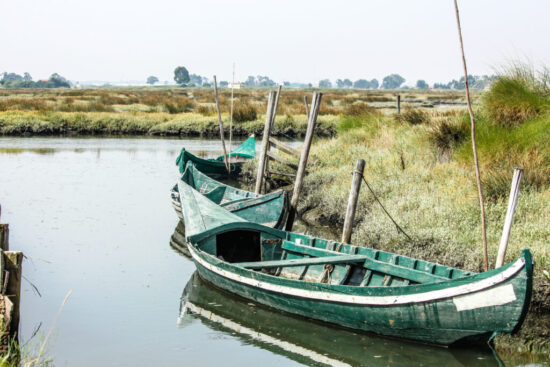
A Portuguese bateira
Battera is said to have been devised in 1891 (Meiji 24) by Tsunekichi Naka, the founder of the Osaka sushi restaurant "Sushitsune."
At the time, "Sushitsune" would filet konoshiro, which were often caught in Osaka Bay, into two pieces, cure them with a cloth, and make them into pressed sushi to sell, but because it was so well received, curing with a cloth could no longer keep up, so when they used a wooden boat-shaped sushi mold, customers who saw it began calling it "bateera" because it resembled the Portuguese bateira, and this became established as battera.
In time, as konoshiro became expensive, it was replaced by cheaper mackerel, and the pressing mold used also changed from a small-boat-shaped mold matching the half-body of a konoshiro to an easier-to-press square box-shaped mold, taking on its present form.
Today, when people say battera, it almost always refers to battera made of pressed mackerel sushi, and the shape is generally square.
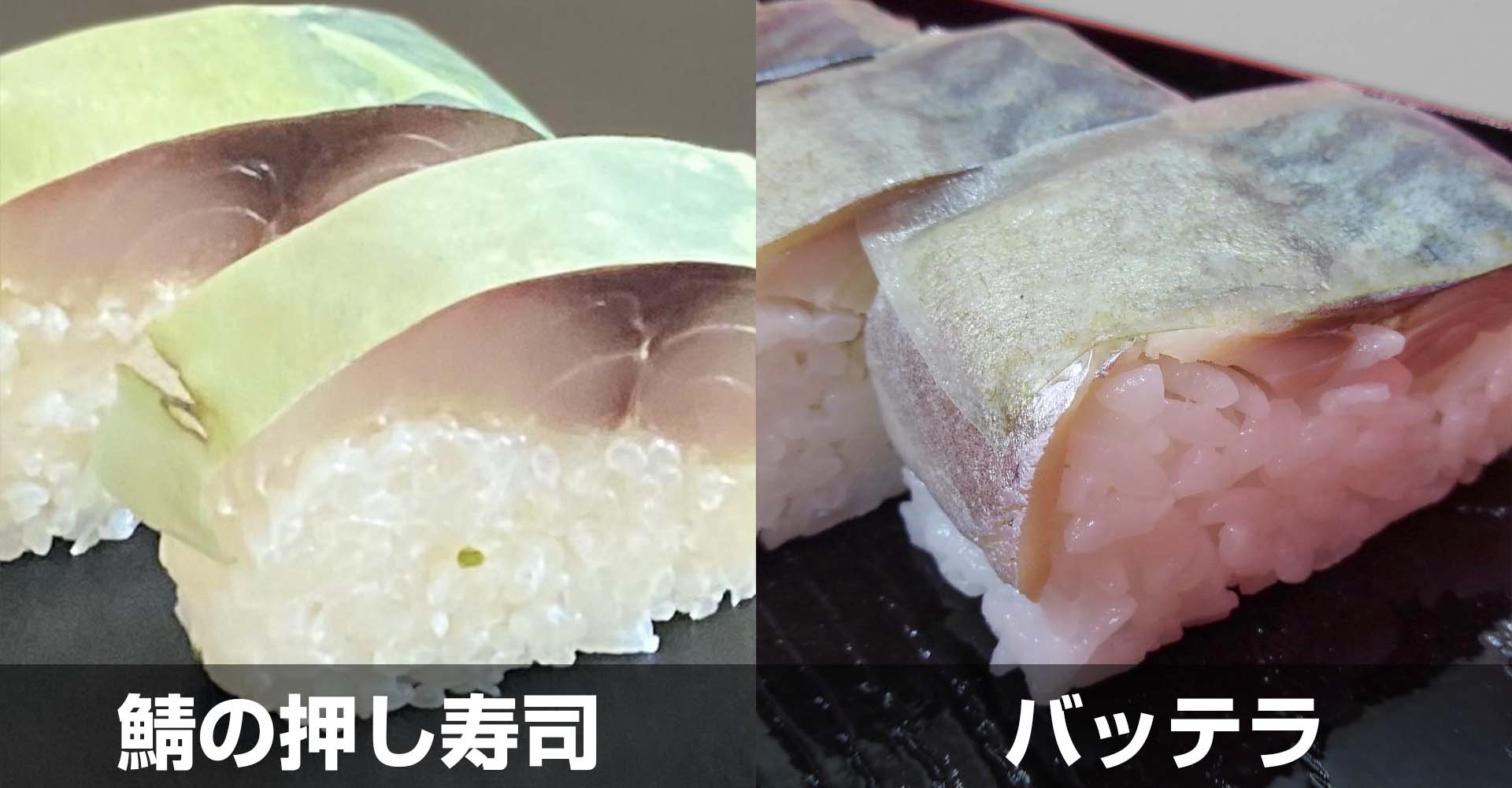
Battera is one of Osaka's local sushi, but there exist several pressed sushi using mackerel similar to battera throughout Japan.
What differences are there between battera and these sushi?
There are pressed sushi using mackerel like battera all over the country, but the major difference is that whereas battera uses thinly processed mackerel, mackerel sushi (saba-zushi) uses an entire half-body of mackerel, so the amount used is a major point of difference. In other words, mackerel sushi uses a larger amount of mackerel.
For this reason, mackerel sushi is generally more expensive, while battera is sold relatively cheaply. There are not a few mackerel sushi that exceed 5,000 yen, but depending on the item, battera can be bought at supermarkets and convenience stores for around 500 yen.
Also, while battera is mostly made by molding it with a pressing mold, mackerel sushi is generally made using a bamboo rolling mat. For this reason, mackerel sushi often has a rounded shape as a characteristic.
The kelp used in both is mainly shiraita-konbu. Shiraita-konbu is a type of oboro-konbu made by shaving a single piece of kelp, corresponding to the white core part left after shaving off the black oboro. Mackerel sushi also often uses shiraita-konbu, but in the case of high-end mackerel sushi, thick gyuhi-konbu, which is labor-intensive to produce, is sometimes used.
The birthplaces also differ: while battera's birthplace is said to be Osaka, mackerel sushi has many birthplaces throughout the country, such as Kyoto's bo-zushi, Wakayama's nare-zushi, and Hokkaido's Matsumae-zushi. They all share the use of mackerel, but battera has an image of being for the common people, while mackerel sushi has a slightly more upscale image.
Pressed sushi using mackerel like battera includes Matsumae-zushi.
Matsumae-zushi is the same as battera in that it is pressed sushi using mackerel, but as its name suggests, it is a local dish of Matsumae in southern Hokkaido, and its birthplace differs from battera.
Like other pressed mackerel sushi, it resembles battera, but the reason it is called Matsumae-zushi is that it uses kelp transported by Matsumae ships. There is no particular definition for Matsumae-zushi, and sushi using Hokkaido-produced Matsumae kelp and mackerel is often called by this name. Because a bamboo rolling mat is used, its shape is slightly rounded, which is also a slight difference from battera.
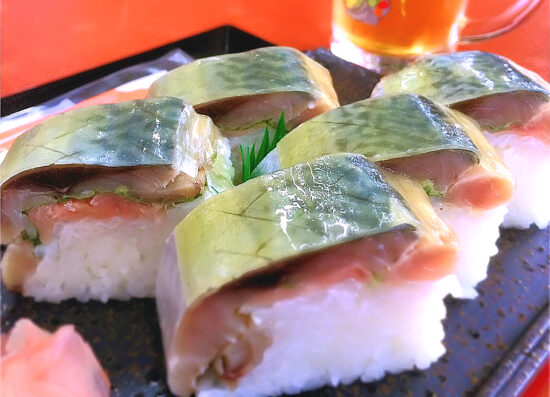
Matsumae-zushi
Although battera uses mackerel, thanks to techniques such as curing the mackerel with vinegar and using kelp simmered in sweet vinegar, you don't feel any fishy smell, so it is very easy to eat and still boasts unwavering popularity today.
The moderate saltiness and the sourness serve as accents, and the texture of the vinegared rice and mackerel makes it a delightful dish. Because it is also a cheap sushi, being able to eat it generously, bite after bite, is one of its charms.
What people are curious about when eating battera for the first time is the shiraita-konbu placed on top.
The kelp, which also serves the purpose of preventing the cured mackerel from drying out, is something you should definitely eat together to enjoy the flavor of the sweet vinegar. Of course, depending on your preference, there is no problem with removing it before eating.
In Osaka, where battera is a local dish, it is a sushi often bought casually at the nearest supermarket and eaten, but you can also make it at home. We will introduce the general way to make battera, so please give it a try if you have the chance.
Battera is popular for its deliciousness and ease of eating, but what nutrients does it contain?
Mackerel, which is essential to battera, is an ingredient with much to note nutritionally.
Specifically, it contains large amounts of protein, minerals, and vitamin D, as well as plenty of essential fatty acids such as DHA, said to be good for brain cells, and EPA, which has the effect of making blood flow smoothly.
Battera, made with mackerel that contains many nutrients effective for maintaining the health of modern people, can be said to be a sushi with many nutritional benefits as well.
Now, next we will introduce famous shops where you can savor the deliciousness of battera.
This is a famous shop said to be the originator of battera, which also appeared in the history of battera.
Its signature is battera in which the fluffy vinegared rice, overturning the image of pressed sushi, pairs well with juicy, fatty cured mackerel. The quality of the kelp placed on top also conveys a sense of commitment—truly the dignity of a long-established shop.
Currently, they have returned the shape of battera to the boat shape of its original conception, and sell it under the name "bateera" as well.
On some days, you can even eat the original konoshiro battera, it is said.
Restaurant Name: Sushitsune
Phone: 06-6351-9886
Address: 2-4-3 Tenjinbashi, Kita-ku, Osaka City, Osaka
Google MAP: https://goo.gl/maps/sFprTVc7dkjToZ5G9
Website: http://www.ryusdc.net/sushitsune/
If you want to taste the Osaka specialty battera in Tokyo,
"Yonesaku" is recommended at such times. It is a small shop, but it provides a traditional flavor that adheres to the basics of battera. You can feel the authentic taste even in its strong vinegar.
Restaurant Name: Yonesaku
Phone: 03-3431-6065
Address: 2-8-4 Shibadaimon, Minato-ku, Tokyo
Google MAP: https://goo.gl/maps/ux64rYsk1MQ2b84U9
Website: https://enw3.hisyaku.com/
The battera of Abaraya, founded in 1955, is this shop's signature product.
The balance of the see-through thin kelp, fresh mackerel garnished with kinome (Japanese pepper leaf), and sweet vinegared rice is reputed to be the best.
Rather than the vinegar-heavy battera common in Osaka, it has a unique flavor in which the saltiness prevails.
Many people come all the way to Sennichimae in search of this battera, it is said.
Restaurant Name: Abaraya
Phone: 050-5487-2136
Address: 2-14 Namba-sennichimae, Chuo-ku, Osaka City, Osaka
Google MAP: https://goo.gl/maps/f8CNWRuDirAr4wAx6
Website: https://abaraya-namba.gorp.jp/
Battera is an Osaka specialty, but if you want to eat it at home, there is also the method of obtaining it online.
Here we introduce well-reputed battera that can be bought online.
Catering Yonecho, which has protected the taste of Osaka battera for 60 years, competes with a traditional flavor using domestic mackerel and Rishiri-produced kelp! Its deliciousness is guaranteed, as shown by its many repeat customers.
Shop Name: Catering Yonecho
https://item.rakuten.co.jp/yonechou/baxtutera-1000-a/
This battera is characterized by mackerel whose thickness surpasses the rice—a gem made using mackerel, rice, and vinegar produced in Fukui Prefecture. The thickness of the mackerel is close to that of mackerel sushi, but the reasonable price is battera through and through!
Its taste, which even won the Best Mail-Order Grand Prize, is one you should definitely try!
Shop Name: Fresh Mackerel Sushi Echizen Hagi
https://item.rakuten.co.jp/namasabazushi/509/