Sushi Toppings Popular with Foreigners — Rankings and Global Sushi Trends

There are many types of Japanese cuisine, but sushi is by far the most popular among them, and it is eaten all over the world, from neighboring Asian countries to North and South America and Europe. The types of sushi toppings that are favored vary from country to country, and tend to be a little different from those in Japan.
With COVID-19 coming to an end, many people may be thinking, "I'd love to treat the foreign visitors coming to Japan to some sushi!" This time, we'll introduce how sushi is loved overseas, along with the sushi scene abroad and a ranking of the sushi toppings that are popular with foreigners.
Learn more about the sushi scene overseas and enjoy sushi even more than before!The Sushi Scene Overseas

The Changing Styles of Sushi Service Around the World
Sushi is enjoyed in countries all over the world, and its popularity has grown year by year, with it now being served in a variety of formats.
Not only are there sushi restaurants that specialize in sushi, but conveyor-belt sushi, which until now was only seen in Japan, has also become common overseas.
In recent years, sales formats have diversified and blended into local life, such as in supermarket deli sections and sushi-specialized delivery services.
In addition, the number of shops handling sushi itself has been increasing. In France, for example, sushi has already become as widespread as fast food, and French-born chains such as "SUSHI SHOP" boast a number of locations rivaling that of major hamburger chains.
That number is an astonishing 1,500 or more! Just looking at this figure, you can see that sushi is loved by many people regardless of country!
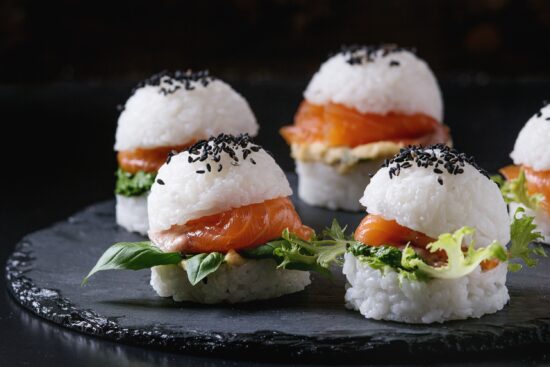
Hamburger-like overseas sushi
Creative and Colorful Sushi Are Popular Overseas!
Nigiri sushi is eaten overseas too, but the overwhelming prevalence of creative sushi other than nigiri is a feature of overseas sushi that doesn't exist in Japan.
This tendency is especially pronounced in the West: in France, it has practically become a small piece of French cuisine; in Spain, "fruit sushi," in which sweet ingredients like mango and strawberry are rolled in sushi rice, has gained popularity, as has "dessert sushi" in Romania, where chocolate is rolled in sushi rice; and in South American countries like Brazil and Chile, even sushi with the entire surface of inside-out rolls coated in breadcrumbs and deep-fried in oil is sold. It is truly diverse.
On the other hand, in East Asian countries close to Japan, such as China, Taiwan, and South Korea, the sushi is relatively similar to Japan's, but even so, there is a tendency to prefer slightly flashier colors than in Japan. Furthermore, in Southeast Asian countries like Indonesia and Vietnam, the proportion of creative sushi such as sushi rolls increases, and the colors gradually become flashier.
It is enjoyed in styles full of originality tailored to each country's culinary preferences, and considering that a wide variety of sushi was born in different regions even within Japan, it is truly fascinating that the same thing is now happening on a global scale.
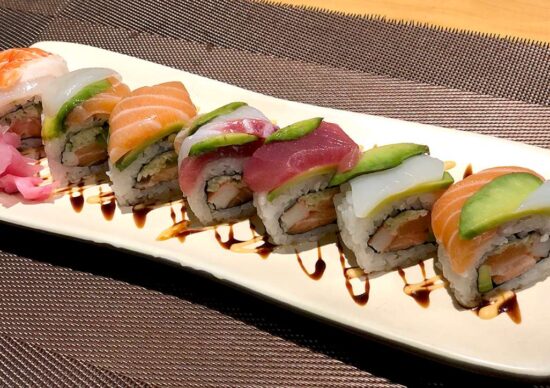
The rainbow roll, popular in the West and Southeast Asia
BEST 10 Ranking of Sushi Toppings Popular with Foreigners
Now, let's take a look at the sushi toppings that are popular overseas in a ranking format!
This ranking was created based on the results of interviews that Sushi Walker editors, who have long eaten sushi from all over the world, actually conducted with many foreigners, as well as on surveys by JETRO and Hakuhodo.
That said, even among foreigners, tastes differ considerably by region, and there are quite significant differences between the West and East Asia in particular.
This time, while taking such circumstances into account, we made this a comprehensive ranking by surveying countries with deep ties to Japan, including China, Hong Kong, Taiwan, Vietnam, Indonesia, South Korea, the United States, France, and Italy.
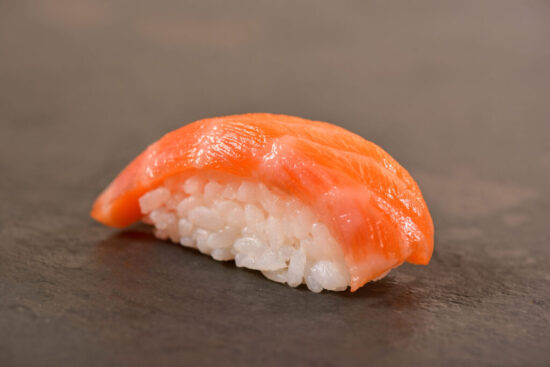
No. 1: Salmon
Salmon, which also won the overwhelming top spot in Sushi Walker's "Sushi Topping Ranking Chosen by 1,000 Women! Conveyor-Belt Sushi Edition," is an overwhelmingly popular sushi topping overseas as well, even more so than in Japan.
It is hugely popular in various countries regardless of East or West, such as the United States, Russia, China, Taiwan, Vietnam, Brazil, and France, and you often meet foreigners who say, "I can't eat sushi, but I can eat salmon," which seems strange from a Japanese perspective.
It has little fishy smell, making it easy to eat, and its rich, sweet flavor with plenty of fat seems to be favored. It is used not only for nigiri sushi but also as an ingredient in rolled sushi, which is popular overseas in general, so it can be enjoyed in all sorts of ways! Its versatility for arrangements is one of the reasons for its popularity.
No. 2: Sushi Rolls (Inside-Out Rolls)
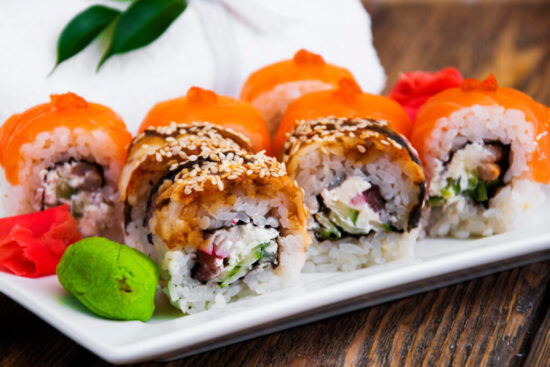
Inside-out rolls are known overseas as sushi rolls, and especially in the West, there is a tendency to recognize sushi rolls as sushi more than nigiri sushi.
It is said to have started when the nori was placed on the inside for Westerners who dislike black seaweed. Unlike the thick rolls and thin rolls known in Japan, they are rolled with the sushi rice on the outside, and California rolls, rainbow rolls, and spicy tuna rolls are famous.
They generally have a colorful and flashy appearance, are often decorated with sesame seeds or brightly colored flying fish roe, and the inner ingredients often include avocado, cheese, and mayonnaise.
They are strongly supported in Western and South American regions such as the United States, Italy, Chile, and Germany, which tend to dislike raw foods and nori, and are enjoyed more casually than nigiri sushi. You often see sushi restaurants where there are more kinds of sushi rolls than nigiri sushi.
No. 3: Tuna
After salmon, the most favored nigiri sushi is tuna.
Rather than the lean red meat familiar to Japanese people, the fatty and richly flavored medium fatty tuna (chutoro) and premium fatty tuna (otoro) seem to be more popular.
It is more popular in Asia, such as China, Taiwan, South Korea, and Vietnam, than in the West like France and the United States, and has earned a certain status as a high-end sushi topping.
However, in Brazil, where it is said to be difficult to obtain high-freshness tuna, and in Malaysia, where the culture of eating raw food has not taken root, it does not seem to be very popular.
Overseas, few countries have as wide a variety of tuna as Japan, so perhaps the true deliciousness of tuna isn't really conveyed.

No. 4: Shrimp
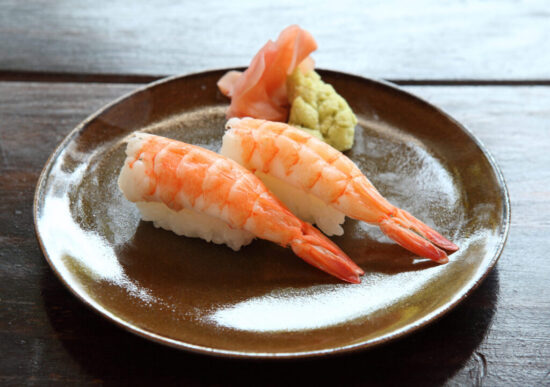
Shrimp is eaten in many countries, including Thailand and Vietnam where shrimp fishing is thriving, as well as the United States and France, and is of course also enjoyed as a sushi topping.
In Japan, raw shrimp and red shrimp are also popular, but especially in the United States and France, where the culture of eating raw food is less widespread, steamed shrimp rather than raw is the standard. Arranged sushi combining steamed shrimp with avocado, mayonnaise, and the like is also popular.
In Asia there are not many foreigners who are big fans of shrimp, but when including the West, it is a sushi topping that ranks high.
No. 5: Salmon Roe (Ikura)
Salmon roe, which is hugely popular in Japan for its gorgeous appearance and deliciousness, is also one of the most popular sushi toppings overseas.
The standard way to eat it is, of course, as a gunkan (battleship) roll, but along with flying fish roe, it is also often used as a decoration to create a luxurious look.
In France, where people are familiar with fish roe such as caviar, salmon roe is also included as one of the basic sushi toppings. It is apparently sometimes called "salmon caviar," taken from the parent fish, the salmon.
However, in parts of Northern Europe and North America, fish roe tends to be avoided, so it seems to be a topping that divides opinion. Incidentally, since the word "ikura" comes from Russian, it is also a popular sushi topping in Russia!

No. 6: Scallop
Scallops are enjoyed not only as nigiri sushi but also as an ingredient in rolled sushi.
For example, at sushi restaurants in Canada, a sushi roll called the "beautiful roll," in which scallop and mayonnaise are rolled in sushi rice, is popular.
In addition, scallops are also caught in the United States and France, and many sushi restaurants seem to handle them.
Scallops are also a popular ingredient in China and Taiwan, and seared scallop sushi is a popular topping at conveyor-belt sushi places, but due to circumstances such as few sushi restaurants offering it, its recognition is lower than that of the other higher-ranked sushi toppings.

No. 7: Octopus
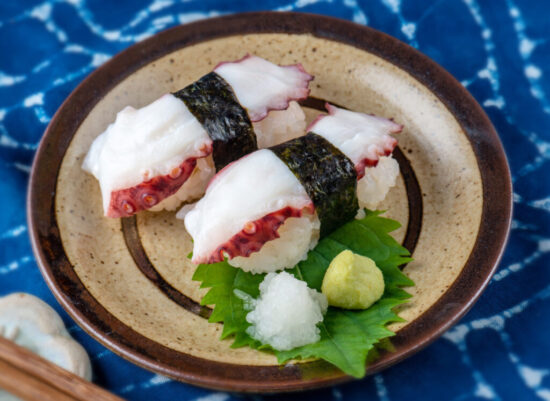
Octopus is also one of the popular sushi toppings at overseas sushi restaurants.
Octopus is used in dishes such as carpaccio, and is especially favored and eaten in Italy, Asia, Central and South America, Greece, and Spain, making it a familiar ingredient to foreigners as well.
Overseas, boiled octopus is used rather than raw octopus, and it is often served wrapped in nori.
In some countries, there are people who avoid octopus for religious reasons, but thanks to its unique texture and flavor, it is loved around the world and is a popular sushi topping handled at many sushi restaurants.
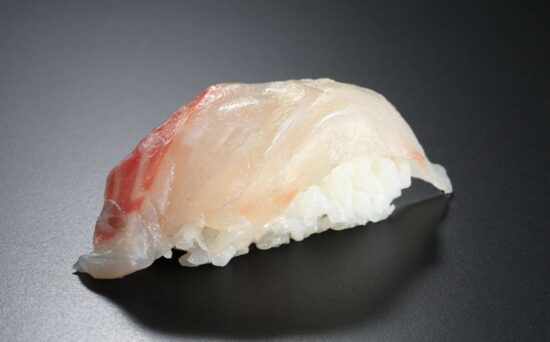
No. 8: Sea Bream
Sea bream is also a sushi topping loved in many countries.
In France, for example, it ranks among the top 4 most popular sushi toppings. It is also enjoyed as sushi in South Korea, where there is a custom of eating it domestically, and in Italy, where there is a custom of eating it raw in dishes like carpaccio.
With its light flavor, sea bream seems to be eaten more often as nigiri sushi than as rolled sushi.
However, since it is not a very common sushi topping in Asia and Southeast Asia, there is a difference in popularity between the West and Asian regions.
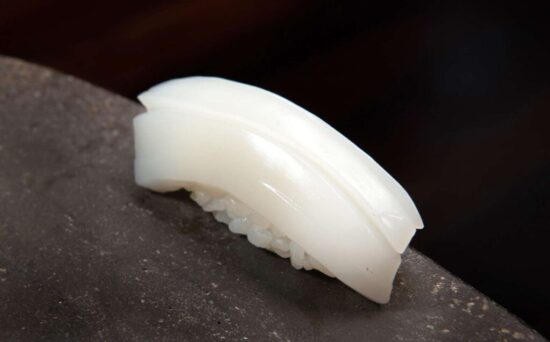
No. 9: Squid
Squid sushi is one of the sushi toppings often seen abroad. Since squid is caught in many countries, it tends to be readily chosen as a sushi topping. However, since some foreigners have an aversion to the appearance and unique texture of squid, it is not necessarily accepted by everyone.
Even so, since squid has originally been used in various dishes, it is familiar to foreigners and easily accepted as sushi, so squid sushi has become a popular sushi topping as one of the variations of sushi in many countries.
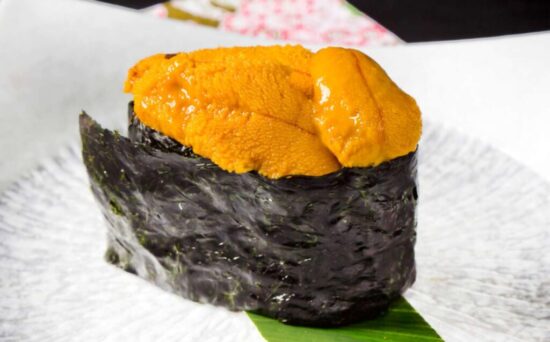
No. 10: Sea Urchin (Uni)
Sea urchin is treated as a sushi topping whose popularity is greatly polarized overseas, especially in the West. Since sea urchin is caught in Greece, Italy, the United States, France, and other places, it is eaten as a gunkan (battleship) roll just as in Japan.
Good-quality sea urchin is also caught in Australia, but because there is no custom of eating raw seafood, many people are not fond of eating it as is, and there seems to be no demand for it in sushi either. Also, in some places like Indonesia and the United States, it is conversely unpopular if its unique flavor and smell are not accepted.
SUSHI, Merging with the World's Food Cultures: Sushi Keeps Evolving Overseas!
This time, we introduced a ranking of sushi toppings popular overseas and the sushi scene abroad.
Even though it's all called sushi, some countries have no custom of eating raw fish, and preferences differ depending on the local food culture, so there is diversity in the sushi toppings handled as well.
In addition, with unique arrangements added, there is even an aspect where the lineup is more varied than in Japan.
Based on each country's food culture, they use creativity and ingenuity to offer sushi full of originality.
There are many parts that differ from the Japanese sushi we usually see, and some parts may feel unfamiliar, but that is also proof that sushi is beginning to take root around the world as a new food culture.
Overseas sushi keeps evolving. If you ever come across it while traveling abroad, please do give it a try.
References
Asia14年におけるJapanese Cuisine·Japan酒·緑茶の浸透度(経験度)|博報堂のGlobal生活者調査レポート