What Is Chirashi Sushi? From Its Origins to Recipes
What is chirashi sushi?
There are many kinds of chirashi sushi.
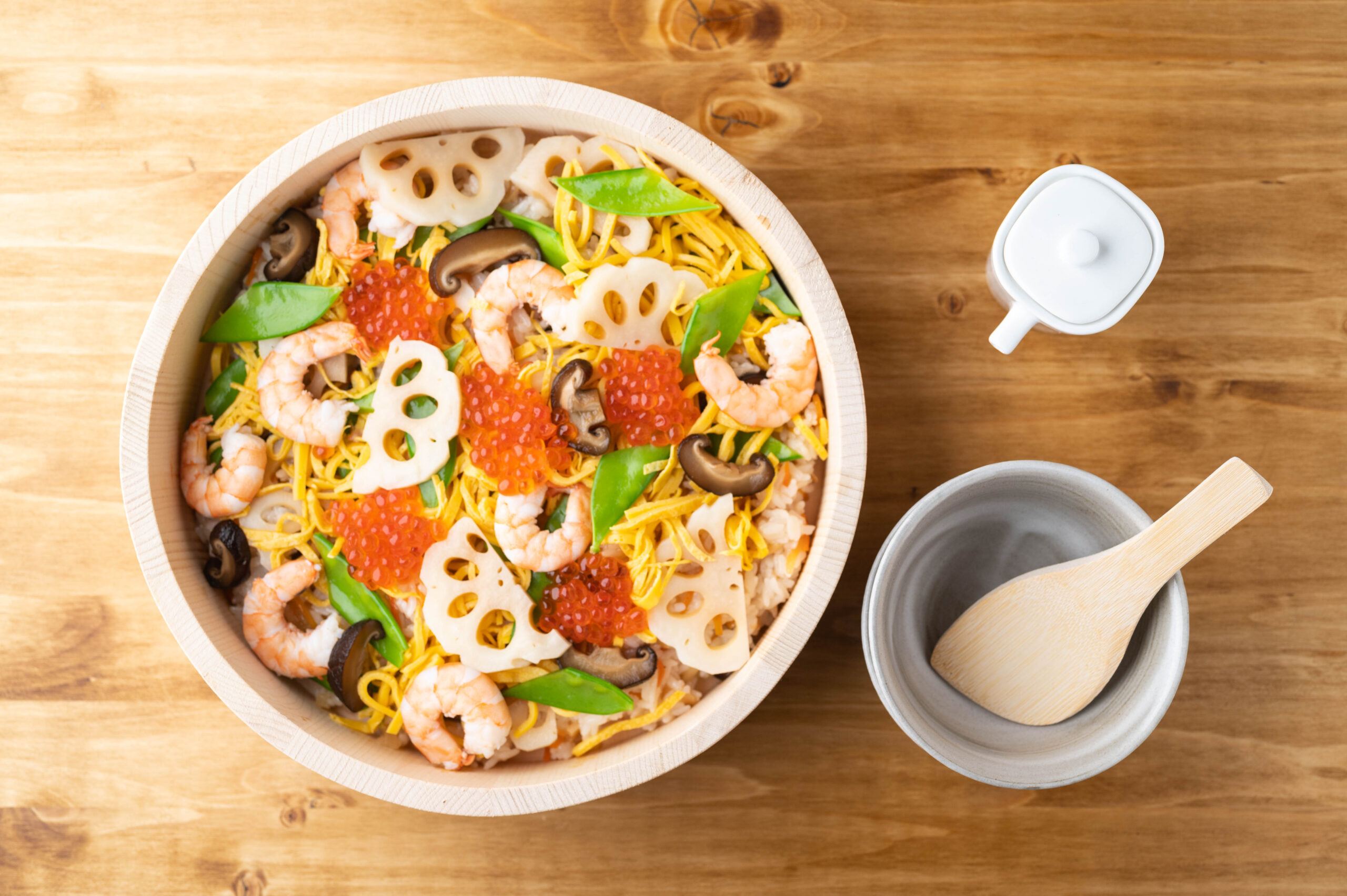
The general definition of chirashi sushi is “various toppings placed on top of vinegared rice.” The type in which the ingredients are mixed into the vinegared rice is strictly speaking “gomoku sushi,” but in practice it is often treated as chirashi sushi as well.
The ingredients of chirashi sushi commonly include sashimi, boiled shrimp, kamaboko (fish cake), tamagoyaki (rolled omelet), and kanpyo (dried gourd strips), but there are differences in traditional chirashi sushi between the Kanto and Kansai regions.
The above is of course only a general account, and it goes without saying that each household and region has its own way of making it.
There is a wide variety of chirashi sushi, using local specialty products of each region or selecting ingredients to match seasonal events.
Traditionally, chirashi sushi is also a dish often eaten on occasions when people gather, such as festivals, celebrations, and the Obon period.
The history and origin of chirashi sushi
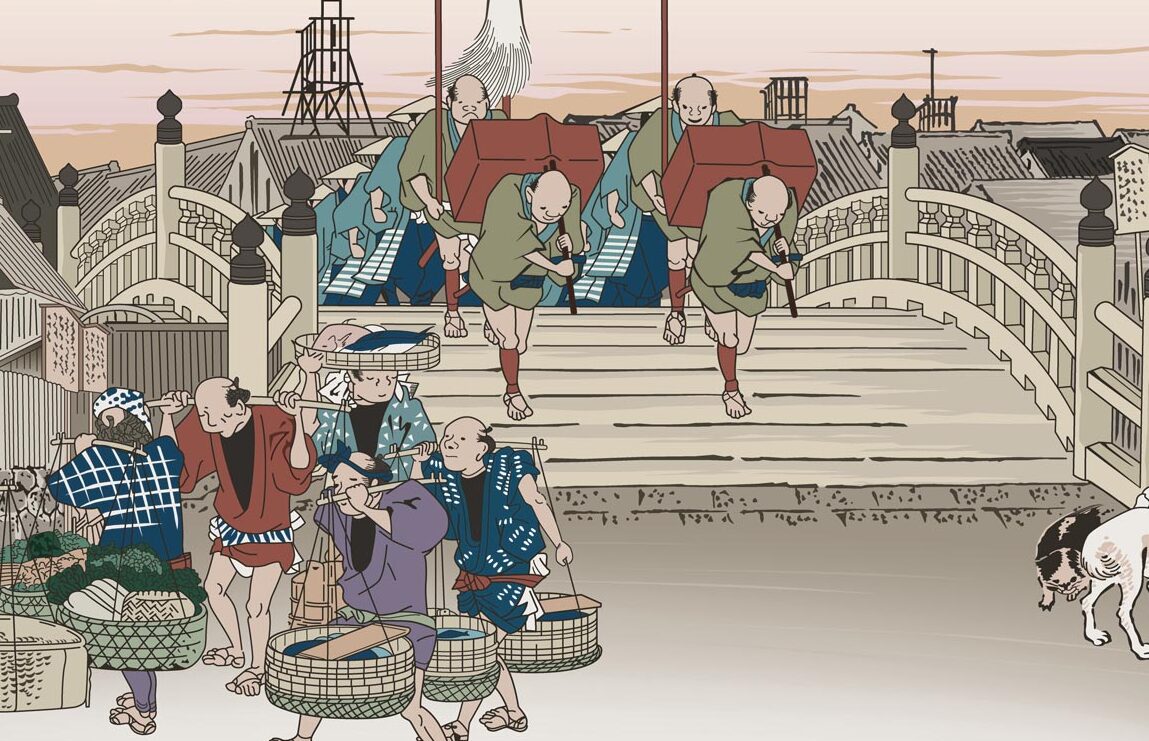
Chirashi sushi appeared earlier than nigiri sushi
When was chirashi sushi born?
A revolution occurred in the culture of nare-zushi, which required several days from preparation to eating, and sushi using cooked rice made its appearance in the Tenmei era at the very end of the 18th century.
Hako-zushi (box sushi), considered the predecessor of chirashi sushi, was also born in this trend. Hako-zushi refers to vinegared rice packed into a wooden box with toppings placed on top.
A book titled “Shichijugonichi,” published in the 7th year of Tenmei, is a collection of the trademarks of shops of the time, and it is known that among them there was a sushi shop that served hako-zushi.
This hako-zushi, made with kohada (gizzard shad) and tamagoyaki, originated earlier than the nigiri sushi that appeared in the Bunsei era, and has the air of a forerunner of the Edo sushi that took the world by storm.
The origin of the name chirashi sushi
It is clear from literature that the name gomoku sushi comes from the ingredients mixed into the vinegared rice being called “moku,” but the origin of the name “chirashi sushi” has many theories and remains unclear in many respects.
Since the words “chirashi” and “gomoku” already appear in the “Morisada Manko,” published in the 6th year of Kaei (1853), the established view is that chirashi sushi, which developed from hako-zushi, was already well known by the mid-19th century.
There were also cases where people disliked the word “chirashi” and called it “okoshi-zushi.” This term arose from the act of “raising up” (okosu) the vinegared rice with chopsticks when eating.
Chirashi sushi loved by women and feudal lords
According to the aforementioned “Morisada Manko,” it is recorded that by the Kaei era many sushi shops had made nigiri sushi the mainstream, and the popularity of chirashi sushi had declined.
On the other hand, chirashi sushi, which could be eaten with chopsticks rather than stuffed into the mouth like nigiri sushi, was popular among female customers as an elegant sushi. Though it lacked the “chic” of nigiri sushi, chirashi sushi neatly packed into wooden boxes also enjoyed great popularity among feudal lord families. It is known that in the early Meiji era there was a luxury version with bamboo leaves cut into each family’s crest placed on top of the chirashi sushi.
Chirashi sushi, also popular as a kind of rice bowl dish
When it comes to sushi, people often picture nigiri, and among those who love nigiri sushi, the popularity of chirashi sushi is so-so.
The reason is the image that the leftover trimmings from making nigiri sushi are used as the toppings for chirashi sushi.
However, top-class sushi restaurants use proper, fine ingredients for the toppings of chirashi sushi and are particular about its beautiful appearance.
It is also popular as a rice bowl dish that can be made at home, and chirashi sushi has thus become established as a standard menu item that graces the Japanese dining table.
Chirashi sushi that remains as local cuisine
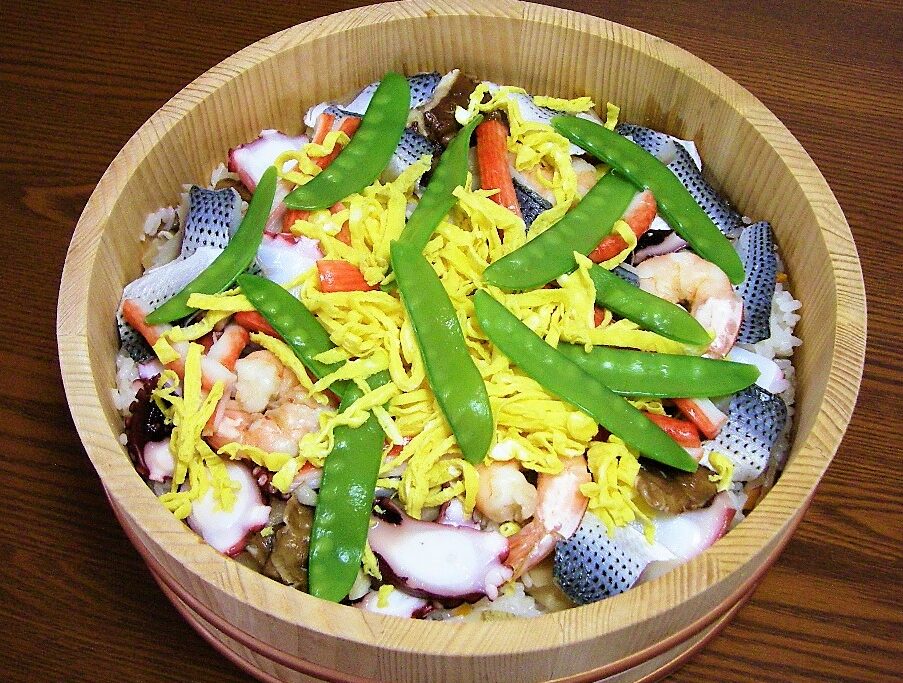
Originating from the hako-zushi born in the 18th century, chirashi sushi also remains throughout Japan in the form of local cuisine.
Chirashi sushi differs in character between the Kanto and Kansai regions.
In Kanto, vinegared rice is placed in a lidded vessel, and the ingredients are arranged neatly on top.
In Kansai, so-called gomoku sushi is often called chirashi sushi, and after mixing the ingredients into the vinegared rice, it is topped with shredded egg crepe (kinshi tamago) and finely cut nori.
In addition to these differences, each region has its own distinctive chirashi sushi as local cuisine.
Let us introduce some well-known chirashi sushi.
Okayama bara sushi (matsuri sushi)
Okayama’s chirashi sushi, which lavishly uses the bounty of the sea and the mountains, is sometimes called “bara sushi” or “matsuri sushi.”
There is a legend that because Ikeda Mitsumasa, the lord of the Okayama domain famous as a wise ruler, issued a frugality ordinance and everyday meals became simple, the chirashi sushi made on occasions such as festivals became lavish in reaction.
Vinegar-marinated Spanish mackerel, shrimp, squid, conger eel, kamaboko, shiitake mushrooms, snow peas, shredded egg crepe, and ginger are the main ingredients of Okayama sushi.There is a custom of eating it on occasions when people gather, such as festivals and Obon.
Bara sushi
Bara sushi, made using mackerel caught in Wakasa Bay, is a local dish of Kyoto.
In order to deliciously eat mackerel, which spoils quickly, Kyoto has a custom of grilling the mackerel, making it into flakes, and eating it on vinegared rice together with red pickled ginger and shredded egg crepe.
It still thrives today as a dish eaten on occasions such as New Year’s and weddings.
Mikan sushi
Ehime Prefecture’s mikan sushi is a chirashi sushi that uses the juice of the local specialty mandarin orange instead of rice vinegar.
A fruity chirashi sushi that uses not only fish, shiitake mushrooms, carrots, and lotus root as ingredients but also mandarin orange peel. Mikan sushi, served at celebratory occasions, sometimes uses citrus fruits such as kabosu depending on the season. It is a chirashi sushi so beloved locally that it even appears in Ehime’s school lunches.
Why do people eat chirashi sushi on Hinamatsuri?
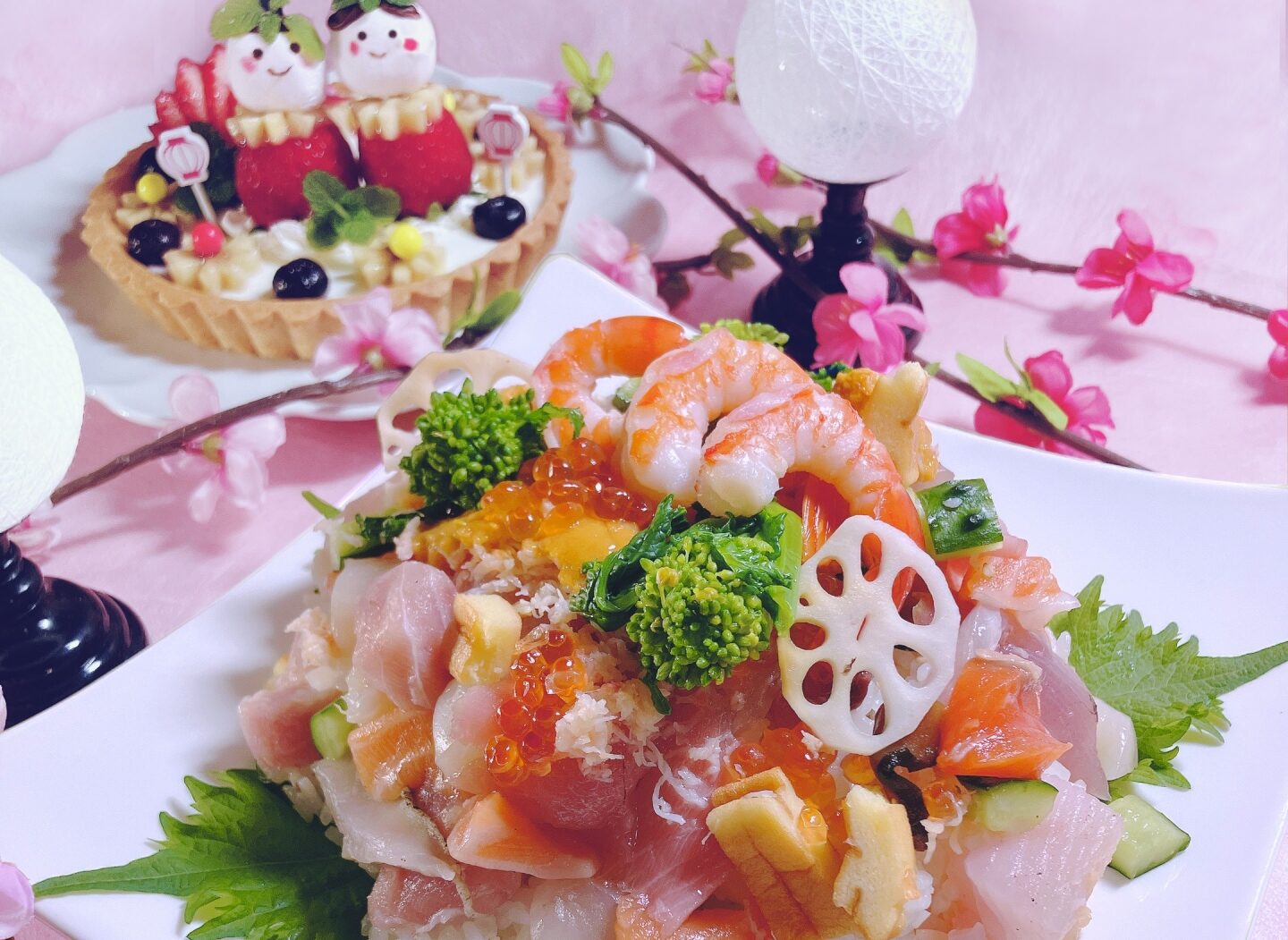
Chirashi sushi is a standard dish for Hinamatsuri (Doll’s Festival).
Why do people eat chirashi sushi on Hinamatsuri?
In fact, the connection between Hinamatsuri and chirashi sushi is said to come from the following reasons.
According to one theory, chirashi sushi, which was originally often eaten at celebratory occasions, was considered suitable for a girls’ festival because of its gorgeous appearance.
There is also a theory that shrimp and lotus root, which are often used as ingredients in chirashi sushi, were auspicious items evoking longevity and the future, which became a factor in it being eaten on Hinamatsuri.
This custom spread nationwide from the Taisho era onward and continues to this day.
5 selected chirashi sushi recipes
Chirashi sushi, whose recipe differs by region and household.
Here, we introduce 5 selected chirashi sushi recipes that can be made deliciously even at home.
[Hinamatsuri dish] Easy and delicious! How to make chirashi sushi!
This clearly introduces how to make chirashi sushi for Hinamatsuri.
Since it can be made with easy steps, it is a great choice even for beginners to try.
The appearance is gorgeous and perfect for the Hinamatsuri atmosphere!
[Hanawa Family Lunch] Easy to make at home! Hearty “gomoku chirashi sushi”
This introduces how to make a hearty gomoku chirashi sushi that can be easily made at home.
The ingredients and steps are explained in detail, making it easy to understand even for those trying it for the first time.
Please give it a try as one of your enjoyable home meals.
[Girls festival] Introducing our family’s Hinamatsuri dishes!
While conveying a homey atmosphere, this showcases Hinamatsuri dishes you can enjoy at home.
Please try delicious chirashi sushi while sharing the Hinamatsuri mood with family and friends.
Bright and gorgeous! A recipe for colorful bara-chirashi sushi
This is how to make bara-chirashi sushi using colorful ingredients.
It is visually vivid and a dish that is fun to look at.
The combination of ingredients and the arrangement enhance its gorgeousness.
For Hinamatsuri! An easy-to-make chirashi sushi cake
This is how to make a chirashi sushi cake perfect for Hinamatsuri.
By finishing ordinary chirashi sushi in a cake style, the appearance becomes even more gorgeous.
The steps are explained clearly and it is easy for beginners to try, so please give it a go.
Available to buy online! Renowned chirashi sushi
Chirashi sushi is a dish more often made at home than eaten out.
Chirashi sushi–related products that let you make it deliciously can be purchased online.
From among them, we introduce some popular products.
Kanazawa Asadaya Gomoku Chirashi Sushi no Moto (mix)
“Asadaya,” a long-established shop in Kanazawa where both the bounty of the sea and the mountains are delicious.
The gomoku chirashi mix sold by Asadaya features mellow-flavored ingredients.
You can enjoy the taste of a top-class restaurant even at home.
[Rakuten Ichiba] [Kanazawa Asadaya] Gomoku Chirashi Sushi no Moto (for 2 go of rice)
Fujimuraya Pure Kyoto-style Chirashi Sushi no Moto (mix)
Founded over 170 years ago in the Gion district of Kyoto, Fujimuraya’s pure Kyoto-style chirashi sushi mix is a product with many repeat customers thanks to its refined Kyoto-style seasoning.
This unusual product, which contains chirimen-jako (dried baby sardines), is by no means cheap, but you can savor a deliciousness that makes it worthwhile.
Pure Kyoto-style Chirashi Sushi no Moto: Kyoto Obanzai, Gion Fujimuraya
Shidashi Yonechou Seafood Chirashi Sushi
At Shidashi Yonechou, popular as a sushi shop you can buy from online, you can purchase seafood sushi fine enough to serve at a celebratory occasion.
It is great that you don’t need to prepare the various kinds of seafood at home. Its luxuriousness is sure to satisfy your fellow diners.
[Seafood Chirashi Sushi] Shidashi Yonechou
Shidashi Yonechou Crab Chirashi Sushi
A gorgeous chirashi sushi that lavishly uses crab—which could be called the king of seafood—is also a popular product of Shidashi Yonechou.
Crab from the Sea of Japan and crab miso are the finest delicacies, fitting for a special day.
Topped with salmon roe and shredded egg crepe, it is the ultimate chirashi sushi, super gorgeous in appearance too.
[Rakuten Ichiba] [Crab Chirashi Sushi] Shidashi Yonechou
Shidashi Yonechou King Salmon Oyako Chirashi Sushi
An oyako (“parent and child”) chirashi sushi that lavishly uses king salmon and salmon roe.
The harmony of the aroma of shiso sprinkled over the rice, the fatty salmon, and the wonderfully textured salmon roe is a gem beloved by people of all ages.
References
·小学館Japan大百科全書「ちらしずし」
·小学館Japanの歳時記「雛祭」
·永瀬牙之輔著『すし通』2016年,土曜社刊
まつりずし/ばらずし Okayama | うちの郷土Cuisine:農林水産省
みかんずし Ehime | うちの郷土Cuisine:農林水産省
ばらずし Kyoto | うちの郷土Cuisine:農林水産省