How to Plate Sushi Beautifully — Basics
The basics of plating that make food look beautiful
Beautiful-looking dishes have things in common. When food is brought to you at a restaurant, have you ever felt, "The plating is lovely"?
The key points for appetizing plating are three: "color," "empty space," and "height."
Let's explain each of these points.
Point 1: Skillfully choose the "color" of the vessel to match the food
The first point is to avoid having the color of the food and the color of the vessel be in the same color family. Using a vessel in a color complementary to the food (the opposite color) makes the vividness of each color emphasize the other, so the food stands out more.
For example, red and green, and yellow and blue-purple, are each in a complementary relationship. In other words, pairing a red tomato with a green vessel, or a yellow rolled omelet with a blue vessel, tends to make them look more appetizing.
Point 2: Plate the food leaving moderate "empty space" in the vessel
The second point is not to pile on too much food relative to the size of the vessel. As a guide, it is said that leaving at least 30 percent of the whole vessel as empty space makes it look beautiful.
With plenty of empty space, the gaze gathers on the food, making it look luxurious and special. If the amount of food you want to plate is fixed, choose a vessel sized to allow for the empty space you want to leave.
Point 3: Add "height" to make the food look three-dimensional
The third point is to add height to the plating. If all the food on the vessel is the same height, the look tends to be flat and plain.
By adding some degree of difference in height, the food looks three-dimensional, and even a simple dish can have a luxurious atmosphere.
Point 4: Use an "accent color"
The fourth point is to use green or blue as an accent color.
Sushi has many toppings with reddish colors, like tuna, salmon, shrimp, and salmon roe, or colorless toppings like white-fleshed fish. So using green or blue, the opposite colors of red, as an accent gives a wider range of hues and makes it look appetizing.
The green shiso and oba leaves added to sashimi can be said to play the role of an accent color that sets off the sashimi. Using a vessel with a green or blue pattern on a white ground is also lovely.
The standard plating styles: "nagashi-mori" and "hosha-mori"
There are various plating techniques in Japanese cuisine, but the standard ones for sushi are "nagashi-mori" (flowing arrangement) and "hosha-mori" (radial arrangement).
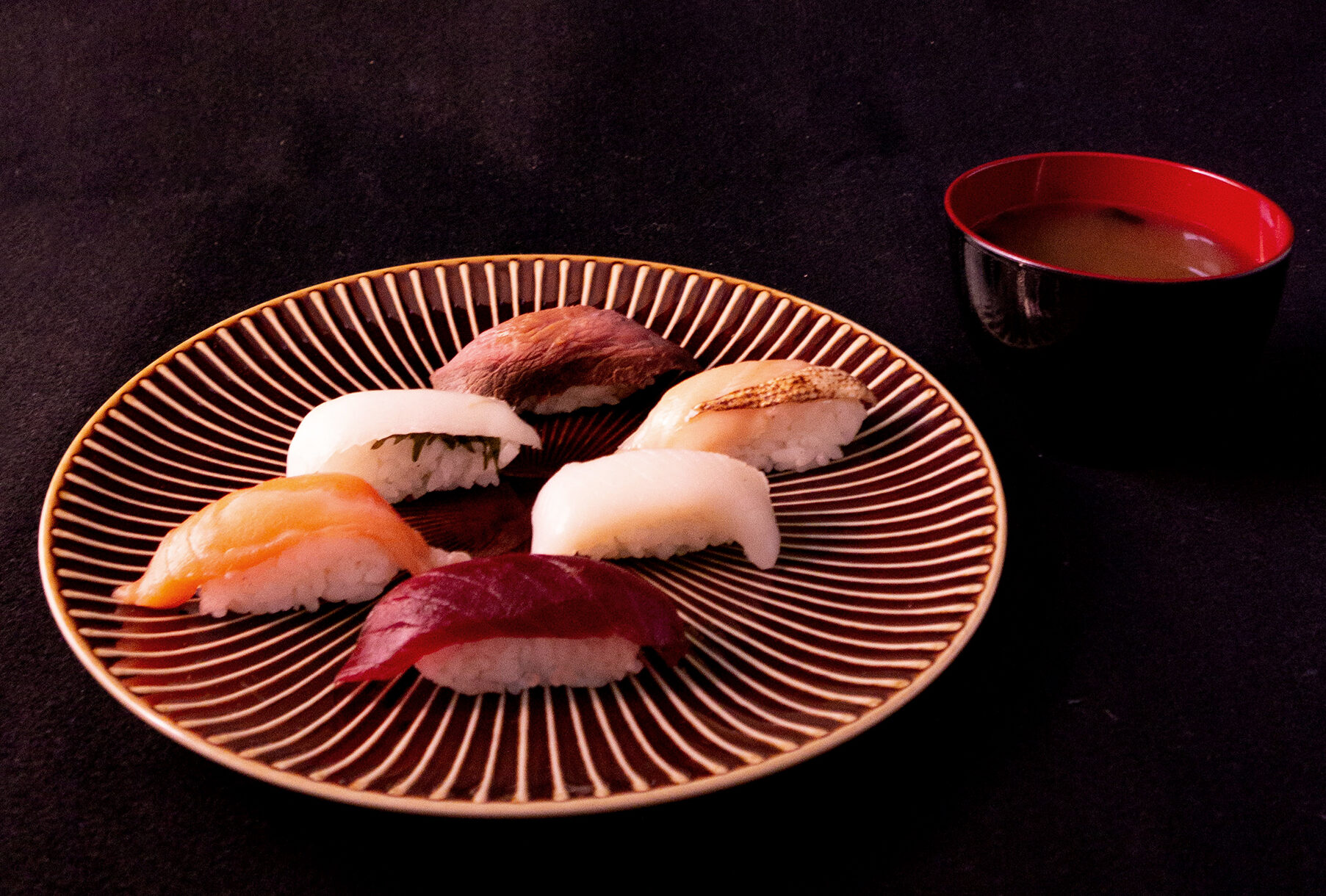
When plating multiple items similar in shape and size, like hand-formed sushi, "nagashi-mori" is the most basic. "Nagashi-mori" is a method of plating the sushi at a slight angle, tilted rather than lined up straight relative to the vessel.
Meanwhile, "hosha-mori" is a plating method in which food is arranged radially from the center of the vessel. It is often used when arranging sushi in a tub.
Nagashi-mori
In nagashi-mori, you plate the food so that it flows from upper left to lower right. The vessel can be square or round, but a square plate comes together in better balance. The basic approach is to tilt the sushi slightly counterclockwise as seen from directly above and place it on the vessel so it points toward the lower right.
Leave space so that adjacent pieces of sushi don't stick tightly together, and line them up all facing the same direction on the vessel. This not only creates a pleasant amount of empty space but also makes it easier for right-handed people to lift the sushi with chopsticks.
Also, you may arrange the toppings in any order you like, but we recommend not letting similarly colored toppings line up next to each other. Alternating, such as white-fleshed fish after red-fleshed fish, with yellowish sea urchin or rolled omelet here and there, gives a colorful finished look.
Incidentally, for sushi served on a sushi geta (wooden stand), as at a sushi shop, it is said to be good to eat your way from upper left to upper right, then lower left to lower right.
That is because the chef arranges the sushi in the order that lets you taste each topping at its most delicious, from light to rich in flavor. It would be good to arrange your sushi with such points in mind as well.
Hosha-mori
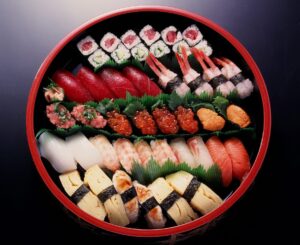
Hosha-mori is suited to using a round vessel. Since it has no front and is symmetrical top-bottom and left-right, the feature is that it looks gorgeous from any angle.
First, place sushi at the center of the vessel. Arranging several rolls, such as kappa-maki or kanpyo-maki, or gunkan-maki such as sea urchin or salmon roe, into a petal-like shape makes it gorgeous.
Next, draw a mental crosshair from directly above the vessel and place sushi at the four points where it meets the edge of the vessel. Then, from the center toward the outside, arrange the sushi radially so as to fill the empty space of the vessel.
In hosha-mori, the gaps between the pieces of sushi become narrower than in nagashi-mori. However, packing the sushi in too tightly makes it hard to insert chopsticks, so it is good to leave just a little gap.
Using baran (green plastic decorations modeled on leaves) to partition the pieces is also an option. It prevents the sushi from sticking together and adds color.
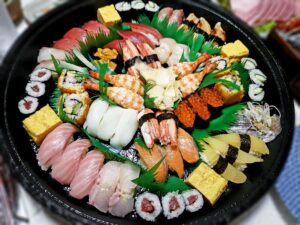
An advanced plating style: "chirashi-mori"
One advanced plating method is "chirashi-mori" (scattered arrangement). It is a method of thinking of the vessel as a canvas, leaving empty space between each piece of sushi, and plating them so they are scattered across the vessel.
For sushi, arrange the pieces with the image of taking even wider empty space than in nagashi-mori. Each piece of sushi stands out, so the sense of specialness increases.
It is good to do it with the feeling of painting a picture.
One tip: add three-dimensionality with garnishes
Because sushi pieces are similar in size and shape, it may be hard to create height differences in the plating. In such cases, try adding garnishes to the sushi toppings to give a sense of dimension.
For example, just scattering chopped scallions on top of the sushi makes it much more stylish. Pairing thinly sliced sudachi with white-fleshed toppings not only gives a refined look but also makes it taste refreshing, so we recommend it.
Let's savor sushi even more deliciously with creative plating
Sushi is a dish that often appears as a feast for special days. Besides the methods introduced here, there are various other plating styles.
Rather than just arranging things on the vessel somehow, by placing them in good balance while thinking about appearance, the luxuriousness increases and you can savor it more and more deliciously.
Enjoy your dining time together with sushi plated beautifully and with good taste.