Sushi Basics Part 3 — Hikarimono (Silver-Skinned Fish)
What is Hikarimono?
Hikarimono is a term unique to the sushi industry, and as the name suggests ("shiny things"), it refers to fish whose surface skin gleams.
Hikarimono is characterized by the fact that the flesh is cured with vinegar or salt before being formed into sushi, allowing you to enjoy a texture, aroma, and flavor different from raw fish. Adding refinement to the flavor by curing with vinegar or salt is a hallmark of Edomae sushi that has continued since the Edo period.
So, why does the skin of hikarimono fish shine?
The skin of hikarimono fish shines because of a component called guanine, which exists in the form of small crystal plates within the pigment cells attached to the scales. Although it is not a pigment, the guanine crystal plates reflect light, which is why hikarimono appears to shine.
The name hikarimono, derived from the way the sushi topping shines, is a stylish expression typical of Edomae sushi.
Incidentally, hikarimono and aozakana (blue-backed fish) are often confused, but aozakana refers to glossy, bluish fish, a term used in the angling industry and at markets. Aozakana is merely a practical classification based on appearance, and differs from scientific fishery definitions such as red-fleshed fish or white-fleshed fish. Even though both terms refer to glossy fish, it is a different name from hikarimono, which is unique to the sushi industry.
How to Enjoy Hikarimono
Hikarimono fish spoil quickly (their freshness deteriorates easily), so in the Edo period, instead of placing the sushi topping on raw, an extra step was added before forming the sushi. As is the case today, hikarimono such as kohada were often vinegar-cured back then, while toppings such as kisu (sillago) and sayori (halfbeak) were sometimes kombu-cured.
Vinegar-curing is a cooking method in which the fish, having had its organs removed and been butterflied open, is sprinkled with salt, left for a while, and then marinated in vinegar. If marinated in vinegar for too long, the flesh may fall apart, the color and the luster of the skin may be lost, or the flesh may become dry if too much moisture is removed, so delicate skill is required. Because the subtle balance of vinegar and salt requires a discerning eye and technique, it is even said that you can judge a craftsman's skill by their hikarimono sushi.
Kombu-curing involves sprinkling salt on the butterflied fish after processing the organs, leaving it for several dozen minutes, and then sandwiching it between two sheets of kombu (kelp). By wrapping the fish flesh in kombu, excess moisture is absorbed, helping it keep longer.
Vinegar-curing and kombu-curing are done not only to maintain freshness and bring out the flavor of the topping, but also have a cultural aspect of passing down the techniques of Edomae sushi.
Popular Hikarimono Sushi Toppings
There are many types of hikarimono fish, with representative examples including kohada (gizzard shad), saba (mackerel), aji (horse mackerel), sanma (Pacific saury), iwashi (sardine), kisu (sillago), and sayori (halfbeak).
Among these, we will introduce the popular sushi toppings. Keep the characteristics of hikarimono in mind and use this as a reference when ordering at a sushi restaurant.
Saba (Mackerel)
The representative hikarimono fish is saba, which has long been enjoyed as a popular common fish. Although it varies by species, the season is November to February and June to September.
Since saba loses freshness easily, it is basically often vinegar-cured as a sushi topping, but in some regions such as Kyushu, it is sometimes eaten raw without curing.
Vinegar-cured saba pairs perfectly with the rice. It can be said to be a representative example of Edomae sushi. Its deep flavor, where concentrated umami, slightly sweet fat, and the refreshing acidity of vinegar intertwine, is popular among a wide range of diners.
Kohada (Gizzard Shad)
Kohada is known as the iconic hikarimono of Edomae sushi. It is a shusse-uo (fish that changes name as it grows), and its juvenile form, shinko, is famous as a top-grade sushi topping that can be called a seasonal symbol of summer. Shinko's season is short, from June to August, while kohada is from autumn to winter, September to December.
Shinko, with its soft flesh, develops a delicate aroma through vinegar-curing, resulting in an exceptional flavor.
Kohada, rich in fat, has its distinctive deliciousness and flavor brought out by curing with vinegar and salt. In addition to simply forming it into sushi, decorative knife cuts may be added to enjoy an elegant appearance and a different texture. In the Kansai region, it is marinated in sweet vinegar before being formed into sushi, allowing you to taste a flavor different from the Kanto region.
Aji (Horse Mackerel)
Aji is a popular hikarimono that has long been enjoyed. Although it varies somewhat depending on the region and species caught, it is said to come into season from April to August.
Wild aji has a refreshing flavor yet a moderate amount of fat. It is also characterized by its firm, springy bite and aroma. Farmed aji has strong umami and sweetness, is well-fatted, and rich.
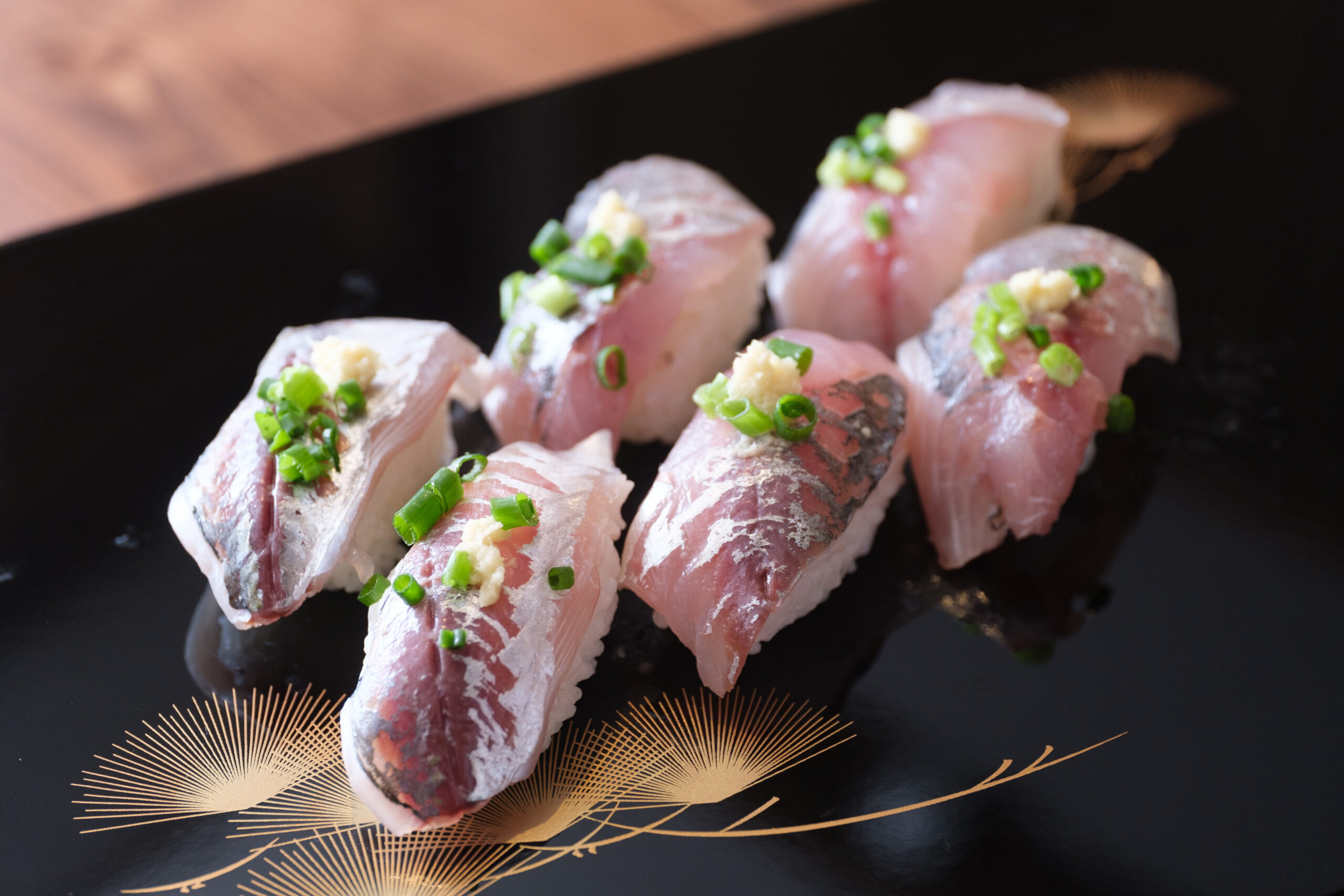
It is sometimes lightly seared before eating, but in either case, when made into nigiri sushi it is formed raw, and condiments such as ginger or chopped scallions are often placed on top, or it is dipped in ginger soy sauce when eaten. This eliminates the characteristic odor of aji, making it even more delicious. Eating it raw is a modern practice; in the old days, it was generally eaten vinegar-cured.
Kisu (Sillago)
Kisu is at its fattiest and most delicious during its spawning period from June to September. It is characterized by a subtle sweetness and an elegant aroma.
It contains plenty of umami components such as glutamic acid and lysine, making it very delicious, and its delicate flavor makes it an all-rounder that goes well with any dish. Since the moisture content of its flesh is high at about 80%, eating it raw can feel watery, so it is kombu-cured or lightly salted to remove moisture before being used as a sushi topping.
It is often eaten refreshingly with a squeeze of sudachi just before eating, or with salt to further bring out its sweetness.
Sayori (Halfbeak)
Sayori is considered one of the high-grade fish among hikarimono.
Its season is wide-ranging: from March to May during spawning, and from November to March when it becomes fatty. Its unique texture and elegant flavor make it popular.
As a sushi topping, it used to be vinegar-cured like saba and kohada. In modern times, it is often eaten raw without processing, with grated ginger and chopped scallion condiments placed on top, or with shiso (perilla) sandwiched between the rice and the sayori.
Also, decorative cuts may be made to showcase its beautiful translucent flesh, making it a sushi topping that can be enjoyed not only for its flavor but also for its appearance.
Summary
This time, we introduced the characteristics of hikarimono, its difference from aozakana, and popular sushi toppings.
Since hikarimono fish spoil quickly, various techniques have been devised since the Edo period to prevent loss of freshness.
Hikarimono is often vinegar-cured, and vinegar-curing is truly a craftsman's art that demands delicate technique. Vinegar-curing, which carries on the tradition of Edomae sushi, is a technique that reveals a craftsman's skill, and hikarimono can be said to be an important sushi topping that, among many sushi toppings, tests the level of the restaurant.
When eating sushi at a restaurant, focusing on hikarimono as you savor it, or comparing it across different restaurants, may allow you to enjoy sushi from a perspective different from usual.