

Akami — Red Meat (Lean Tuna)
【Reading】あかみ
【English Name】Akami (Lean Tuna / Red-fleshed Fish)
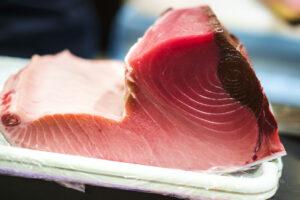
At a sushi restaurant, akami (red meat) refers mainly to the lean, low-fat portion of the back of the tuna (maguro). In a broad sense it means fish flesh in general that is rich in pigment proteins such as myoglobin and hemoglobin, and fish containing 10 mg or more of pigment protein per 100 g of ordinary flesh are said to be classified as red-fleshed fish (akami-zakana).Representative red-fleshed fish include migratory fish such as tuna, bonito (katsuo), and mackerel (saba). These fish, which swim long distances continuously, have well-developed slow-twitch muscle (chiai-kin) rich in myoglobin to store oxygen, and this is the source of the red color of the flesh. Note that although salmon (sake) flesh looks red, the true cause of the color is astaxanthin derived from its food, and taxonomically it falls under white-fleshed fish.
As a sushi topping it is contrasted with toro (chutoro and otoro); being lower in fat, it has a firm bite and lets one enjoy the inherent umami of tuna and a faint tartness derived from iron. Nutritionally it is high in protein and low in fat, and contains heme iron, DHA, and EPA. It is said to have originated when, during the Tenpo era of the Edo period when tuna was abundantly caught, it was incorporated into sushi as zuke, marinated in soy sauce. This was also a preservation device in an age without refrigeration, and because fatty toro was shunned as nekomatagi (something even a cat would step over), only akami was used.
Related Features: Akami
-
Sushiの基礎知識①Akami
今回はSushiの基礎知識として、Sushi Toppingsの「Akami」について見ていきましょう。 Akamiと聞くとTunaを思い浮かべる人が多いと思いますが、AkamiのSushi ToppingsはTunaだけではあ
Load More
Close