Sushi Basics Part 1 — Akami (Red Fish)
What is akami as a sushi topping?
In sushi, fish are classified by appearance into akami (red-fleshed), shiromi (white-fleshed), and hikarimono (shiny fish).
"Akami" and "shiromi" are distinguished by the color of the fish's flesh, while "hikarimono" refers to fish with a blue back and a lustrous belly. Akami, as the name suggests, means fish with red flesh, but in the world of sushi, even fish whose flesh is red are treated as hikarimono if their backs are blue and their bellies shine white.
Why does the flesh turn red?
Akami and shiromi are distinguished by the color of the flesh, but why does the difference in color arise?
The difference in the color of a fish's flesh arises from the type of muscle and the proteins in the blood. The muscle fibers that make up a fish's muscle come in two types, slow-twitch and fast-twitch, with slow-twitch called "red muscle" and fast-twitch called "white muscle."
Red muscle is muscle with endurance that can move actively for long periods, and migratory fish such as tuna and bonito that swim around the wide ocean have red muscle. Like humans, fish need oxygen to exercise. Red muscle contains large amounts of the pigment protein "hemoglobin," which efficiently supplies oxygen in the blood, and "myoglobin," which stores oxygen, and because the pigments of hemoglobin and myoglobin are red, the fish's flesh is also red.
On the other hand, fish with white muscle are not constantly swimming around like migratory fish; they usually lurk on the seafloor and move quickly only when capturing prey. This muscle with explosive power is white muscle, and because it doesn't use much oxygen to move the muscle as migratory fish do, it has little myoglobin and, inevitably, almost no pigment protein, resulting in whitish flesh.
Classification of akami and shiromi
As mentioned earlier, the color of a fish's flesh changes according to the pigment proteins in the muscle that transport and store oxygen, but in fisheries science, "red-fleshed fish" and "white-fleshed fish" are classified by the content of pigment proteins.
Fish containing 10 mg or more of the pigment proteins hemoglobin and myoglobin per 100g are "red-fleshed fish." Those with less than 10 mg are classified as "white-fleshed fish."
By the definition in fisheries science, the Pacific saury (sanma) is red-fleshed. Because its flesh is whitish, sanma tends to be thought of as a white-fleshed fish, but it is a migratory fish with slow-twitch muscle and is a red-fleshed fish. What's a bit complicated is that, although sanma is a red-fleshed fish, because its back shines, it is treated as a "hikarimono" in the world of sushi.
Another fish often mistaken for white-fleshed is the yellowtail (buri). Although buri has whitish flesh, in terms of the amount of pigment protein it is a red-fleshed fish.Conversely, the one most easily mistaken as red-fleshed despite being a white-fleshed fish is salmon. The reason salmon's flesh is red lies in thecrustaceans (small shrimp, crabs, and plankton) it feeds on. Crustaceans feed mainly on Haematococcus algae, and because these algae contain the pigment astaxanthin, salmon's flesh turns red.
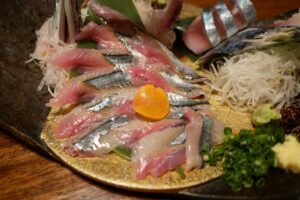
In fisheries science, sanma is red-fleshed
Characteristics of akami
Akami, from migratory fish with abundant pigment proteins, is rich in iron from its myoglobin and hemoglobin, making it effective for preventing anemia. It also contains plenty of DHA and EPA, which suppress cholesterol levels in the blood and activate the brain, and is considered effective for anti-aging as well.
Another characteristic of akami is the abundance of "chiai" (dark meat). Chiai is the part where the red-colored muscle fibers between the back and belly of the fish are concentrated. Both akami and shiromi have chiai, but akami has more, at 15% or higher, while shiromi has less, at under 10%.
Chiai is useful for judging freshness. When freshness is good it is a vivid, dark-red color, but as freshness declines it becomes blackish. Whether the chiai is a vivid dark red or a darkened color can be used as one criterion for judging freshness.
Dark-red chiai may at first glance seem unhealthy. In reality, however, it contains plenty of nutrients. It is rich in iron, anserine, vitamin A, vitamin D, and so on, and is useful for replenishing iron and vitamins. Since chiai is a little fishy when raw, simmering or grilling it makes it easier to eat.
Red-fleshed fish handled as sushi toppings
Next, let's introduce the "akami" (red-fleshed) fish handled as sushi toppings.
Representative akami sushi toppings include tuna, bonito, yellowtail, sardine, Pacific saury, and mackerel. As mentioned earlier, fish such as sardine, sanma, and mackerel—which have blue backs and whitish, shiny bellies—are red-fleshed in fisheries science but are regarded as hikarimono in the world of sushi, so be careful not to confuse them.
Tuna
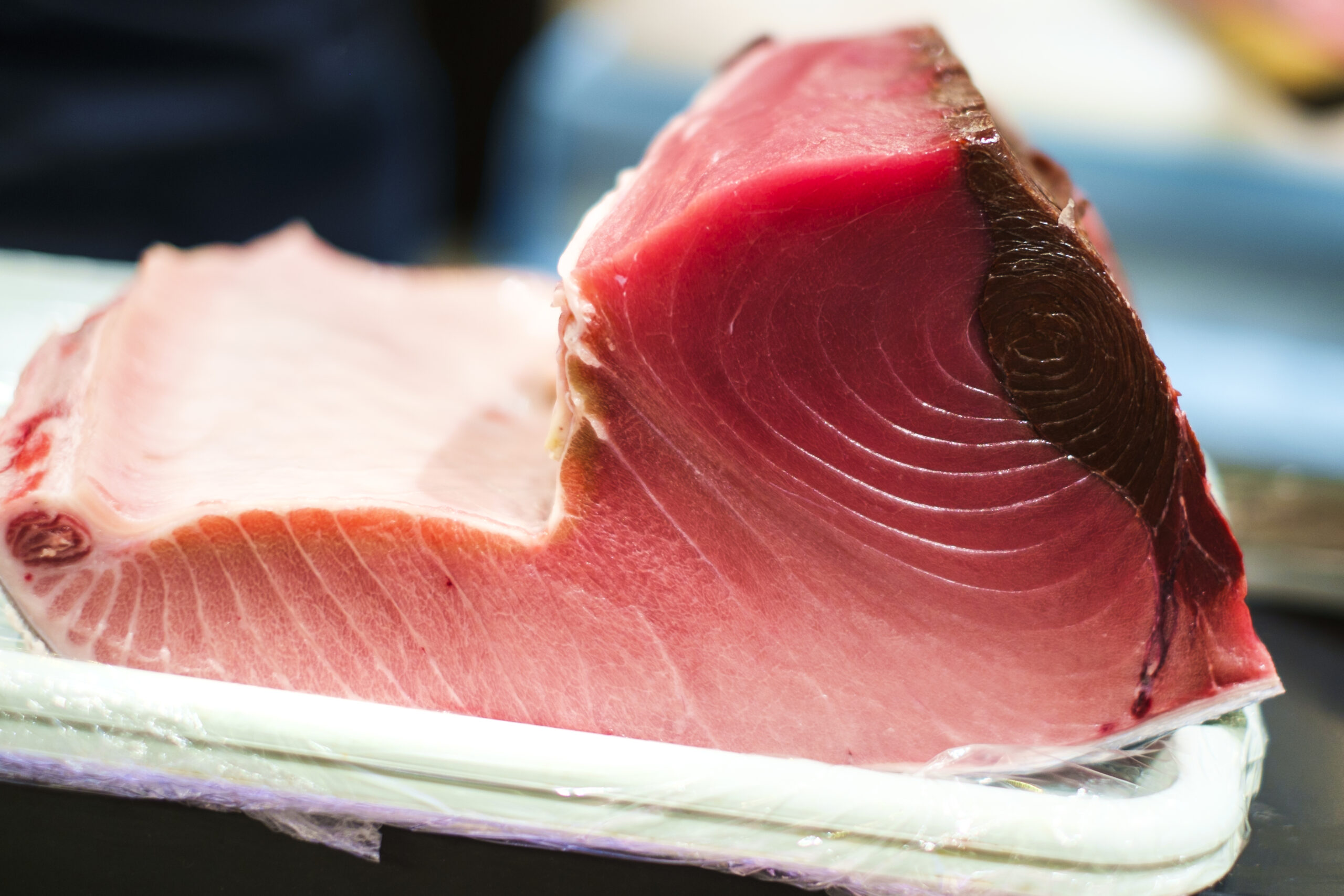
The most representative fish among the "akami" is, without a doubt, tuna.
Tuna is a migratory fish that constantly swims around the sea—a large, carnivorous fish.
It is enjoyed as an important food fish not only in Japan but in various places around the world, including Asia, Europe, and the Americas.
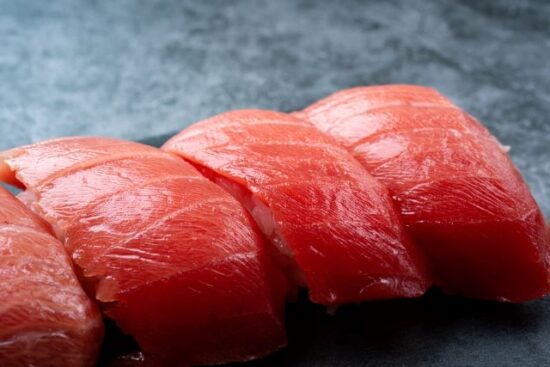
The treatment of tuna as a sushi topping varies by cut: the belly part near the head is "otoro," the muscular part on the back side with little fat is "akami," and the "chutoro" lies between the muscular yet supple akami and the fatty otoro. In Edomae sushi, it is such an important akami topping that the "rank" of a restaurant is said to be revealed by the quality of the tuna it handles.
Bonito
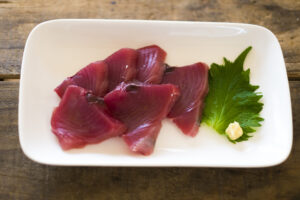
Bonito (katsuo), in season in spring and summer, is also one of the red-fleshed fish handled as a sushi topping.
Bonito was a very popular fish since the Edo period, but because it loses freshness easily, at the time it was mainly eaten as sashimi. It came to be eaten as sushi only from the Showa era. With its subtle sweetness, refined tartness, and refreshing aroma, it is popular with many people. There is hatsugatsuo (first bonito) that swims north up the Pacific from spring to summer, and modorigatsuo (returning bonito) that swims south in autumn; modorigatsuo is fatty and has a rich flavor.
Yellowtail
Yellowtail (buri), with its whitish flesh, is easily mistaken for a white-fleshed fish, but it is actually a red-fleshed fish. Buri is a shusse-uo (fish whose name changes as it grows); in the Kanto region, its name changes by size in the order "wakashi (20cm) → inada (40cm) → warasa (60cm) → buri (80cm or larger)." What's confusing is that in Kansai, inada and warasa were apparently called "hamachi."
And nowadays, even in Kanto, small farmed buri have come to be called hamachi. Both hamachi and buri are rich in vitamin D among red-fleshed fish. It is effective for forming the skeleton, making it an especially recommended sushi topping for children. Buri loaded with fat is so rich it rivals otoro, characterized by a melt-in-your-mouth flavor.
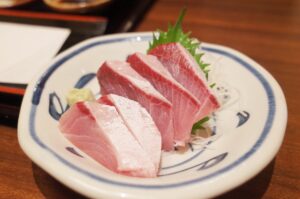
Sardine, sanma, and mackerel—red-fleshed but considered "hikarimono"
Sardine, Pacific saury (sanma), and mackerel are red-fleshed, but in the sushi industry they are treated as hikarimono. Hikarimono are often cured with vinegar to eliminate fishiness, and vinegar-curing takes effort and is a place to show off one's skill—so much so that it is said you can tell a restaurant's level by eating its hikarimono.
Incidentally, the often-heard terms "aozakana" and "aomono" are general terms for shiny, bluish fish, and are separate from the fisheries-science classification and from hikarimono in the world of sushi; they are merely practical names used for convenience.
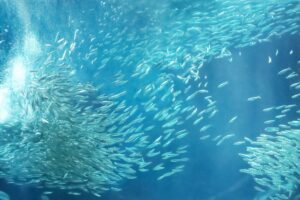
A migrating school of sardines
Summary
What did you think? This time we introduced "akami," the royal road of sushi toppings.
The reason the flesh of red-fleshed migratory fish turns red was the pigment proteins contained in the red muscle (slow-twitch muscle) that transport and store oxygen. The distinction between akami and shiromi is determined by the content of pigment proteins; there was buri, which is red-fleshed even though it looks white-fleshed, and conversely salmon, a white-fleshed fish often thought to be red-fleshed. The pigment proteins myoglobin and hemoglobin are rich in iron and effective for preventing anemia. Akami also contains plenty of DHA and EPA, which suppress cholesterol levels, as well as vitamins, making it a sushi topping that's very good for the body.
There were also sushi toppings that, although red-fleshed by classification, are considered hikarimono in the world of sushi, like sardine, sanma, and mackerel. By correctly recognizing akami, shiromi, and hikarimono, you can deepen your knowledge of the world of sushi and enjoy sushi all the more. Each has its own distinct deliciousness, but savoring them while comparing their respective charms might let you enjoy a side of the sushi world different from usual, and that could be interesting.