Best Prefectures for Sushi — Toyama Prefecture Special Feature
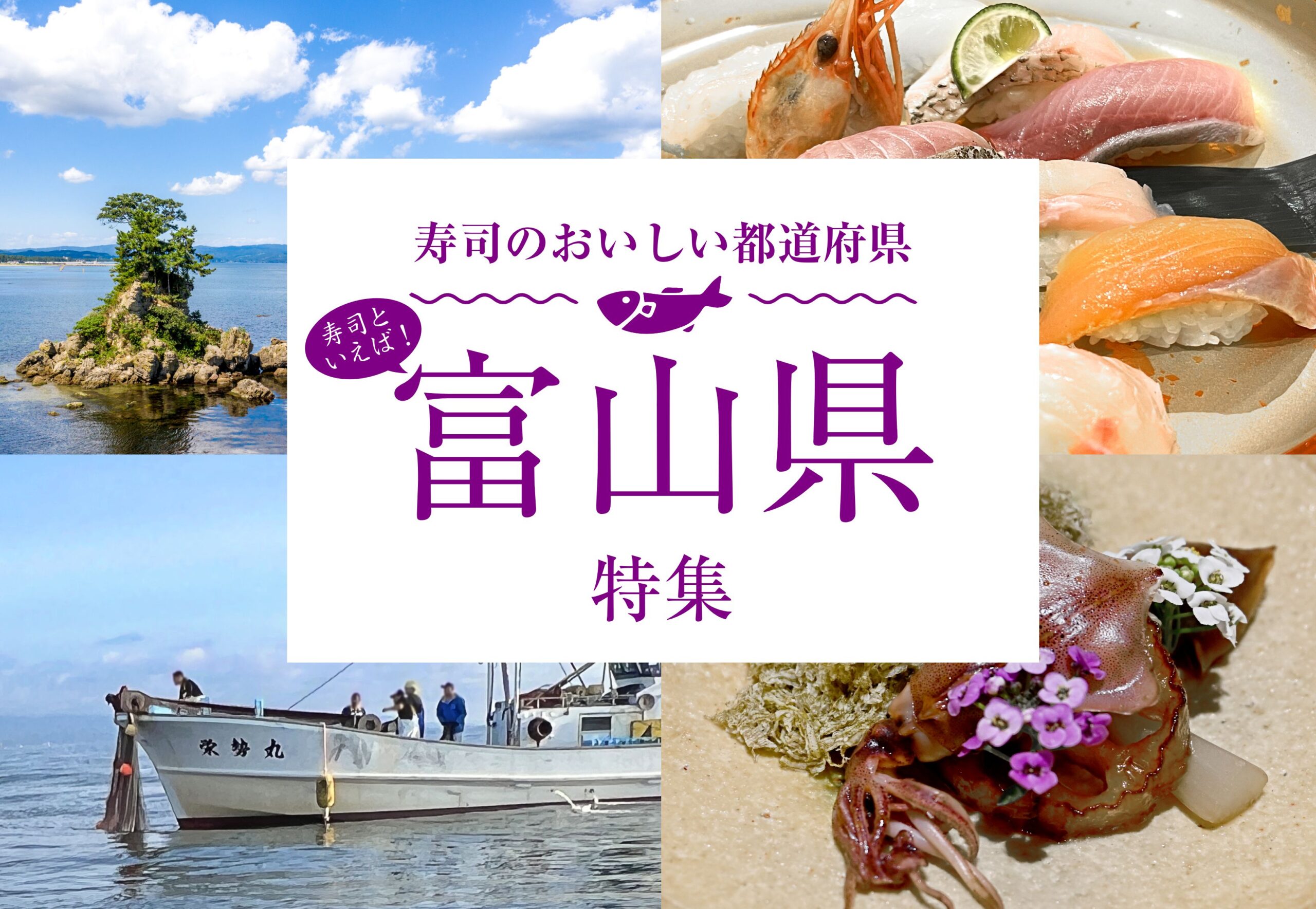
It's no exaggeration to say that “when it comes to sushi, think Toyama.” Toyama Prefecture is famous for its abundant, delicious seafood. It is home to Toyama Bay—one of Japan's three great deep bays and known as a “natural fish tank”—and the wide variety of seafood caught there earns high praise even from gourmets.
Among Toyama Prefecture's specialty products, the nationally renowned “Himi Buri” (Himi yellowtail), the shiro-ebi (white shrimp) known as the “Jewel of Toyama Bay,” and hotaru-ika (firefly squid)—whose “firefly squid swarming waters” are even designated a Special Natural Monument—are famous, but many other kinds of seafood are caught here too: of the roughly 3,400 species of fish in Japanese coastal waters, about 500 species are found here. It would be no overstatement to call this abundance a “treasure trove of seafood” representing all of Japan.
This time, along with the appeal of Toyama's sushi, we delve into the secret of why Toyama's seafood is so abundant and delicious. So, sushi lovers, let's set out together on a journey to Toyama—Japan's proud treasure trove of sushi and seafood!
Why Toyama's seafood is so abundant and delicious
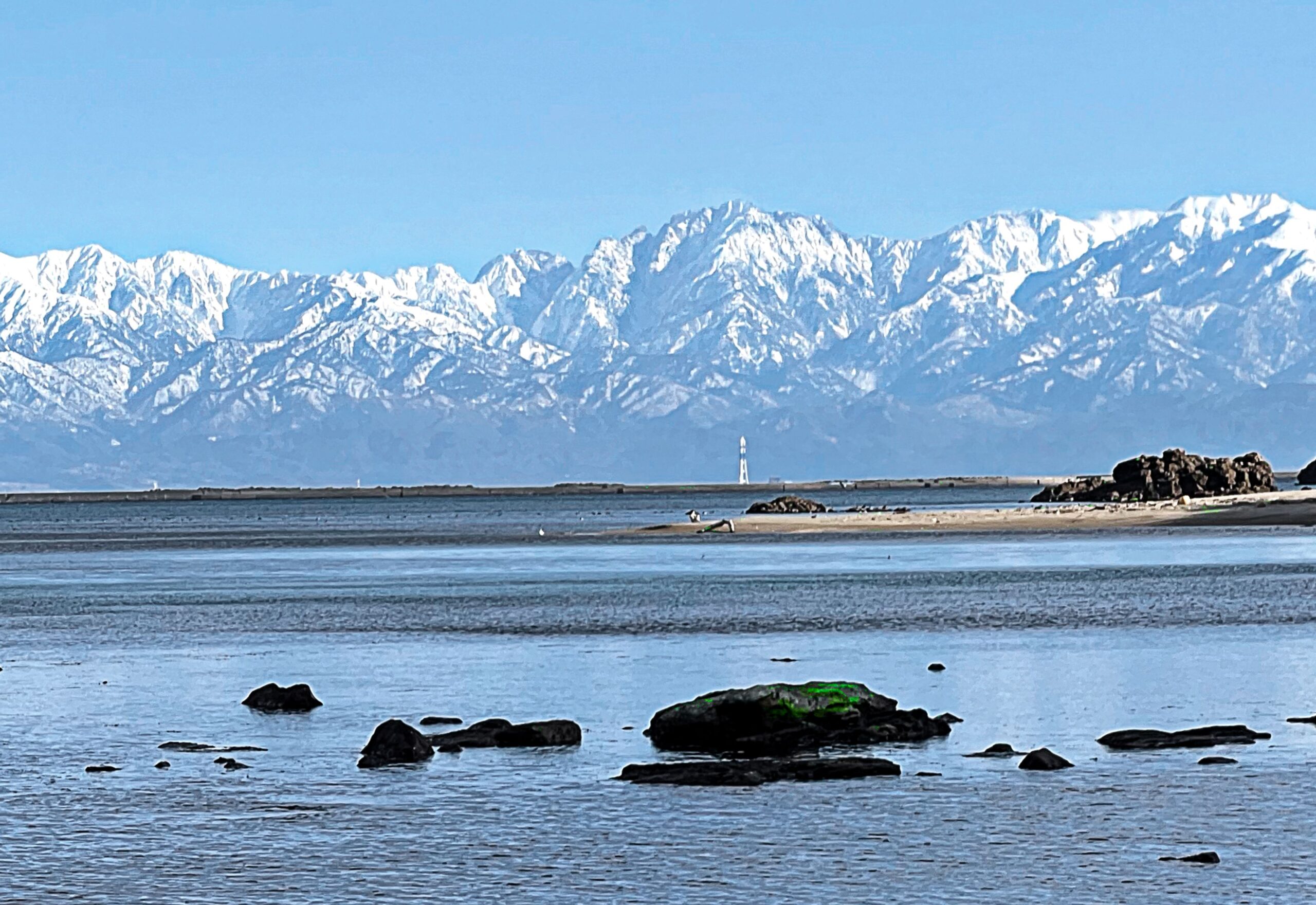
Toyama Prefecture is known as a place so famous for delicious sushi and seafood that people say “when it comes to sushi, think Toyama.” There are solid reasons why Toyama's seafood is so abundant and delicious.
A 4,000-meter elevation difference nurtures top-quality fish
Toyama Prefecture is home to Toyama Bay, one of Japan's three deep bays, cradled as if embraced by the Noto Peninsula.
Famous as one of Japan's foremost deep bays, Toyama Bay is more than just deep.
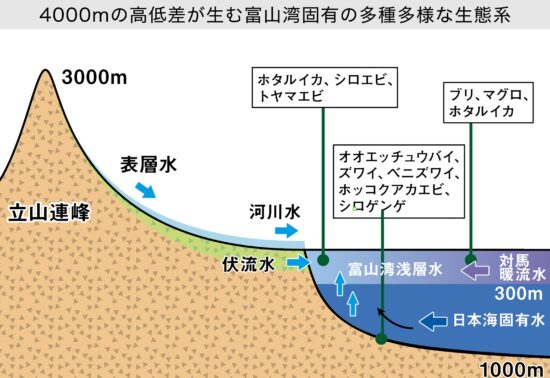
Toyama Bay is about 1,000 m deep, and the Tateyama Mountain Range rises to about 3,000 m—this 4,000-meter elevation difference is one of the major reasons Toyama Bay's seafood is so abundant and delicious.
Rainwater and snowmelt that fall on the Tateyama Mountain Range and the Hida Highlands flow into Toyama Bay as subterranean water, supplying forest nutrients and oxygen year-round, making Toyama Bay an extremely comfortable environment for fish.
A bountiful fishing ground brought by currents and topography
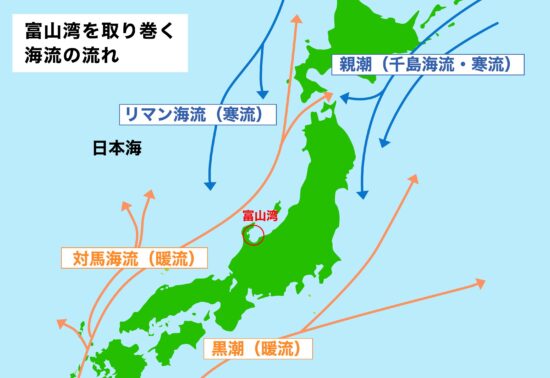
The Tsushima Current (warm) and the Liman Current (cold) flow around Toyama Prefecture; the surface water of Toyama Bay is Tsushima warm-current water, while the deep water is Japan Sea Proper Water. As a result, Toyama Bay yields both warm-current seafood and deep-sea-dwelling seafood, which is why such a wide variety is caught here. The fact that migratory fish like buri (yellowtail) and hotaru-ika (firefly squid) are caught alongside cold-water creatures such as noro-genge (snailfish) near the shore is also unique to Toyama.
Moreover, since photosynthesis does not occur and nutrient salts are not consumed in the deep sea, deep water is richer in nutrient salts than surface water. Owing to Toyama Bay's steep topography, this deep ocean water wells up from the seabed to the surface (a phenomenon called upwelling). At such times, abundant nutrient salts are carried to the surface, triggering a massive bloom of plankton that fish feed on, forming an excellent fishing ground.
This upwelling is also a major factor in the large catches of hotaru-ika (firefly squid) and shiro-ebi (white shrimp) in Toyama Bay, having a great influence on the formation of Toyama Prefecture's distinctive ecosystem.
A giant set-net created by nature
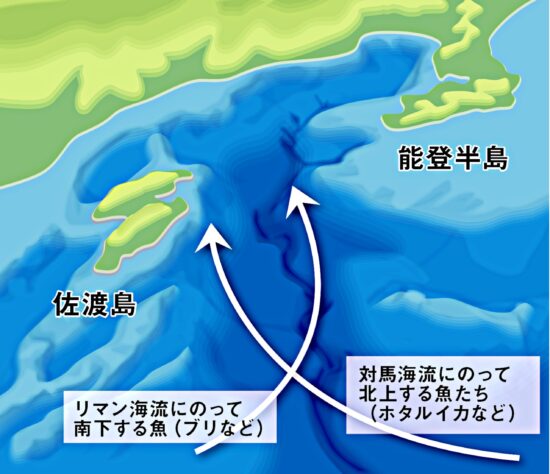
The Tsushima Current (warm) flows northward and the Liman Current (cold) flows southward; warm-current fish such as bluefin tuna, buri (yellowtail), horse mackerel, and Japanese flying squid head north along the Tsushima warm current and then migrate back south from autumn onward.
As shown in the figure below, because Toyama Bay is surrounded by the Noto Peninsula and Sado Island, fish heading north or south are drawn into Toyama Bay as if lured in, making Toyama Bay like a giant set-net created by nature. The seafood of Toyama Bay, having braved the many waves of the Sea of Japan, is firm-fleshed and characteristically just the right amount of fat.
Furthermore, Toyama Bay has a narrow continental shelf with many submarine canyons nearby, making it an extremely hospitable place for seafood—an important point deeply influenced by the formation process of the Japanese archipelago and Toyama Bay described later.
How Toyama's distinctive topography came to be
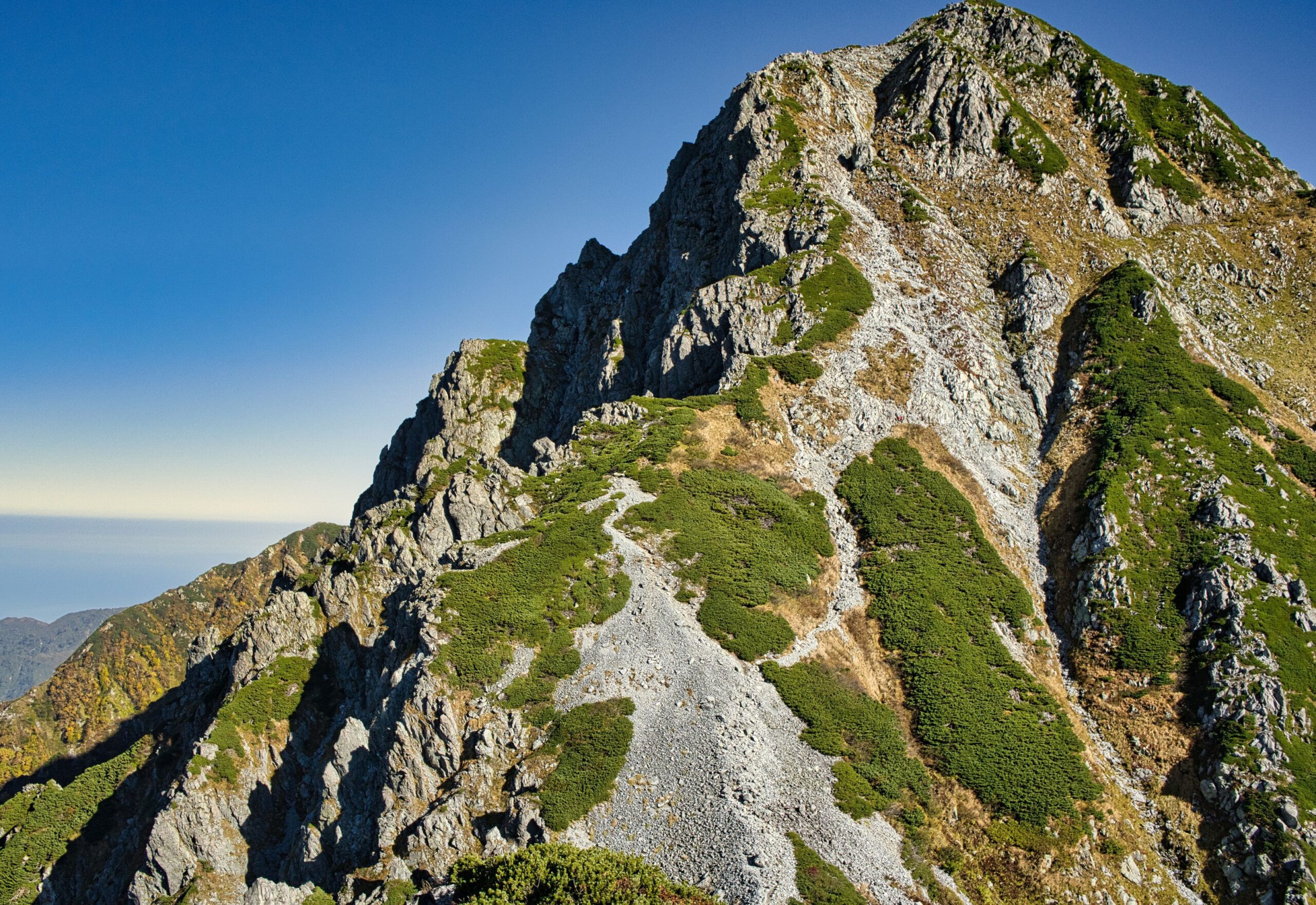
So far we've looked at the reasons Toyama's seafood is so abundant and delicious, and we've seen that the major factors lie in the elevation difference between the Tateyama Mountain Range and Toyama Bay, and in Toyama Bay's distinctive structure. So why did such topography come to be?
The discussion gets a bit technical, but here we'll look at the background behind how the Tateyama Mountain Range and Toyama Bay were formed.
The Tateyama Mountain Range, born of magma activity in one of the world's foremost volcanic zones
The 4,000-meter elevation difference spanning just 50 km from Toyama Bay to the Tateyama Mountain Range makes Toyama Bay a “natural fish tank,” and the uplift of that Tateyama Mountain Range is the result of vigorous magma activity.
The Northern Alps, including the Tateyama Mountain Range, lie in one of the world's foremost volcanic zones, dotted with young granite formed when underground magma surged upward. Because this granite has not fully cooled and is hotter and lighter than the surrounding rock bodies, the ground is uplifting over a (geologically speaking) short period thanks to buoyancy and the like.
The Tateyama Mountain Range was uplifted through a combination of such geological processes, born under highly unusual conditions.
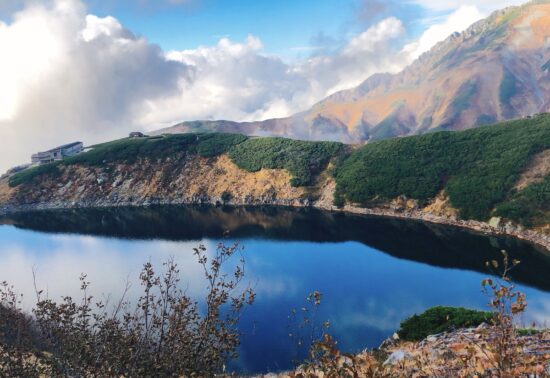
Mikurigaike Pond, a crater lake of the Tateyama volcano
The formation of the Japanese archipelago and the birth of Toyama Bay
About 25 million years ago, the Japanese archipelago formed as it split off from the Asian continent, and as the rift between the continent and the archipelago widened and the Sea of Japan expanded, Toyama Bay was born as well.
Then, about 3 million years ago, a major geological event occurred: a dramatic change in the direction of the Philippine Sea Plate. From 25 million to 15 million years ago, the Sea of Japan had been subsiding as it expanded, but this directional shift subjected the Sea of Japan to strong compression from the opposite direction, and that compression caused various uplifts.
Fish traveling on the currents are lured into Toyama Bay by the surrounding Noto Peninsula and Sado Island, creating a rich fishing ground—and the Noto Peninsula and Sado Island are themselves topographic highs formed when fragments of the continent were uplifted during the formation of the Sea of Japan.
In this way, complex geological factors combined to make Toyama Bay an exceptional fishing ground—a “natural fish tank.” The richness and deliciousness of Toyama's seafood is the result of the grand history of the great migration of the Japanese archipelago.
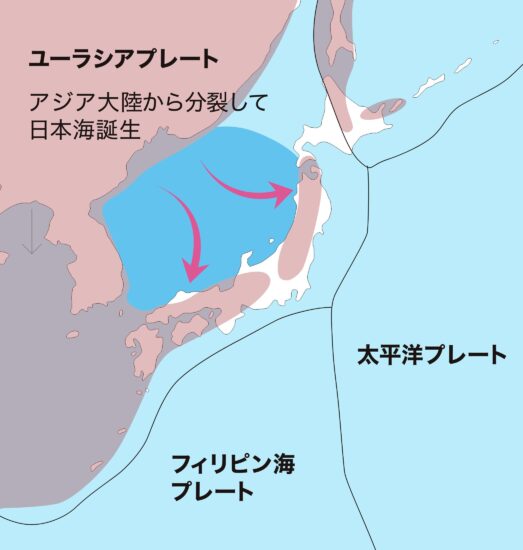
The Japanese archipelago born by splitting off from the continent
The appeal of Toyama's bountiful sushi
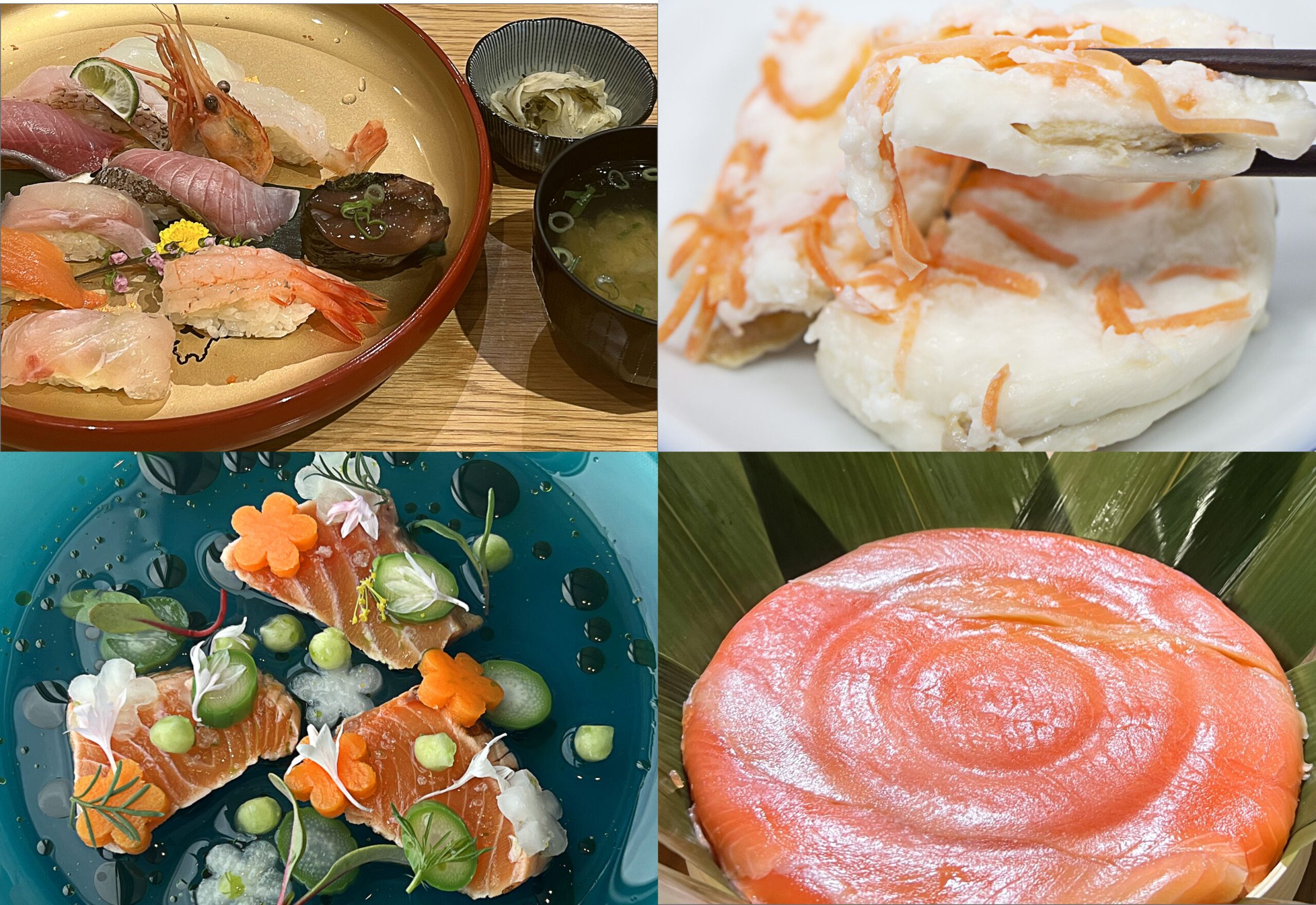
Now that we understand why Toyama Bay's seafood is so delicious and the background behind it, this time we introduce Toyama's sushi made with that bounty of nature's seafood. The flavor of sushi eaten after learning the secret of its deliciousness is exceptional!
Toyama Bay Zushi, made with Toyama Bay's seafood
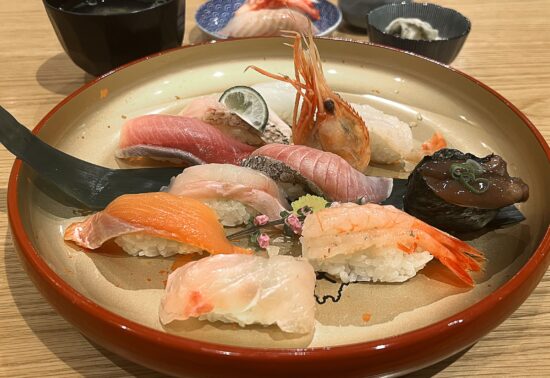
First, let us introduce “Toyama Bay Zushi,” made with local fish from Toyama Bay. Just as Edomae sushi uses seafood caught in Tokyo Bay, “Toyama Bay Zushi” uses fresh seafood landed in Toyama Bay.
“Toyama Bay Zushi” has several rules: it must use local fish caught in Toyama Bay, use rice made from Toyama-produced rice, be served with a Toyama-style soup, consist of 10 pieces, and be priced from ¥2,700 to ¥5,500 (tax incl.). Thanks to this, even first-time visitors to Toyama can casually enjoy Toyama's seafood.
One appeal of “Toyama Bay Zushi” is being able to enjoy fresh seafood just landed at nearby fishing ports, and another is being able to enjoy Toyama Bay's abundant local fish throughout the four seasons. Spring brings hotaru-ika (firefly squid) and shiro-ebi (white shrimp); autumn brings red snow crab; winter brings cold-season buri (yellowtail) and filefish—you can enjoy Toyama's seafood, which varies with the season of your visit.
Toyama's nationally renowned “masu-zushi” (trout sushi)
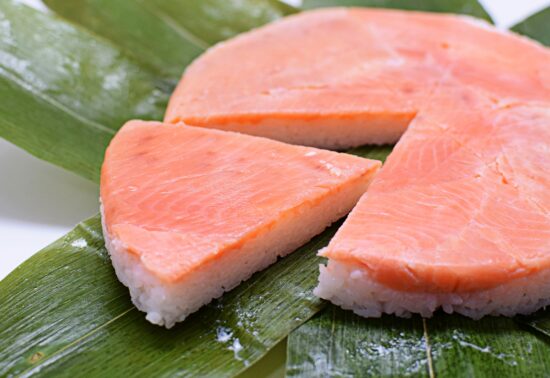
When it comes to Toyama's local sushi, there is the nationally famous “masu-zushi” (trout sushi). Its origins are said to date back to the Edo period, when sweetfish sushi made for the feudal lord Maeda Toshioki was presented to Shogun Yoshimune, and after Yoshimune praised it, it took hold as a Toyama specialty. Later, cherry salmon (sakura-masu) came to be used in place of sweetfish, and after it was sold as an ekiben (station boxed lunch) in the Taisho era, it became famous nationwide.
Modern “masu-zushi” is made by layering and pressing salt-cured trout and vinegared rice; the aroma of bamboo grass envelops the trout and rice, creating a distinctive flavor. There are a great many masu-zushi shops in Toyama City, and you can enjoy the different flavor of each shop, while some shops also offer hands-on masu-zushi making experiences.
Toyama's diverse local sushi: the appeal of kabura-zushi
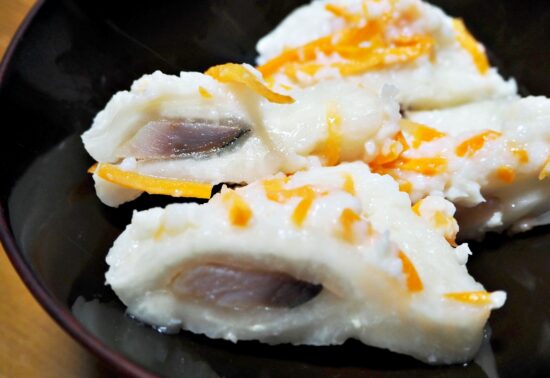
As Toyama's local sushi, in addition to “masu-zushi,” pressed sushi (oshizushi) such as “sasa-zushi” (bamboo-leaf sushi), “osezushi,” and “myoga-zushi” are known, and there was a time when narezushi was also commonly made; even today, “kabura-zushi,” a type of narezushi from western Toyama, is known as a specialty.
“Kabura-zushi” is a long-handed-down local sushi in which buri (yellowtail), mackerel, or the like is sandwiched between salt-cured turnips and fermented with koji; its exquisite balance of tartness and umami has made it beloved as a local taste indispensable to New Year's cuisine, a winter delicacy.
From late November, once the turnip harvest ends, kabura-zushi making goes into full swing.
Toyama's new initiatives in SUSHI
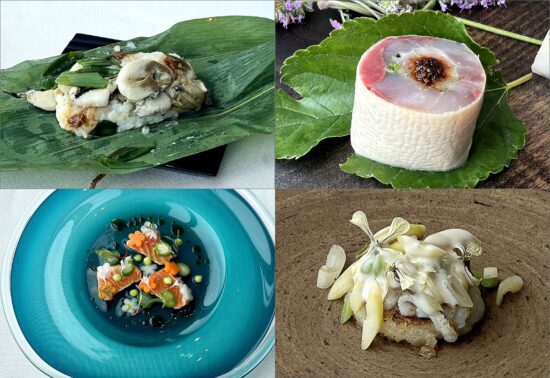
Since around 2023, Toyama Prefecture has rolled out policies to strengthen its branding as a sushi prefecture, and various new initiatives related to sushi are underway.
These initiatives go beyond traditional nigiri sushi to reappraise traditional sushi such as narezushi as well—an ambitious approach that takes a panoramic view of the world of sushi. A new future for sushi is about to begin from Toyama.
At the Toyama Prefecture-hosted event “SUSHI collection TOYAMA,” not only nigiri sushi but various new forms of SUSHI—such as fusion sushi blending narezushi with cuisines from around the world—are unveiled, drawing great attention.
Fusion sushi unveiled at SUSHI collection TOYAMA
Toyama's many charms
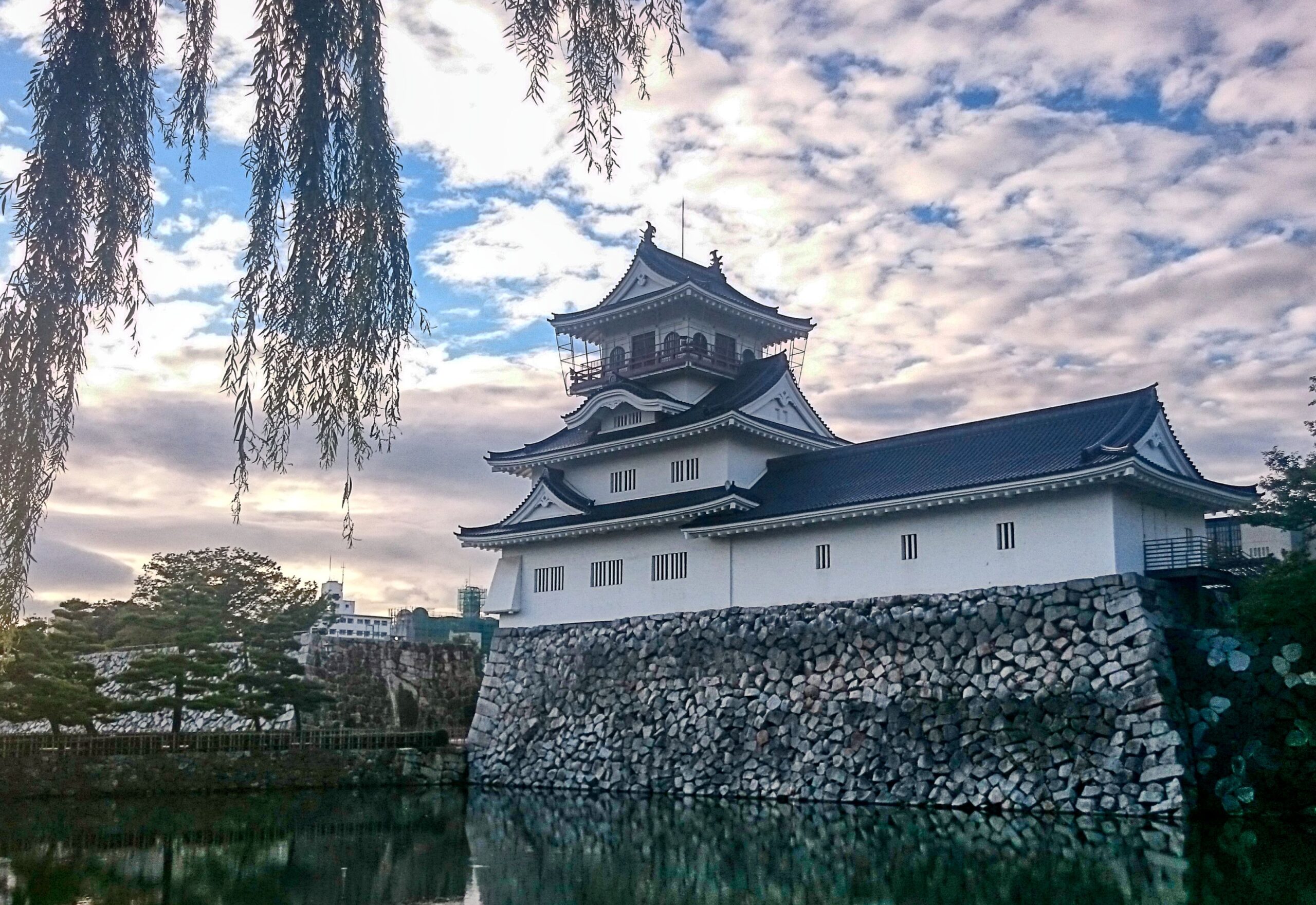
For sushi lovers, Toyama—with its delicious sushi and seafood—is appealing in its own right, but Toyama's charms don't stop at sushi and seafood. Beyond sightseeing spots such as Toyama Castle, the Tateyama Kurobe Alpine Route, and the gassho-style villages of Gokayama, Toyama's majestic nature, charming townscapes, and commitment to sustainable fishing are also among its great appeals.
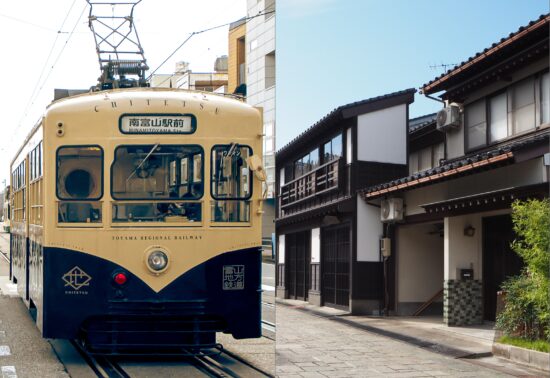
Feel the good old days aboard a nostalgic tram
The first thing that surprises you upon arriving at Toyama Station is the tram lines running every which way through the city, departing from Toyama Station.
The “Retro Train,” designed with retro cars from the 1960s–70s as its motif, features a nostalgic design and a warm wooden interior, letting you leisurely tour the city of Toyama while enjoying its retro atmosphere.
Strolling through the charming townscape aboard the nostalgic tram and savoring Toyama Bay Zushi at the sushi restaurants dotted around town is a luxurious experience unique to Toyama that you can't have anywhere else.
Savor Toyama's nature and flavors aboard the “Belmonta”
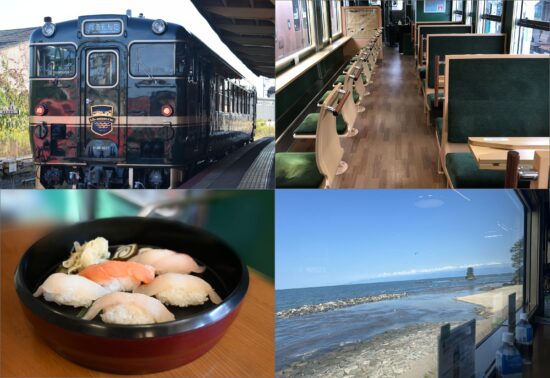
The JR Johana Line, connecting Takaoka and Johana, is beloved for letting you enjoy Toyama's townscapes and natural scenery, and on this Johana Line, the sightseeing train “Belles montagnes et mer (Belmonta)” runs twice a day.
The interior of the “Belmonta” is designed in an antique style, and you can gaze out at sweeping views of the majestic Tateyama Mountain Range and Toyama Bay through its large windows while soaking in the classical atmosphere.
What's more, a sushi chef even rides aboard the train, so you can savor sushi made with fresh Toyama Bay seafood and local sake while enjoying Toyama's scenery—a setup no sushi lover should miss.
Watching shiro-ebi fishing: fishermen protecting the sea with sustainable methods
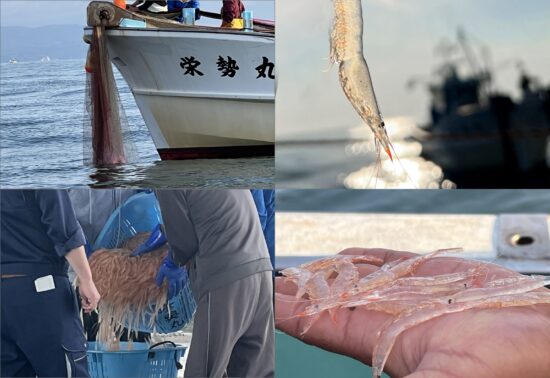
In recent years, “sustainable sushi”—an initiative originating in the United States that uses sushi toppings caught through sustainable fishing and aquaculture—has been becoming standard overseas, and in Japan, Toyama Prefecture is known for practicing such advanced sustainable fishing methods.
In shiro-ebi (white shrimp) fishing, one of Toyama's representative fisheries, a “pool system” is adopted, in which fishermen share the catch among themselves while controlling the limited marine resources. Toyama's shiro-ebi is truly exquisite, so these efforts by Toyama's fishermen are something we'd love to support!
At Shinminato Fishing Port, a “shiro-ebi fishing sightseeing boat” operates, letting you watch actual shiro-ebi fishing up close.
Not only can you watch the fishing, but you can also taste freshly caught shiro-ebi and even observe the auction.
It's sure to be an unforgettable experience, so if you get the chance, please give it a try.
Toyama's fishing ports and markets, where fresh seafood gathers
Taking advantage of its geographic position facing Toyama Bay, Toyama Prefecture is home to many fishing ports and markets.
Here, let's take a look at Toyama's representative fishing ports and markets.
Shinminato Fishing Port
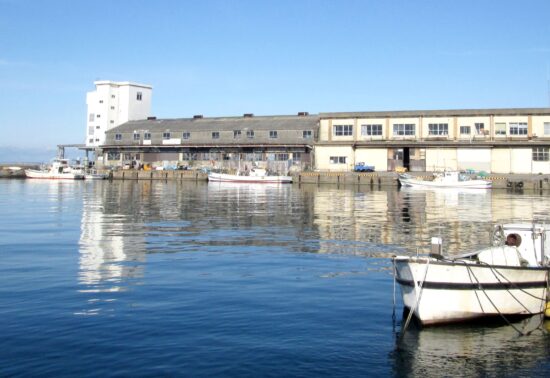
Shinminato Fishing Port in Imizu City is one of the prefecture's leading fishing ports, landing a wide variety of seafood.
It is especially famous for shiro-ebi (white shrimp), and a shiro-ebi fishing sightseeing boat—where you can watch shiro-ebi fishing and the auction—operates from the port.
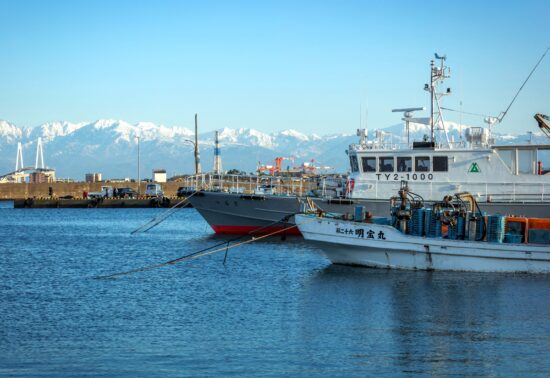
Himi Fishing Port
Himi Fishing Port in Himi City boasts the largest catch volume in Toyama Prefecture.
Himi is an area where set-net fishing that makes use of the topography flourishes, and the “Himi cold-season buri” (Himi kan-buri) landed at Himi is especially famous.
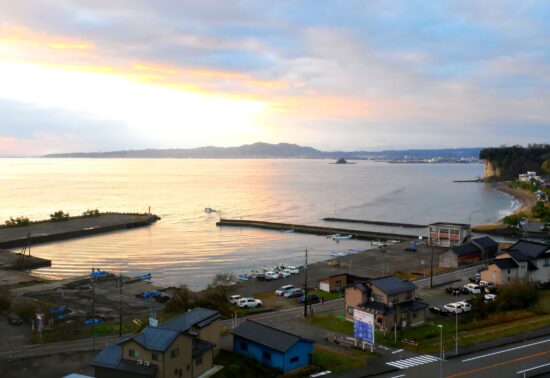
Uozu Port (Uozu Fishing Port)
This port lands large quantities of seafood representative of Toyama Bay, such as hotaru-ika (firefly squid), shiro-ebi (white shrimp), buri (yellowtail), red snow crab, and filefish. It is also known as the fishing port of “Uozu, the city where you can see mirages.”
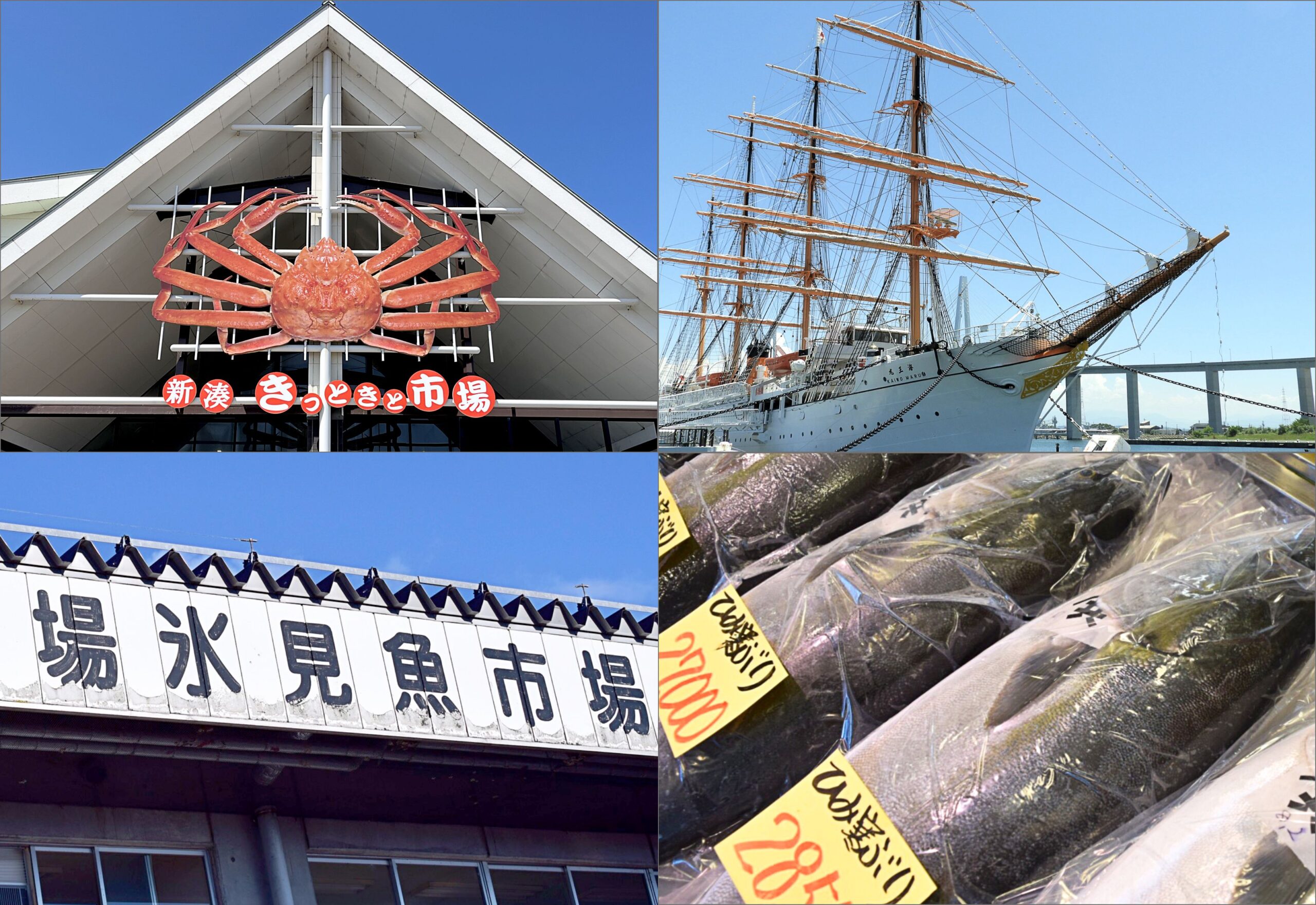
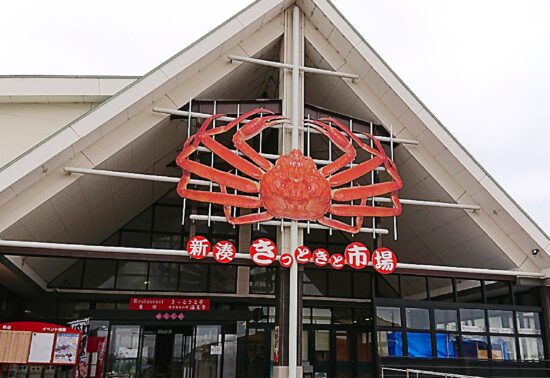
Shinminato Kittokito Ichiba (Market)
Adjacent to Shinminato Fishing Port, this market sells fresh seafood and local specialty products. “Kittokito” means “fresh” in the Toyama dialect, and true to its name, fresh seafood just caught at Shinminato Fishing Port lines its stalls. Inside the market there is also a service to have your purchased seafood cooked on the spot, and it draws many tourists.
Himi Fish Market
The Himi Fish Market is adjacent to Himi Fishing Port and bustles with many people seeking fresh seafood. Inside the market there is not only a direct-sales area for seafood but also a cafeteria serving dishes made with freshly caught seafood, where you can enjoy Himi's buri (yellowtail) just as it is—an appealing spot for tourists as well.
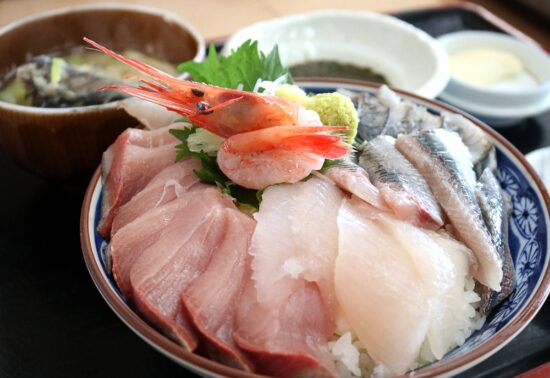
A seafood bowl at the Himi Fish Market cafeteria
The blessings of Toyama: its finest sushi toppings
Finally, let us introduce some of Toyama's representative seafood.
These are by no means the only seafood caught in Toyama Bay, but every one introduced here is representative of Toyama Bay, so please be sure to try them when you visit Toyama.
Shiro-ebi (white shrimp)
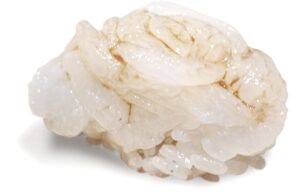
Shiro-ebi, called the “Jewel of Toyama Bay,” is characterized by its beautifully translucent appearance and faint sweetness.
Served as a battleship roll or nigiri, it is a sushi topping highly popular with tourists visiting Toyama.
Hotaru-ika (firefly squid)
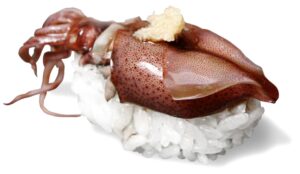
The sight of millions of firefly squid surging in and glowing in the dark of night is a spring tradition of Toyama Prefecture.
Because Toyama's firefly squid are caught during the spawning season, they are all large, well-fattened females.
Buri (yellowtail)
The buri caught in Toyama Bay is famous as “Himi Buri,” and during the cold-season buri (kan-buri) period in particular, it is richly fattened for a supreme flavor. It is the top sushi topping you'll want to eat when visiting Toyama in winter.
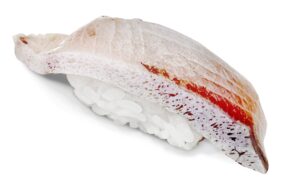
Sakura-masu (cherry salmon)
Toyama Prefecture, with its high-quality, abundant water resources, is home to many sakura-masu (cherry salmon / masu trout). Although wild catches have declined, aquaculture is thriving, and it remains one of Toyama's representative fish.
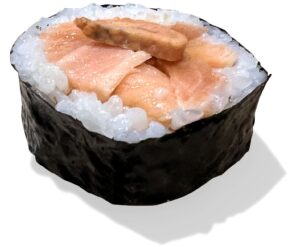
A futomaki roll of vinegar-cured sakura-masu and salt-cured salmon roe (sujiko)
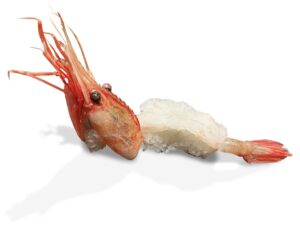
Toyama-ebi (botan shrimp)
The Toyama-ebi is a close relative of the botan shrimp and one of the few shrimp permitted by the Fisheries Agency to be called “botan shrimp.”
With a plump texture and strong sweetness and rich umami, it is one of Toyama's representative gourmet seafood.
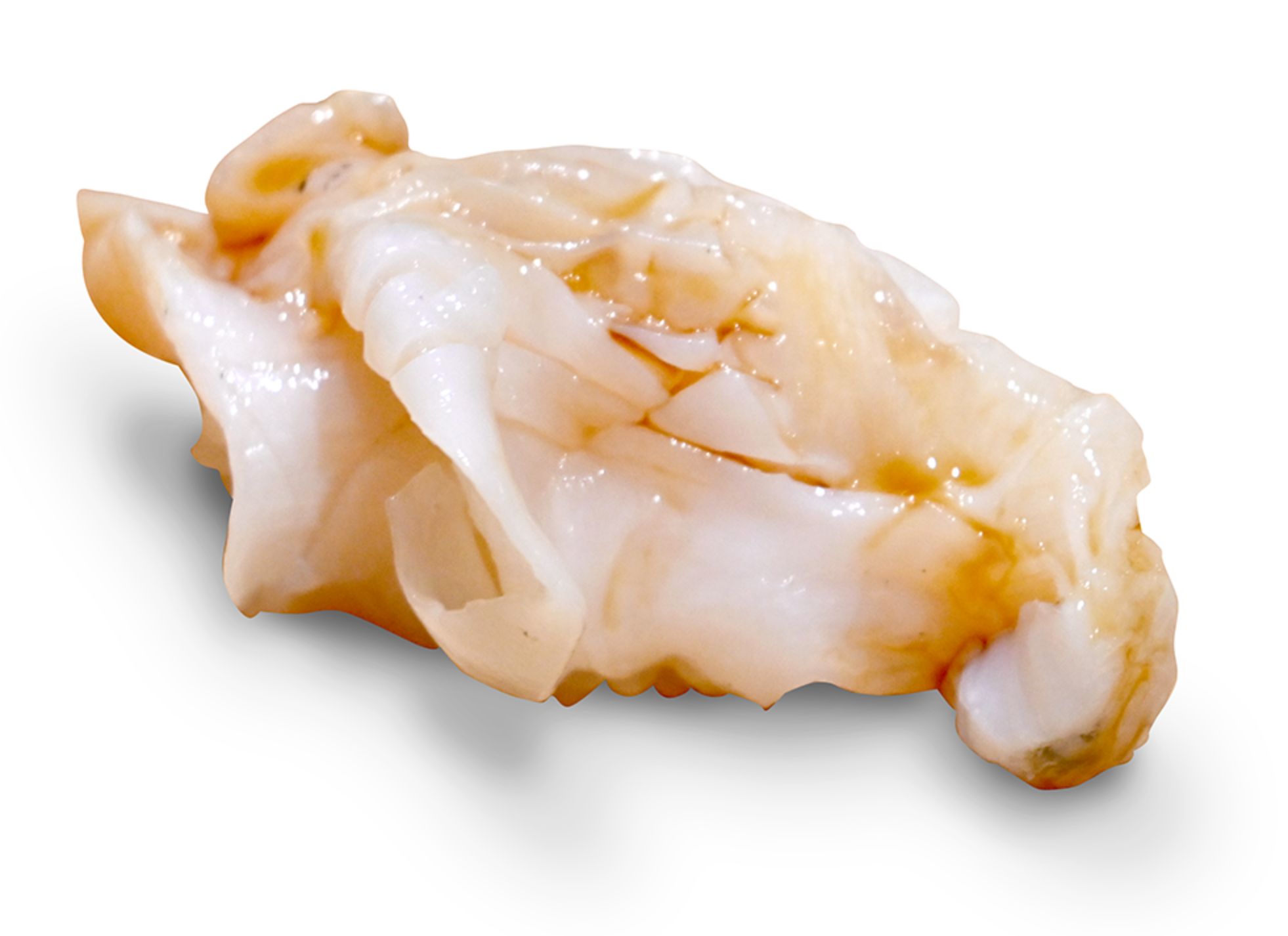
Bai-gai (whelk)
Bai-gai is an edible spiral shell of the Buccinidae family that lives in the deep sea at depths of 200–1,000 m.
Among the bai-gai caught in Toyama Bay, the oo-etchu-bai and kaga-bai are known to be especially delicious.
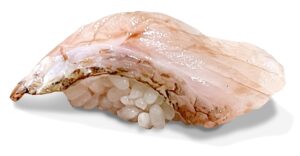
Nodoguro (blackthroat seaperch)
Its standard Japanese name is akamutsu, and it is a high-grade fish also called “the toro of white-fleshed fish” for its richness in fat.
Nodoguro caught in Toyama Bay in particular is known to be firm-fleshed and well-fattened.
Truly, when it comes to sushi, think Toyama!
How did you enjoy that? Toyama Prefecture—a treasure trove of diverse, top-quality seafood—truly proved itself worthy of being called “when it comes to sushi, think Toyama.”
The bounty of the sea brought forth by Toyama Bay and the Tateyama Mountain Range, born of the majestic history of the Japanese archipelago, is truly a gift from heaven.
Toyama's charming townscapes and majestic nature further enhance its appeal.
When you visit Toyama, please enjoy its many charms while savoring its sushi and seafood to the fullest.
Toyama's sushi is sure not to disappoint you sushi lovers!
References
Toyama市公設地方卸売 Market|Toyama市公式ウェブサイト
【公式】Toyamaの観光/旅行サイト「とやま観光ナビ」
【公式】魚津市観光協会 | うおっ!な魚津旅情報@Hokuriku·魚津 魚津ライブラリ/魚津の朝市
Sushiといえば、Toyama/「天然のいけす」、Toyama湾
【ジオリブ公開講座④ーToyama湾/バールデ美富味】第1部:巽先生からのジオストーリー
環境省_Japan海·対馬暖流海域 | 生物多様性の観点から重要度の高い海域
Toyama湾の紹介 – JFToyama漁連 Toyama漁業協同組合連合会
うまさ一番 Toyamaのさかな|越中とやま食の王国 Toyamaの食文化を伝えるOfficial Website
新湊きっときと Market|新湊うまいもん株式会社
レトロ電車 公式ウェブサイト
ベル·モンターニュ·エ·メール~べるもんた~│観光列車の旅時間:JRおでかけネット