What Is Makizushi? — The Sushi Roll Beloved by People Around the World
What is rolled sushi?
First, let us look at the definition of rolled sushi.
Rolled sushi refers to "vinegared rice with fillings at its core, rolled in nori (dried seaweed), sheet-form tororo kombu, or thin omelet."
It is one of the common dishes of Edomae sushi and is sometimes called "makimono."
Among the types of rolled sushi made using a bamboo mat are hosomaki (thin rolls), futomaki (thick rolls), isomaki, datemaki, and the overseas-born uramaki (inside-out rolls).
The history of rolled sushi
When exactly did rolled sushi appear?
Rolled sushi is said to have been born around 1750.
It became generally widespread around 1780. Since nigiri sushi, which could be called the face of modern sushi, was born around 1810, we can see that rolled sushi appeared earlier and led the sushi culture.
Incidentally, futomaki became popular in the 1780s, and shops that emphasized lavishness became hugely popular.
Rolled sushi appeared during the period when sushi culture was shifting from fermented sushi to hayazushi (fast sushi), and it surely came to have a solid presence.
Types of rolled sushi (types in Japan)
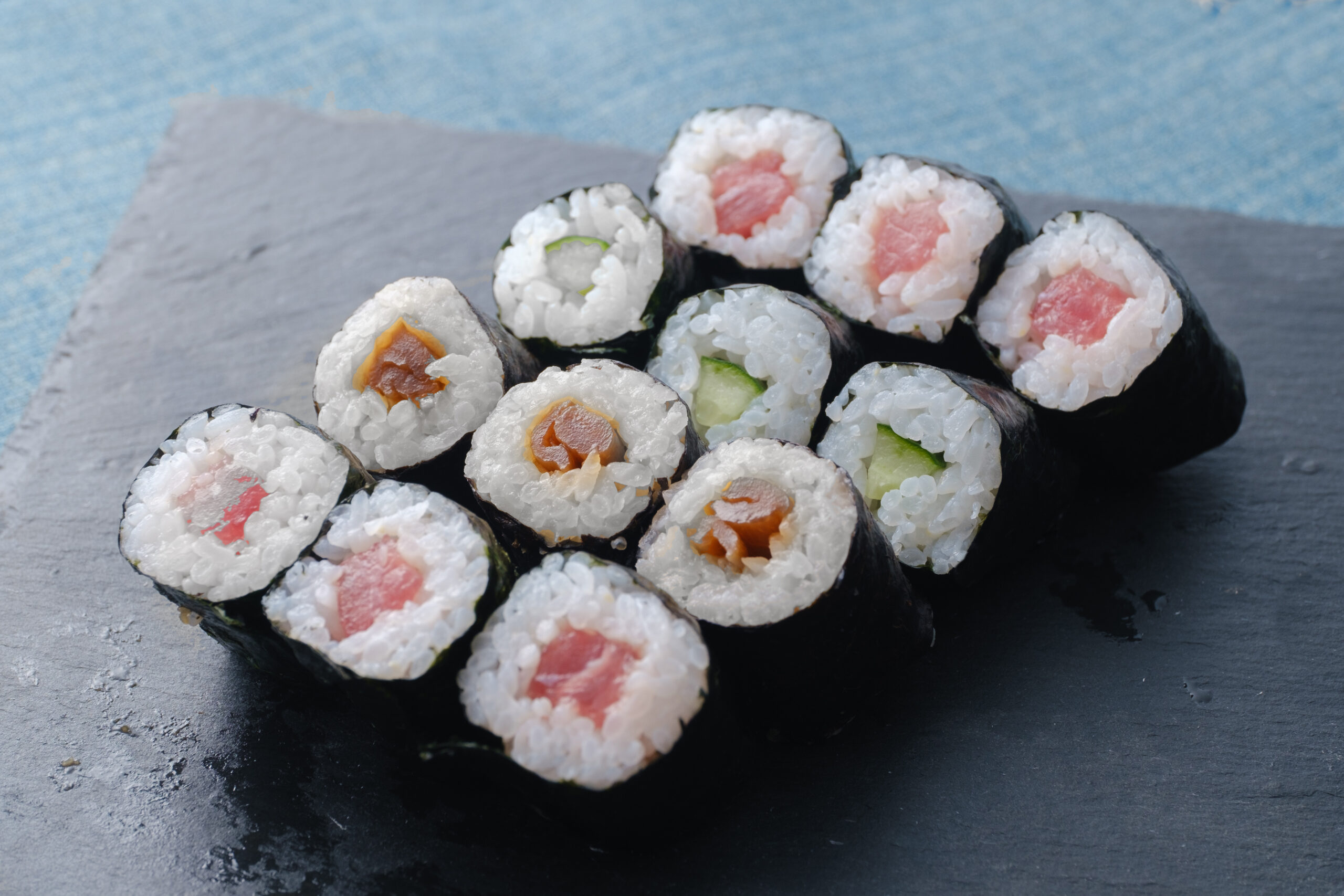
Rolled sushi is structurally rich in variation.
Let us look at the main types of rolled sushi that evolved in Japan.
Hosomaki (thin rolls)
The best known among rolled sushi is hosomaki.
With its small diameter, hosomaki is easy to eat and hugely popular with people of all ages.
Standard varieties include kanpyo roll, tekka roll (tuna), kappa roll (cucumber), negitoro roll, shinko roll, and conger eel roll.
Futomaki (thick rolls)
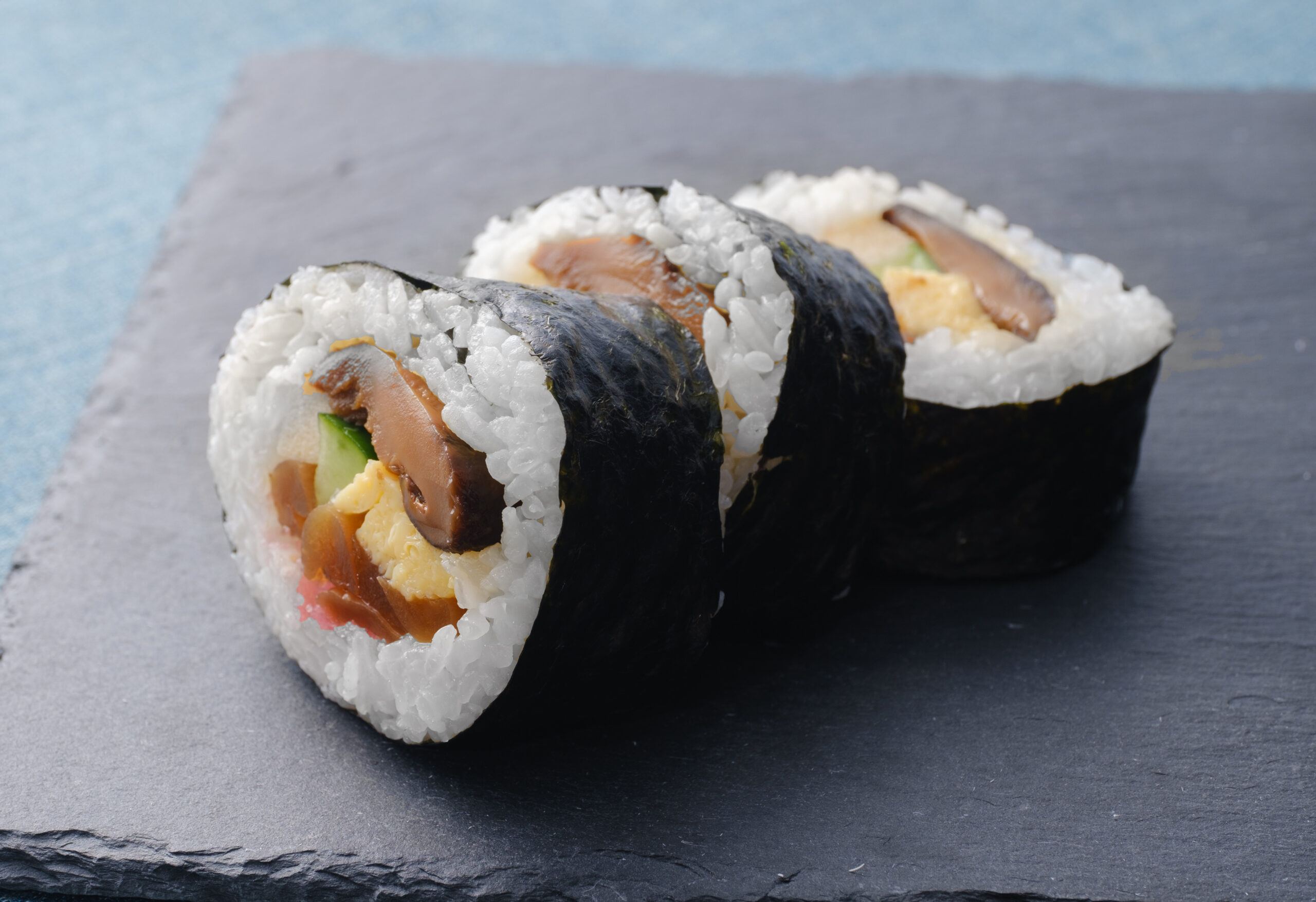
Futomaki mainly refers to rolled sushi that is 5 cm or more in diameter.
The main fillings are egg, kanpyo (dried gourd), denbu (seasoned fish flakes), grilled conger eel, and cucumber, but there are unique recipes depending on the region, household, or shop. In recent years, the ehomaki eaten at Setsubun has become popular, and this is also a type of futomaki.
In Kanto, futomaki often contains rolled omelet, while in Kansai, koya-dofu (freeze-dried tofu) is popular.
There is also vegetarian futomaki, which is called shojin-maki.
Isomaki
Isomaki is rolled sushi eaten mainly in Kansai.
It is characterized by being rolled in tororo kombu, with vinegar-cured mackerel used as the filling.
Datemaki
The rolled sushi called datemaki is a specialty of Choshi.
It is characterized by a thick rolled omelet, a bold sushi with the omelet placed in a half-moon shape over the vinegared rice and fillings.
The difference between rolled sushi and hand-rolled sushi
Hand-rolled sushi (Temaki), which has established itself as a popular party menu item.
Is there a difference between rolled sushi and hand-rolled sushi?
Hand-rolled sushi also falls within the category of rolled sushi in that vinegared rice and fillings are placed in nori and rolled.
The only difference is whether or not a bamboo mat is used.
General rolled sushi is finished neatly using a bamboo mat.
Hand-rolled sushi, on the other hand, is characterized by being rolled by hand without using a bamboo mat. You could say it has the feel of a casual version of rolled sushi.
Rolled sushi evolving overseas
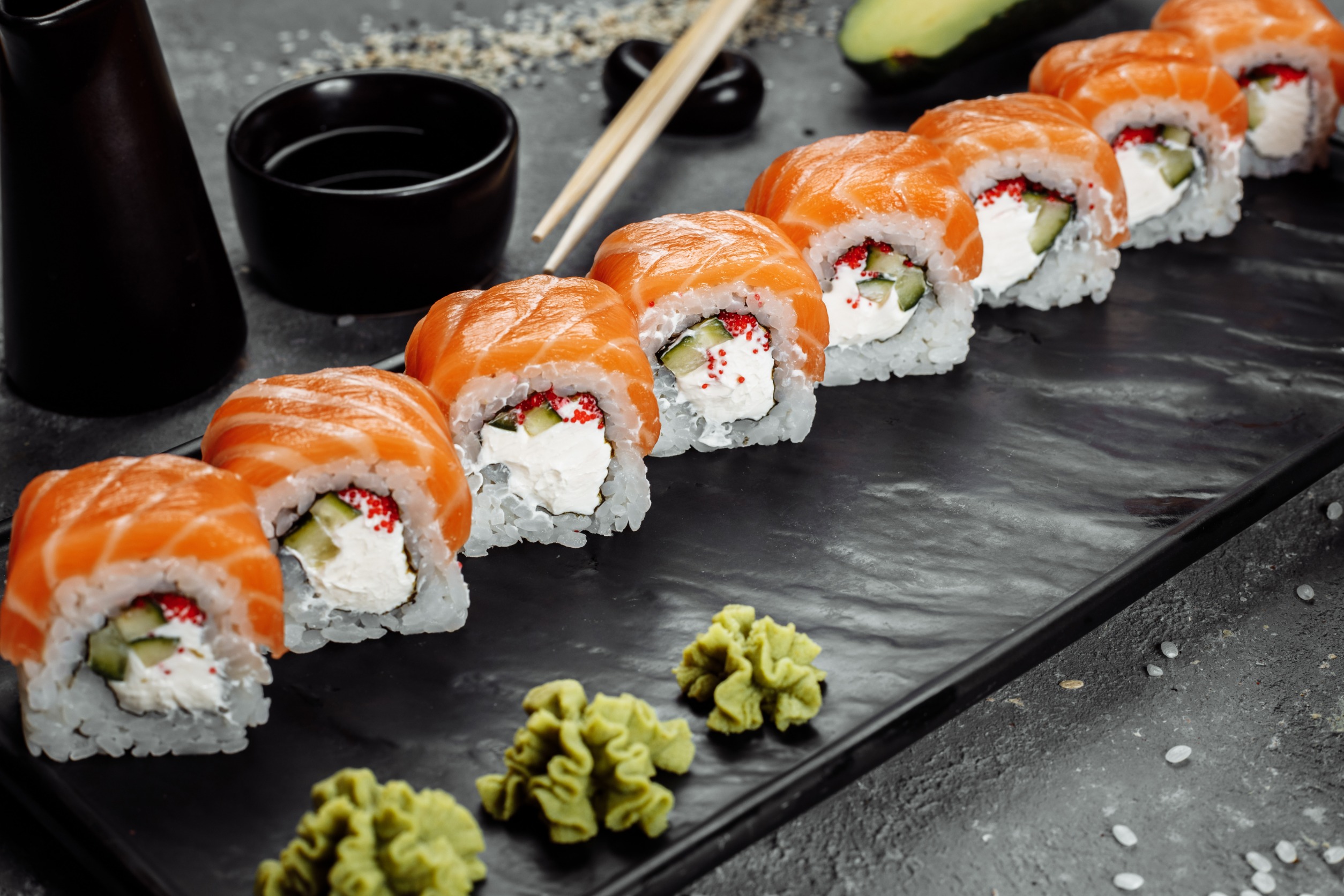
Sushi has undergone its own evolution overseas, centered on countries such as the United States.
The rolled sushi that evolved overseas is the inside-out roll (uramaki).
Rolled sushi is generally called the Sushi Roll and is loved in various countries, including the United States.
What kind of rolled sushi has become popular overseas?
We introduce some examples.
Inside-out roll (uramaki)
When it comes to overseas rolled sushi, the inside-out roll comes to mind first.
In the inside-out roll, the fillings are wrapped directly in nori, and the whole thing is rolled with vinegared rice on the outside. There is a story behind the birth of the inside-out roll, which seems strange to Japanese people.
When sushi first became known in the United States, the inside-out roll was devised so that the nori would not be visible, for Americans who were put off by nori that looked like black paper.
The fillings used in inside-out rolls are also popular with imitation crab, avocado, and mayonnaise, giving them a distinctly Western feel.
So, let us introduce some of the kinds of inside-out rolled sushi.
California roll
The rolled sushi born in the 1970s, when Sushi became a huge boom in the United States, is the California roll.
For Americans unaccustomed to sashimi and nori, it is rolled with avocado, lettuce, and imitation crab, and is the representative of inside-out rolled sushi.
Based on the California roll, variations such as the Boston roll and the Alaska roll have been born.
Philadelphia roll
The Philadelphia roll is rolled sushi made with Philadelphia cheese.
The main fillings are salmon, cucumber, avocado, and onion.
New Mexican roll
The rolled sushi originating in New Mexico uses chili peppers, a specialty of the region.
The seasoning is teriyaki sauce, the very essence of a Japanese-Western fusion.
Sushi burrito
The sushi burrito, popular as a fusion of the Mexican burrito and sushi.
Its characteristic is a distinctly American size.
Many sushi burritos reach 10 cm in diameter, making them the largest class of thick rolls.
It is rolled sushi that wraps all kinds of ingredients, such as meat, vegetables, fried foods, and salad.
Rolled sushi continues to evolve
Rolled sushi, born in 18th-century Japan, has evolved both at home and abroad over nearly three centuries.
Rolled sushi has many varieties in Japan alone, and quite a few regional dishes have their own distinctive types.
Since the 1970s, rolled sushi has been Westernized in the United States and has spread not only in the United States but throughout the world.
Rolled sushi, which has evolved to suit each nation's character and climate, is full of innovative and fresh appeal.
Rolled sushi, a food culture Japan is proud of, is still in the midst of evolution.
We look forward to seeing what kind of rolled sushi will appear in the future!