The Sushi Connoisseur's Path Part 1 — The History of Sushi That Makes It Taste Even Better
The Etymology of Sushi
Do you know the origin of the very name “sushi” in the first place? Sushi can be written with the kanji 「鮨」, 「鮓」, or 「Sushi」, and the sound “sushi” is said to derive from “sumeshi” (vinegared rice), with the “me” eventually dropping away to become “sushi.”
In ancient China, salt-cured fish was written as 「鮨」 and fermented fish as 「鮓」, and these became the kanji used to represent sushi. Then, during the Edo period, the Japanese-made kanji 「Sushi」—written to mean “to preside over (司) longevity and good fortune (寿)”—came into being, carrying the meaning of something auspicious, eaten at celebratory occasions. So that's why there are multiple kanji for sushi—there was this kind of historical background.
The History of Sushi—It Began Over 2,000 Years Ago—
The Origin of Sushi: “Narezushi”
Sushi in the broad sense has a history of over 2,000 years.Its birthplace is said to be not Japan but Southeast Asia,and in some regions of Southeast Asia such as Thailand, Myanmar, and Laos, a type of sushi called “narezushi,” made by fermenting fish with rice and salt for long-term preservation, is said to be the origin of sushi.
That said, the sushi made in Southeast Asia differs considerably in both taste and appearance from the sushi now widely eaten centered on Japan. “Narezushi” is one method of preserving fish, in which raw fish is pickled together with salt and rice for preservation. “Nare” means fermentation—the long-term preservation of food by utilizing the action of microorganisms. With this “narezushi,” only the fish was eaten, while the rice fermented together with it was not. Sushi in the old days was a fermented food consisting of fish alone.
Southeast Asian “narezushi” was transmitted to China, and from China to the Korean Peninsula, and then to Japan. “Narezushi,” the origin of sushi, is said to have been brought to Japan together with rice cultivation.
Sushi in Ancient Japan
Records of sushi in Japan begin in the Nara period. During the Nara and Heian periods, rice, food, and regional specialty products were paid to the capital as taxes, and narezushi, which could preserve fish and shellfish for long periods, was also offered to the capital as tribute.Shiga Prefecture's famous specialty “funazushi” (pictured below) still retains its original form even today.
Rice at the time was a precious commodity, and using a great deal of rice as in narezushi—and then discarding the used rice without eating it—was an extraordinary luxury. Sushi in ancient times was a luxury eaten by nobility and other high-ranking people.
Muromachi-Period Sushi: “Namanare”
However, as agricultural technology advanced and rice production increased, sushi began to spread among ordinary people as well. As sushi spread, “namanarezushi,” in which the rice was eaten together rather than discarded, was born.
This “namanarezushi,” said to have been born in the Kamakura to Muromachi periods, differed from “narezushi,” which was fermented until the rice dissolved; because it only required fermentation to the point where the rice acquired a sour taste, its shelf life was correspondingly shorter, and it was no longer for the purpose of long-term preservation. Here, sushi changed from a “preserved food” into a “dish.”
Edo-Period Sushi: “Hayazushi”
Then, as various methods were devised to shorten the fermentation period further, sushi with a sourness obtained by pickling or mixing fish and rice with vinegar eventually came to be eaten. Because it could be eaten sooner compared to narezushi, sushi using vinegar came to be called “hayazushi” (quick sushi).
Hayazushi is made by layering vinegar-pickled or salt-cured fish over rice mixed with vinegar and pressing it firmly. After leaving it for a few hours to overnight, it is ready to eat once the flavors have blended.
However, the vinegar at the time hayazushi was born was made by fermenting sake, using rice as a raw material and taking time, making it an expensive item. Then, in the 1800s, “kasuzu” (lees vinegar), made from sake lees left over when brewing sake, was invented. Kasuzu went well with sushi, and many sushi shops came to use it, which is said to have helped spread Edo-period hayazushi.
Edo's Fast Food: “Nigiri Hayazuke”
As hayazushi's appearance spread sushi throughout the country, in Edo a revolutionary sushi that rewrote the history of sushi was born: “nigirizushi.”
Nigirizushi is said to have been conceived by Hanaya Yohei around 1820. Before nigirizushi was born, the mainstream was hakozushi (box sushi), made by placing fish on top of sushi rice, packing it into a box, and pressing it with a weight. But Hanaya Yohei omitted the step of packing and pressing in a box, making it possible to shape the sushi by hand and eat it immediately. “Nigiri hayazuke,” which could be made faster than hakozushi and let you eat fresh fish, quickly gained a reputation; numerous nigirizushi food stalls appeared, and it became Edo's representative fast food.
The “nigiri hayazuke” that Yohei created came to be called “Edomae-zushi.” “Edomae” means the sea spreading out in front of Edo—today's Tokyo Bay—and it is the name for sushi made by shaping fish caught in Edo's sea.
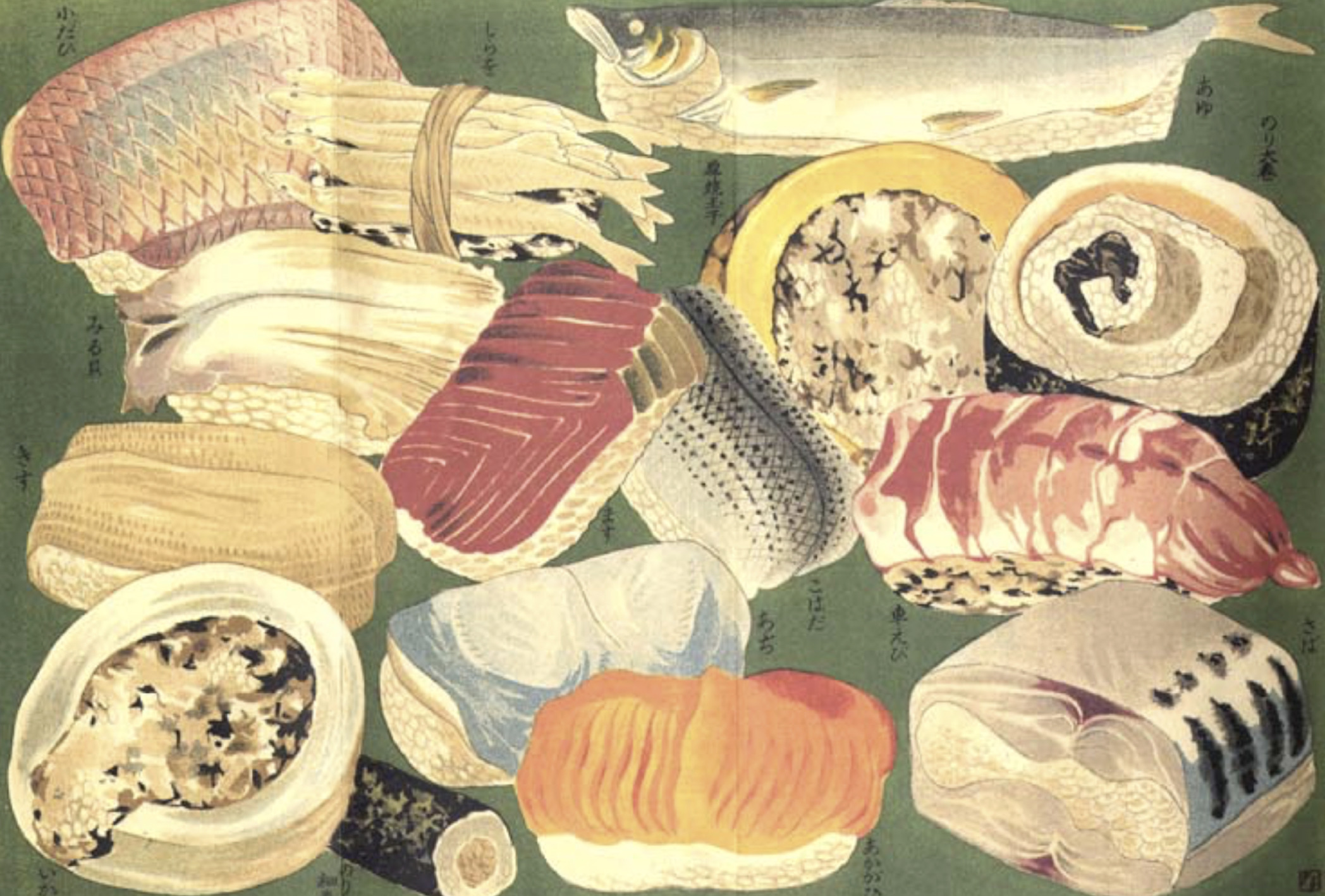
That said, since this was an era without refrigerators as we have today, no matter how fresh the Edomae ingredients were, they would spoil quickly if left raw. So they devised ways to make the seafood last longer, such as “zuke” (marinating in soy sauce), and salting, vinegaring, searing, or simmering. The sushi was also said to be 2 to 3 times larger than today's sushi.
Edomae-zushi Spreads Across the Country
From the Meiji era onward, the nigirizushi that had been popular in Edo spread throughout the country. There were several reasons, but it is said that the Meiji government's policy of spreading Tokyo's culture nationwide, as well as sushi chefs relocating to the provinces and opening shops due to the Great Kanto Earthquake and war damage, became catalysts for popularizing nigirizushi.
Furthermore, after the war, in 1947, the GHQ (General Headquarters of the Supreme Commander for the Allied Powers) banned restaurants from operating except for those serving distributed meal tickets. Volunteer sushi chefs in Tokyo negotiated with the GHQ to somehow be able to operate. As a result, a consignment processing system was approved.
Under the consignment processing system, when a customer brought one “go” (about 180 ml) of rice, the sushi shop would charge a processing fee and make 10 pieces of sushi. The consignment processing system is said to have standardized Edomae sushi to a certain degree and become a factor in its spread across the country.
The Romance-Filled History of Sushi
Now registered as a UNESCO Intangible Cultural Heritage and beloved by people around the world, SUSHIbegan with the Southeast Asian narezushi and, through various twists and turns, evolved into a culture unique to Japan.
The next time you eat sushi, please be sure to let your thoughts wander to the history surrounding it and savor it together with a sense of romance.