

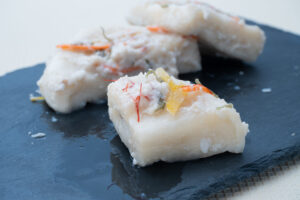
Kabura Sushi — Turnip-Wrapped Fermented Sushi
【Reading】かぶらすし
【English Name】Kabura sushi
Kabura-zushi, the pride of the Hokuriku region in winter, is a fermented delicacy. Inheriting the tradition of narezushi (fermented sushi), this dish is completed by wrapping yellowtail in salt-pickled turnip and entrusting it to the action of lactic acid bacteria through layers of rice koji.Ishikawa Prefecture, home to the Kaga region, is widely recognized as the heartland of this food, and the custom of preparing it in winter still survives in various parts of western Toyama Prefecture, which was once part of the former Kaga domain. Pickling becomes active during the period from November through the following January, and it is an indispensable presence gracing the New Year's table.
The way the turnip is cut shows regional differences: round slices are standard within Ishikawa Prefecture, while on the Toyama side there is a strong tendency to shape them into half-moons or ginkgo-leaf forms. Side ingredients such as carrot and kelp are tucked into the slits of the turnip, then rice koji is laid down in many layers, a weight is placed on top, and it is left to rest for anywhere from a few days to a maximum of two to three weeks. During this process, sugar is produced from the rice starch and lactic acid bacteria proliferate vigorously, so it develops into a flavor in which sweetness, sourness, and umami are complexly intertwined. A major characteristic is that, following the ancient method, neither vinegar nor sugar is added, and the flavor is completed solely through the power of fermentation.
Its origins date back to Kanazawa in the Edo period. A document from 1757 confirms its name as a dish served to New Year's guests, and at first it was a food limited to the upper classes because it required expensive ingredients. Entering the 1920s, homemade versions began to spread among households, and after the war the expansion of gift demand combined synergistically with the development of home-delivery networks, so today it has developed into a winter seasonal tradition that can be enjoyed throughout Japan.
Related Features: かぶらSushi
-
かぶらSushiとは?かぶらSushiの由来と名店のご紹介
Hokurikuを代表するCuisine「かぶらSushi」。IshikawaやToyamaの特産として、最近は全国的にも有名になってきていますね。かぶらSushiは旧加賀前田藩の領地にあたる広い地域で作られて
Load More
Close