"I want to become a sushi chef." When you think that, where do you even begin? Train at a sushi restaurant, attend a vocational school, teach yourself -- there are several options, and in April 2026, a new path was added. Sushi Daigaku®, a fully online sushi school under the supervision of the Japan Sushi Federation Association (J.S.F.A), launched with a tuition fee of 58,000 yen. It promises a way to learn sushi techniques and knowledge at your own pace, regardless of location or schedule.
In this article, we explore the background behind Sushi Daigaku's creation and what it aims to achieve.
The Path Opened by Sushi Schools -- and the Challenges That Remain
"Three years washing rice, eight years mastering nigiri." In the world of sushi, it was long believed that becoming a full-fledged chef required close to a decade. What changed this common wisdom was the emergence of specialized sushi schools from the 2000s onward. With systematized curricula, they created an environment where the fundamentals of sushi could be learned in a short period. This was a major turning point for the industry.
However, whether the doors to sushi education are truly open to everyone who wants to learn is another question entirely.
Three Major Barriers
When aspiring sushi chefs seek professional training, they typically face three major obstacles.
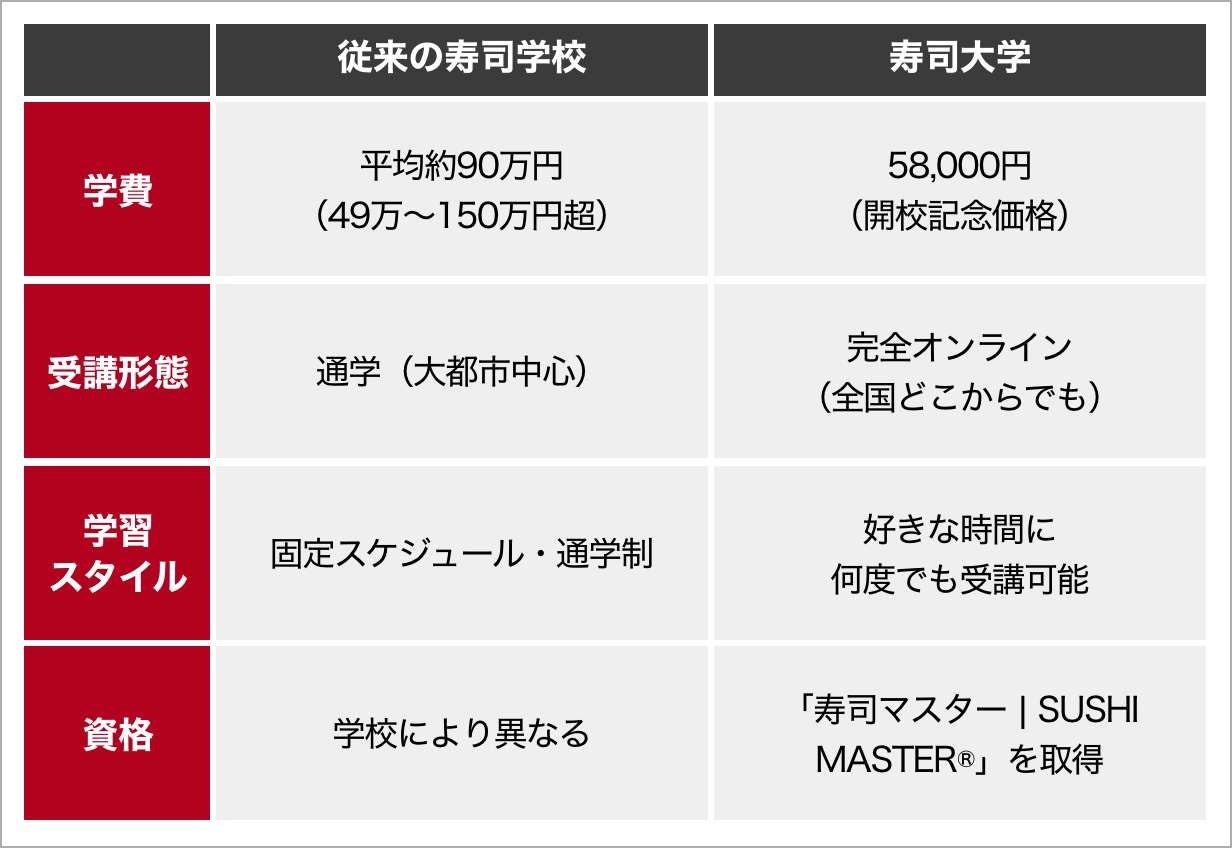
First, cost. The average tuition at a sushi school in Japan is approximately 900,000 yen, and courses exceeding 1,000,000 yen are not uncommon. "I want to learn, but I simply cannot afford it." There must be many who have given up for this reason.
Next, distance. Most sushi schools are located in Tokyo, with the remainder concentrated in major cities like Osaka and Kyoto. For those living in rural areas, the financial burden of relocation and living expenses is added on top of tuition.
And finally, time. Since classroom-based instruction is the norm, working professionals looking to change careers often find that they would need to quit their jobs to attend.
These barriers stand in the way of people who dream of entering the world of sushi.
On the other side, the industry itself faces urgent challenges. According to a survey related to the Ministry of Health, Labour and Welfare, 57.7% of sushi restaurant owners are aged 60 or older. The proportion of business operators who answered that they have "no successor" stands at 60.4% (Source: National Sanitary Business Management Guidance Center, "Survey on Business Conditions of Sanitary-Related Industries (FY2022)"). Increasing the number of people who aspire to become sushi chefs is an issue that affects the future of the entire industry.
"We Want to Eliminate Educational Inequality" -- The Starting Point
Responding to this situation was the Japan Sushi Federation Association, which has been involved in sushi education through its sushi certification exams. "There are people who want to learn sushi but are forced to give up because of money, location, or time constraints. We want to change that." This conviction is what gave birth to the concept of Sushi Daigaku.
The features are clear.
Tuition is 58,000 yen (tax included). By adopting an online format without physical facilities, operating costs are kept low, and the savings are passed on to students.
Classes are fully online. As long as you have an internet connection, you can study regardless of where you live. No relocation or extended stays are required.
Learn at your own pace. The on-demand format allows you to study while continuing to work. With focused effort, it is possible to complete the program in as little as one month.
Practical Skills Course -- Learning Professional Techniques Systematically Through Video
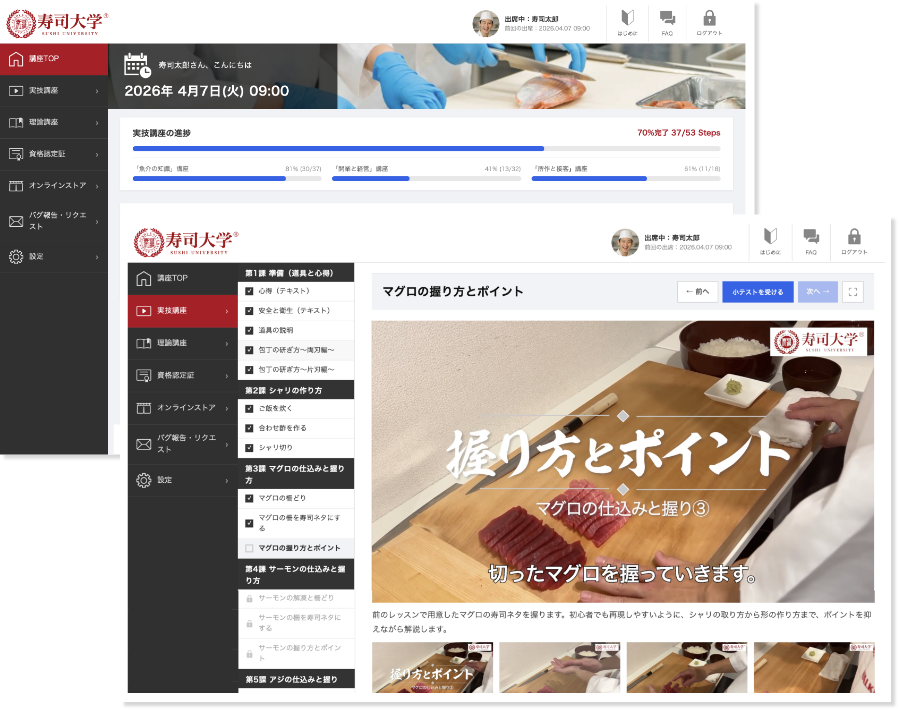
The practical skills course, which forms the core of the curriculum, guides students through the techniques required of a sushi chef step by step via video and commentary. Starting with how to handle tools and prepare shari, the course progresses through filleting small fish such as aji (horse mackerel) and kohada (gizzard shad), medium-sized fish like madai (sea bream) and hirame (flatfish), and finally the preparation and shaping of maguro (tuna) and salmon. The entire process is organized systematically.
What stands out is the careful articulation of "why" each step is performed. Rather than simply watching and imitating a professional's hand movements, students can learn while understanding the reasoning behind each action. The course also focuses on common stumbling points for beginners, making it accessible even to those with no experience in the food industry.
The ability to rewatch lessons as many times as needed and confirm understanding through tests is a distinctive advantage of the online format.
Theory Courses -- Three Areas of Knowledge Beyond Just Making Sushi
Alongside practical skills, Sushi Daigaku places great emphasis on three theory courses. They are designed based on the belief that "technical skill alone is not enough to sustain a long and successful career as a professional."
Specialized Knowledge of Seafood
This course provides comprehensive coverage of the seafood used in sushi restaurants, including characteristics, peak seasons, production areas, and the principles of quality assessment. It also delves into market mechanisms and the practicalities of procurement, making it not just an encyclopedia of fish, but a body of knowledge that can be applied in real-world settings.
Opening and Managing a Business
From creating a business plan, managing finances, and developing strategies for attracting customers and differentiation, to talent development -- this course covers the knowledge needed to run a sushi restaurant at a practical level. No matter how much technical skill you acquire, you cannot sustain a restaurant without business knowledge. The included "Business Plan Template" and "Financial Plan Template" are reportedly designed with sufficient rigor for submission to financial institutions.
Deportment and Customer Service
Proper conduct behind the counter, the art of conversational timing with guests, fundamental skills for floor staff -- this course develops the "human skills" that technique alone cannot cover. With inbound tourism demand in mind, the course also includes case studies on serving international guests.
The “Sushi Master” Certification Awarded to Graduates
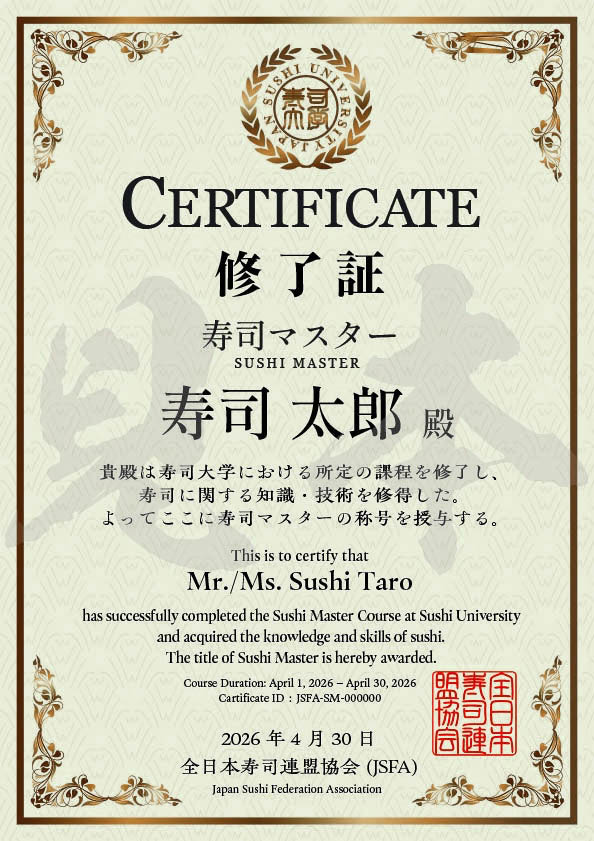
Upon completing the prescribed courses and passing the examinations, graduates are awarded the "Sushi Master | SUSHI MASTER®" certification, accredited by the Japan Sushi Federation Association. This certification is available exclusively to Sushi Daigaku graduates and serves as an objective credential demonstrating sushi-related skills and knowledge, which can be used in job searches and when opening a business.
Not Just for Beginners
Sushi Daigaku was not created solely for those aspiring to become sushi chefs. Even for professionals already working behind the counter or students attending other sushi schools, it can serve as a place to gain new perspectives.
There is more than one way to make sushi. Exposure to different approaches can provide an opportunity to objectively reassess one's own techniques and philosophy. The affordable tuition also makes it easy to use alongside other schools.
Toward a Future Where In-Person and Online Education Complement Each Other
Sushi Daigaku's goal is not to replace existing sushi education. In-person instruction offers value that online learning cannot provide, and vice versa. By complementing each other, the gateway to learning sushi becomes wider -- that is the vision Sushi Daigaku envisions.
Those who were once held back by the barriers of cost and distance can now step into the world of sushi, adding even greater depth to Japan's sushi culture. A 58,000 yen online school is setting out to open that door.
Sushi Daigaku Overview
Service Name
Sushi Daigaku (SUSHI UNIVERSITY)
Tuition
58,000 yen (tax included, opening commemorative price)
Certification Available
Sushi Master | SUSHI MASTER (accredited by Japan Sushi Federation Association)