Behind the Scenes at a Sushi School — Exploring the Current State of Sushi Education at Inshokujin University
What kind of place is the sushi chef training school Insyokujin University?
For this interview, we visited Insyokujin University Tokyo School, which has its campus in Ebisu, Tokyo.
It is a sushi school established with the aim of training professional sushi chefs.
By compressing the traditional "watch and learn" training period with its own original curriculum, the school continues to prove that solid skills can be acquired even in a short time—
Stepping into a room in a building along a major street, the classroom held a distinctive air of tension that contrasted with the lively atmosphere outside. As if it were a different world from the cityscape visible through the glass, the students inside silently moved their hands.
What characterizes this school is its consistent educational design, which goes beyond mere skill acquisition and is built on the premise of "working in a real workplace."
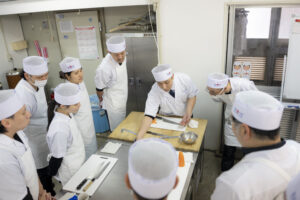
The backgrounds of the enrolled students vary widely.
Some aspire to become sushi chefs with no prior cooking experience, some are already working in the food industry but want to deepen their expertise, and some have their sights set on future independence or working abroad—their goals are not uniform. What they share, however, is a clear determination: "to make sushi viable as a profession."
The curriculum is structured to emphasize hands-on practice over classroom study.
Starting from the basics such as how to handle a knife and how to prepare fish, students build up step by step through prep work, forming the nigiri, and serving. Ultimately, the program incorporates practical training that assumes actually standing before customers, and it was striking that it does not end as mere practice.
Lessons that were more hands-on than imagined
On the day of the interview, the first thing I felt upon entering the classroom was an atmosphere more tense than I had imagined.
There was almost no idle chatter, and each student was focused on the work in front of them.
The instructor's directions, not loud but precisely to the point, created a quiet sense of tension.
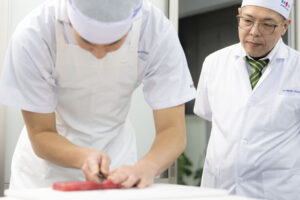
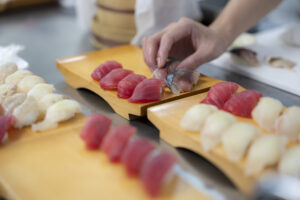
A student earnestly practicing slicing tuna
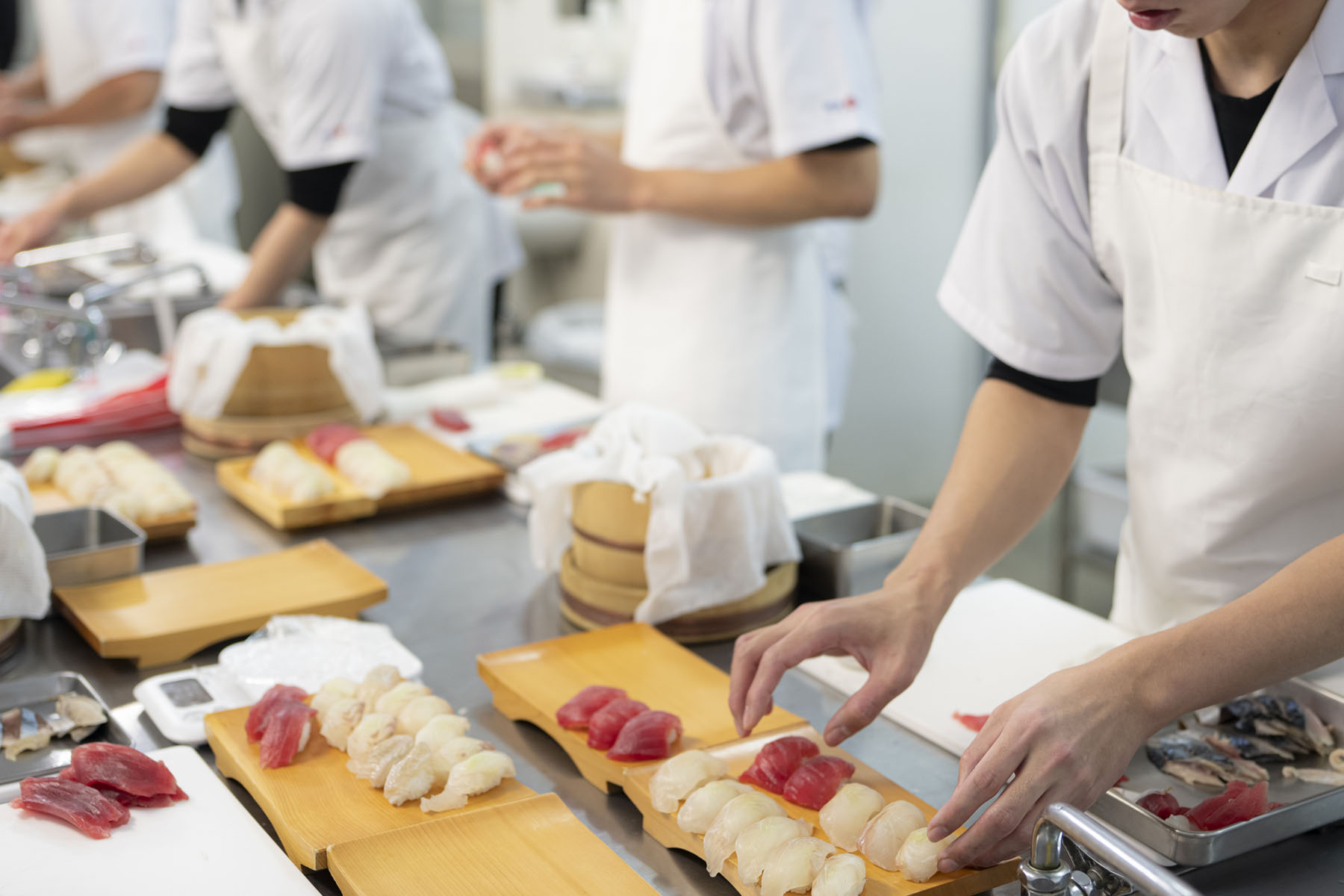
The lesson that day was practical content carried out from prep work all the way through to serving.
Each student took their station, filleting fish, preparing the toppings, and progressing to forming the nigiri. The instructor, always surveying the whole room, would stop their hands at the necessary moments and point out details down to the angle of the knife, their standing position, and how they moved around the space.
What was impressive was not just the technique itself, but the fact that they always put into words "why it is done that way."
Rather than simply showing the correct answer, by clarifying the reasons for mistakes and the direction for improvement, you could see how they guided students so as not to repeat the same errors.
It is not "watch and steal," but above all "move your hands and learn with your body." That said, rather than repeating blindly, because the instructor teaches the "theory (why it is done that way)" on the spot, the techniques seem to take hold by the shortest route, without hesitation.
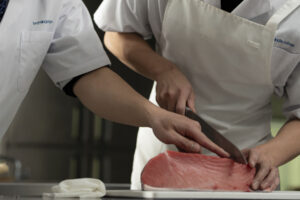
An overwhelming volume of "hands-on practice" and precise "theory" guidance from instructors support their growth
Also, the ingredients used in the practical training are not just something dismissed as practice material.
By handling highly fresh fish purchased directly from Toyosu Market, students are said to learn the differences between ingredients and the delicacy of handling them through their own bodies.
What I felt throughout the entire classroom was the "density required to make students improve in a short period."
They repeat each individual movement, immediately correct it, and try again. That cycle is extremely fast, and seeing the setting made it clear why students naturally lean in.
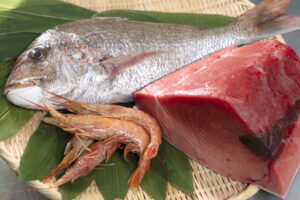
The fish and seafood used in the lessons
We talked with a current student
While observing the actual lesson, there happened to be a student taking on the serving practicum.
Since it was a valuable opportunity, the student let us hear a little during a break in the lesson.
The one who spoke with us was Y, a student who said they had no cooking experience when they enrolled. Standing at a workbench made to resemble a counter and actually serving sushi, Y conveyed a composure that made it hard to imagine they had been a beginner until two months earlier. When asked about their situation before enrolling, a surprisingly frank answer came back.
"I really was a complete beginner. I had never even held a knife properly, and I had absolutely no idea how to handle fish. In the early days, I think even the way I held the knife was awkward."
In the early days right after enrolling, every movement was said to be awkward
— At what point did you feel that you had grown?
"It was when I first served a fish I had filleted myself to a customer during the serving practicum. At first my hands trembled and my timing for serving was slow… But as I repeated it again and again, my hand movements became natural and I got a feel for the rhythm. When a customer told me it was 'delicious,' I finally felt that I had grown."
The student said the changes were not only in technique but also in their conduct and way of thinking.
"Of course there's the precision of filleting seafood and the rhythm of forming the nigiri, but how I handle the knife and how I move around the space changed greatly too. And above all, I started to think about 'what kind of experience I want to give the customer.' I learned that cooking is not just about the ingredients, but that the way you present it and the timing matter too."
— What do you think is the reason you were able to change this much in such a short period?
"The density of the lessons is just so high. Classroom study is truly kept to a minimum and it's almost all hands-on. There's a lot of time spent simply moving your hands. And on top of that, the instructor is right beside you making detailed corrections, so even when you fail, it's quick to put it to use the next time."
Indeed, for a beginner, having an instructor guide you right by your side is extremely helpful. What about the ingredients used? We also asked about the seafood used in the lessons.
"Being able to use ingredients shipped directly from Toyosu Market is a big deal. By handling good fish, I came to understand the differences in how it's killed and prepared and in freshness as a matter of feel. More than practice, it's wonderful to be able to learn with the same sense as the real workplace."
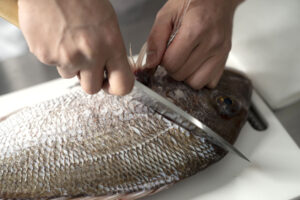
Filleting madai (red sea bream) shipped directly from Toyosu Market
When asked about the instructors and classmates, the student told us this with a smile.
"The presence of fellow students in the same cohort is really significant. Because I'm with people who share the same goal, a desire not to lose naturally emerges, and my practice volume increased too. The teachers' guidance is detailed as well, and I appreciate that they don't compromise."
The figure of a graduate shows the future after graduation
On the day of the interview, a graduate happened to be visiting the school, and although it was brief, we were able to hear from him.
Mr. T, a graduate who said he is already working at a sushi restaurant, frankly shared "how his experience at the school is useful now."
"What I feel now that I'm out in the workplace is the prep work, the movement around the space, and the sense of speed. For example, preparing anago (conger eel) is quite difficult, but because I was taught it thoroughly from scratch at the school, I now handle everything from prep to forming the nigiri on my own. Being taught to workplace standards from the very start was a big advantage. I feel that what I did at the school connects directly to the job."
The fact that what they learned at the school does not end as mere practice but connects directly to real work is reflected not only in the words of current students but also in those of graduates, and you could sense that Insyokujin University has become a reassuring presence for those aspiring to be sushi chefs.
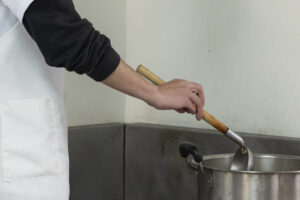
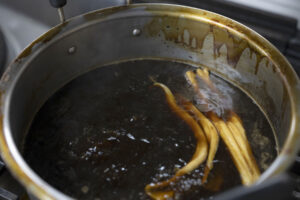
He says he can now handle anago on his own, from prep all the way to forming the nigiri
Asking the instructor about the system that supports growth
Finally, we also spoke with one of the instructors. As for why inexperienced students can stand before customers in a short period, the instructor explained it this way.
"What we value is thoroughly establishing procedures that can be reproduced. Rather than relying on a sense of intuition, we put into words why something is done that way, and we give feedback so that even when you fail, you can understand the cause. It is precisely because of repeated practice that students become able to move in a way close to real work, even in a short period."
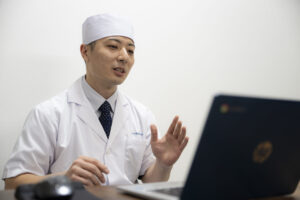
An instructor speaking passionately about the structure of the curriculum and the students' growth
The instructor also touched on the ingredients.
"By using ingredients shipped directly from the market, the speed of learning definitely rises. There is no teaching material that beats handling the real thing. We want to make the gap as small as possible for when they go out into the workplace."
The school also provides a certain level of support regarding career paths, and it is said that they think through realistic options—employment, independence, working abroad—together with each student, in line with their individual aspirations.
Especially in recent years, with the worldwide sushi boom,
Thoughts from the interview
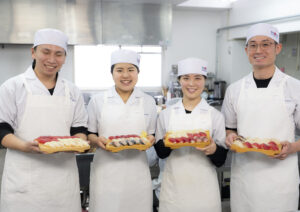
This time, by covering the setting of a sushi school, actually observing the lessons, and hearing from students and instructors, the role that a sushi school plays came into clearer view.
Insyokujin University, which we covered, is a school that accepts inexperienced people yet never sets its goals leniently, and the points that left the strongest impression were the following three.
① Above all, you move your hands and learn with your body. The curriculum is designed to workplace standards.
② Even in a short period, you acquire a "craftsman's perspective," backed up by results such as graduates producing a Michelin-listed restaurant.
③ The environment is set up so you can concentrate on acquiring sushi skills, with highly experienced instructors and peers who share the same goal.
On the other hand, I also felt that it is by no means an easy path.
The concentration and the volume of repetition demanded are considerable, and without resolve, one would likely struggle partway through.
That is precisely why it is an excellent fit for those who want to develop their skills in a short period, those who want to experience the atmosphere of the workplace at an early stage, those who want to learn sushi properly in a well-prepared environment, and those who want to choose sushi as a profession.
Now that the ways to learn sushi have diversified, "where" and "in what kind of environment" you learn has become more important than ever.
Insyokujin University could be said to be a school that can become one clear option, especially for those aspiring to become professional sushi chefs.
Interview cooperation: Insyokujin University Tokyo School
Reporting & writing: Sushi Walker Editorial Team
Official site: Sushi Chef Training School - Insyokujin University