Sushi Chefsへの道1- Sushi Chefsになる三つの方法
Sushiの知名度が外国にも広がり、その知名度は年々高くなっており、Sushiを知らない外国人はいないほどです。
しかし一方、 Craftsmanのほうはなり手不足でその数が足りず、需要は上がっていることを・・・

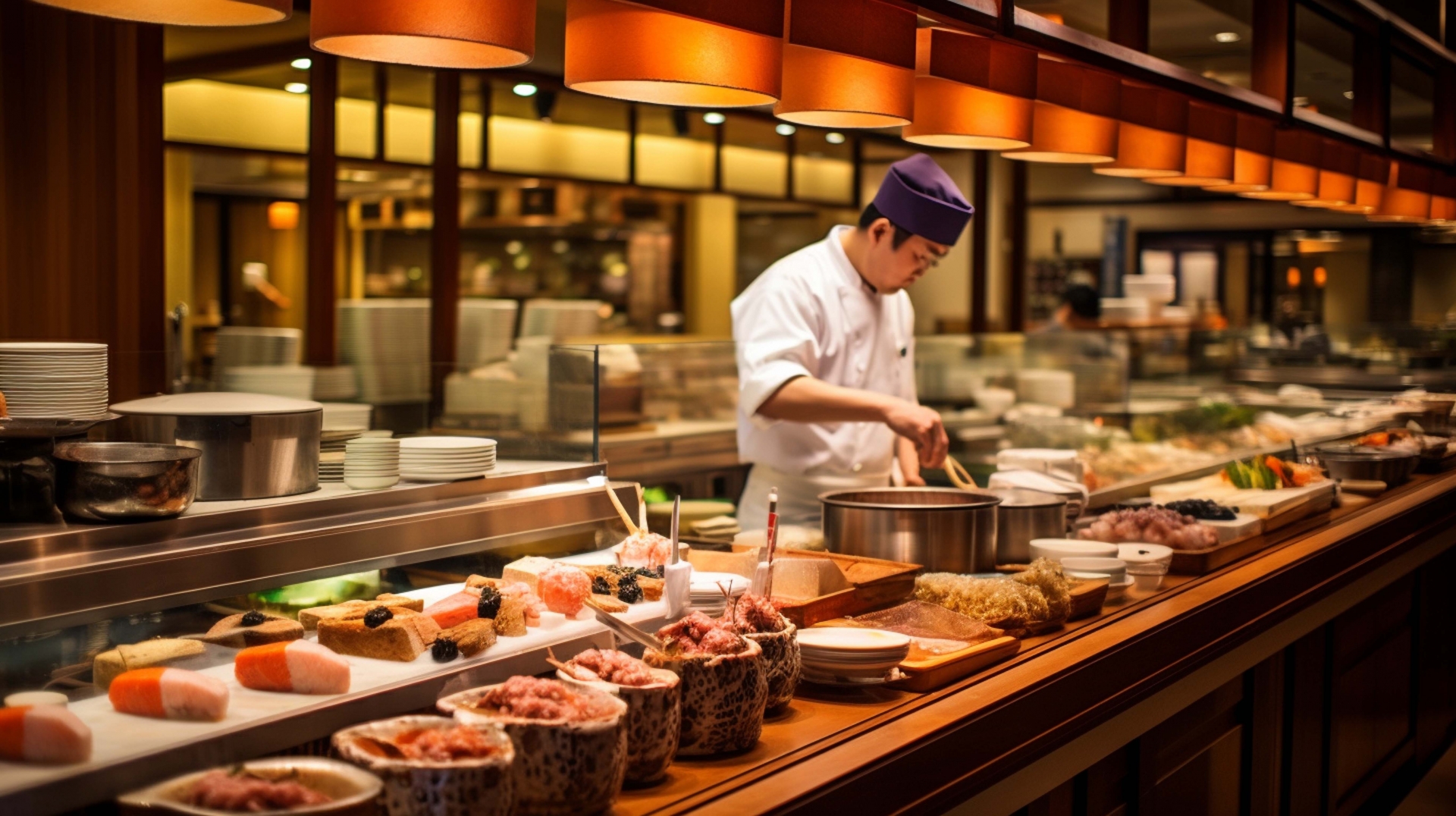
SUSHI is now popular worldwide, and in urban areas of the United States there are many sushi restaurants, with their popularity growing day by day.
There are several reasons sushi is popular among Americans, and one of them is that it is healthy.
Low in fat, high in protein, and containing vitamins, sushi is widely recognized as a healthy meal that fits modern preferences.
Of course, taste and appearance are also among the reasons for its popularity. Creative sushi arranged by combining America's diverse ingredients has also gained popularity, allowing people to enjoy new flavors.
The establishment of sushi in America has been remarkable.
American-born sushi rolls such as the California roll and the Philadelphia roll have even been reimported to Japan and have become some of the popular types of sushi there.
It is already common for sushi to be offered as fast food, and it can now be easily purchased at supermarkets as well.
Furthermore, interest in Japanese culture is also driving the spread of sushi. As many Americans come into contact with Japanese anime and the like, they develop an interest in Japanese culture as a whole, and as part of that, opportunities to try eating sushi have increased.

The average salary of sushi chefs in America has more than doubled, from an annual income of $26,000 in 2008 (approx. 3 million yen at the exchange rate of the time) to $44,000 (approx. 6.2 million yen). Because supply is falling short of demand, it is expected to rise even further.
Also, these average incomes are merely the average for sushi chefs who are mainly American. For Japanese chefs with a reasonable amount of sushi experience, postings offering $80,000 (approx. 11.5 million yen) or more are commonly seen.
The regions where the average salary of sushi chefs is high, in other words where demand is high, are as follows. In the northeastern United States centered on New York, even including non-Japanese chefs, the figure exceeds 9 million yen.
For experienced Japanese chefs, it is highly likely to exceed 10 million yen.
New Jersey: $83,573 (approx. 12 million yen)/year
Pennsylvania: $67,170 (approx. 9.7 million yen)/year
New York: $61,011 (approx. 8.8 million yen)/year
The runner-up regions are as follows, where pay starts at around 7.5 million yen.
San Francisco: $54,786 (approx. 8 million yen)/year
Chicago: $53,105 (approx. 7.5 million yen)/year
Los Angeles: $52,293 (approx. 7.5 million yen)/year
Boston: $51,727 (approx. 7.5 million yen)/year
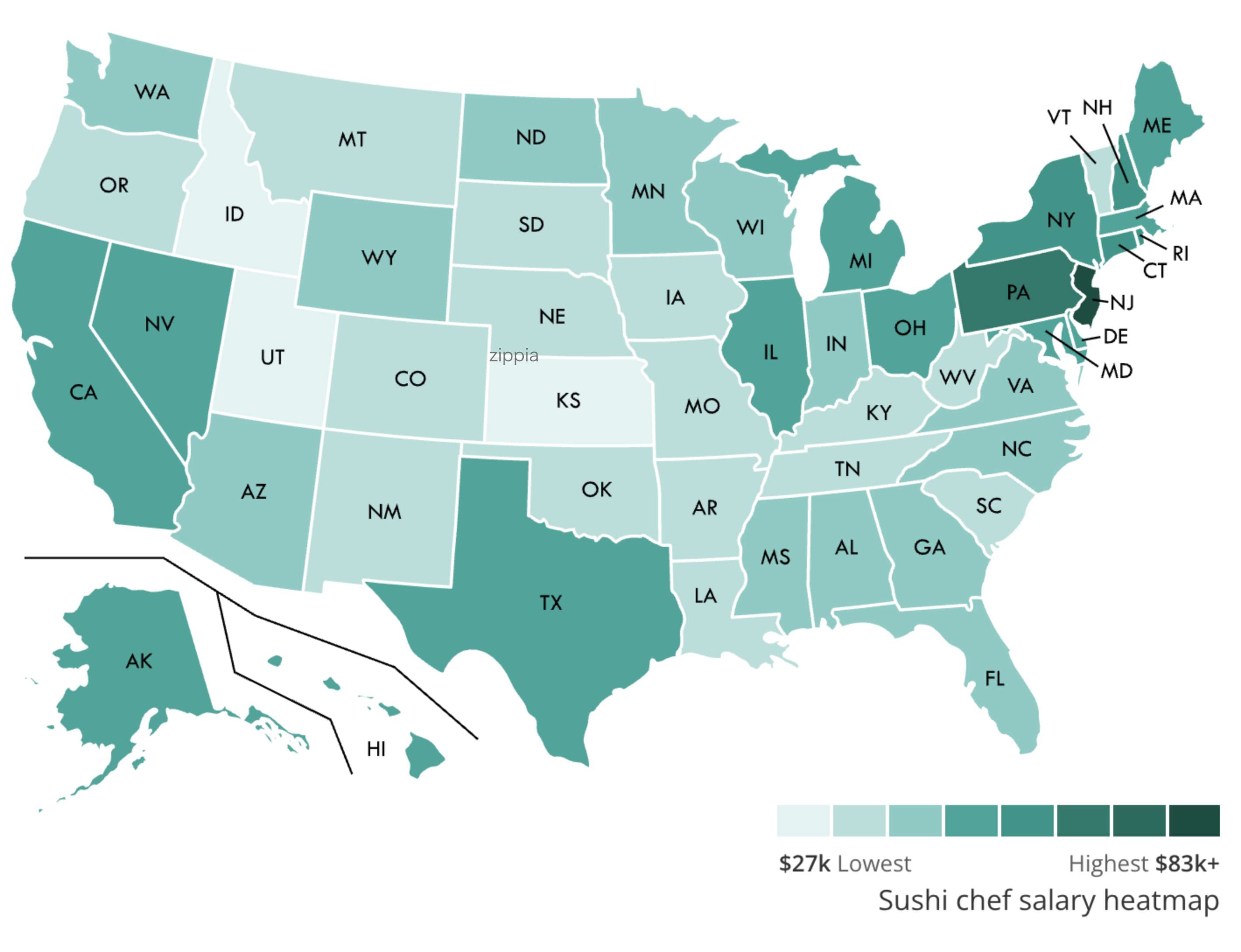
Source:Zippia.com 
Considering America's cost of living and that the overall average annual income in the United States is $95,000 (approx. 13 million yen), it cannot be called an especially high income. However, compared to the 4.5 million yen said to be the average annual income of a sushi chef in Japan, working as a sushi chef especially around New York can be called an attractive option.
Also, unlike Japan, the existence of a tipping culture is one notable point.
Especially at high-end sushi restaurants, tips alone can exceed 500,000 yen per month, and working at a high-priced sushi restaurant has the potential to significantly increase your income compared to working in Japan.
To work as a sushi chef in America, you need visa support from the company you work for, but because visa support involves considerable cost and effort, companies do not provide it easily.
When actually moving to America, how much skill is required?
Basically, you should assume that if you have no practical experience as a sushi chef, you will not receive visa support.
There is no specific number of years defined, but at a minimum you will need 3 or more years of practical experience, and preferably 4 to 5 years. So when aiming to work as a sushi chef in America, the realistic approach is first to gain practical experience in Japan while developing your plan.
Especially at high-end restaurants in places like New York, skills equal to or greater than those in Japan are required.
If you are not confident in your skills, targeting casual sushi restaurants is also a good strategy.
Because such restaurants prioritize how efficiently they can operate, they tend to hire relatively easily even if you have little experience.
When seeking employment overseas, rather than fixating excessively on brand prestige, it becomes important to conduct a strategic job search that takes obtaining a green card into view.
Because American work visas do not require proof of English ability, it may be possible to obtain one even if you are not fluent in English.
It depends on the type of visa, but for an L-1 visa, experience and work history as a manager are more important, whereas to obtain a J-1 visa for purposes such as training, at minimum a conversational level of English is essential.
As such, the English skills essential for working as a sushi chef are not high, but to actually work in America you will need a level of English that allows for a certain degree of communication, so studying at least basic everyday English conversation is necessary.
Especially at high-end restaurants where serving customers at the counter is required, many sushi restaurants list English communication skills as an application requirement.
Also, interviews when obtaining an American visa are basically conducted in English.
Since it is not a test, you do not need to speak perfect English.
Simple English is fine, so it is best to relax and aim for smooth communication.

Although sushi chefs enjoy better conditions in America than in Japan, a work visa is essential to work as a sushi chef there.
As for sushi chef visas, in the past there were companies that provided visa support due to circumstances such as a shortage of chefs. However, due to factors such as a rapid increase in Chinese and Korean chefs and stricter immigration regulations, obtaining a visa has become more difficult than before.
Note that the "H-1B visa," which is generally required to take up a professional occupation, is for specialized skilled occupations with high expertise such as doctors and accountants, requiring qualifications equal to or above a bachelor's degree in the specialized field. It does not apply to sushi chefs or itamae, for whom academic credentials are not required.
There was a time when America's regulations were lax enough that one could still obtain it, but currently it is nearly impossible for a sushi chef to obtain an "H-1B visa." Therefore, for a Japanese person to work as a sushi chef or itamae in America, it generally comes down to one of the "E-2 visa," "L-1 visa," or "O-1 visa."
Also, for an apprentice such as someone in training, it would be a "J-1 visa."
Each is explained below, so please use it as a reference.
*Visa information is subject to change, so please check the latest information on the U.S. government's website.
The visa most often applied for when a Japanese person works as a sushi chef in America is the "E-2 visa."
The "E-2 visa" is for investors, expatriates, and their families. The condition is that the foreign company of the sponsoring sushi restaurant holds an investment stake of 50% or more, and the visa applicant must be of the same nationality as the sponsoring investor or company.
For this reason, the majority of the owners of the sponsoring company, such as the sushi restaurant, are Japanese individuals or Japanese companies who do not hold permanent residency or a green card. The sponsoring company or investor needs a certain scale of investment or more, and the arrangement takes the form of bringing over an experienced Japanese chef necessary for the investment.
Note that applying for a visa as an investor is case by case, but generally an investment of $500,000 to $1 million is required. The number of people who can be sponsored varies depending on the restaurant's situation, but since the purpose is investment, local staff must always be employed as well.
The L-1 visa is what is known as an expatriate visa. There are two types, the "L-1A" and "L-1B visa," and it takes the form of moving from a company in Japan to America.
The L-1A (intracompany transferee) is a visa that applies when transferring as a "manager" or "executive" from a company located in Japan to a parent company, branch, subsidiary, or affiliated company in America.
The L-1B (intracompany specialized knowledge worker) is a visa issued to those transferring as a "specialized skilled worker" from a company located in Japan to a parent company, branch, subsidiary, or affiliated company in America.
The "O-1 visa" is a visa issued to those who can objectively prove they have extraordinary ability in fields such as the arts, sports, science, or education.
There is the "O-1A visa" issued in fields such as sports, science, education, and business, and the "O-1B visa" issued in fields such as the arts, film, and the television industry. Since cooking is included within "the arts," a sushi chef may qualify depending on their abilities.
It is not strictly defined, but being merely good at cooking makes issuance difficult. You need to prove that you objectively possess extraordinary ability, such as awards won at home or abroad, a record of being highly praised in newspapers, trade journals, or the media, a publication history, having worked at a renowned restaurant, or holding special qualifications.
The J-1 visa is part of an exchange program, and the categories that can be applied for in a form such as a sushi chef apprentice are "Trainee" and "Intern."
The Trainee category requires work experience and is generally aimed at those up to around 40 years old, with a validity period of 18 months (12 months for the hospitality industry).
The Intern category is for junior college and university students or those in their first year out of school. It targets people under 30 with no work experience, and the validity period is 12 months regardless of industry.
For the J-1 visa, jobs that are part-time-like in restaurants and hospitality-related fields, as well as small-scale companies, tend to face stricter screening.
With the establishment of sushi culture in America, a career as a sushi chef in America holds great potential.
Salary levels are also higher than in Japan, and especially for Japanese people with experience as a sushi chef, there is a chance for high income.
In regions centered on the northeastern United States, including New York, experienced sushi chefs are paid high salaries, and that income is attractive.
However, the path to becoming a sushi chef in America is not easy.
Because visa support involves cost and effort, if you aim for success as a sushi chef in America, you need to map out a clear path and prepare carefully while gaining practical experience.
Thus, while there are high hurdles to working as a sushi chef in America, there are also people who, after working as a sushi chef, have opened their own sushi restaurant and succeeded in earning a considerably high income.
Please use this article as a reference, prepare thoroughly, and seize the American Dream.

Japanese food continues to gain popularity overseas | The Japan Times
Sushi Chef Job Outlook And Growth In The US [2023] - Zippia
Average Salary in United States 2023 - The Complete Guide