

Yoshoku — Farm-Raised / Aquaculture
【Reading】ようしょく
【English Name】farmed / aquaculture
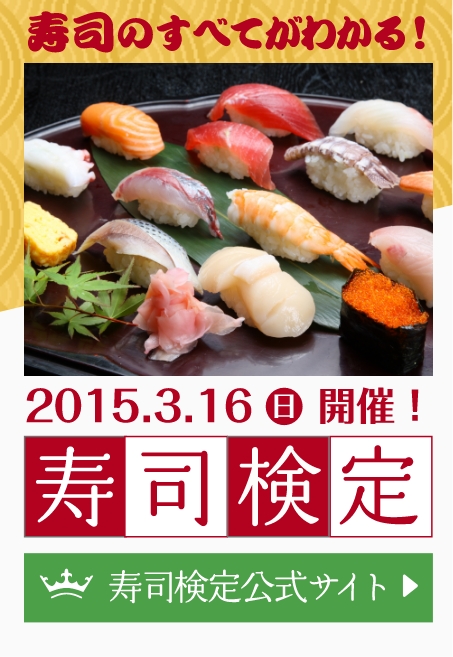
Aquaculture (yoshoku) refers to the method of producing fish, shellfish, and various marine products under artificial and planned management. It is called "aquaculture" in English.It has a deep connection with sushi toppings, as many of the standard nigiri toppings such as red sea bream (madai), yellowtail (buri / hamachi), salmon, and Pacific bluefin tuna (kuro-maguro) are distributed on the market as farmed products. Aquaculture includes methods of raising fish from the egg or fry stage, and "ranching" (chikuyo), in which wild juveniles are caught and raised to adulthood. Ranching is said to be the mainstream method for hamachi and similar fish.
The method of consistently managing fish from birth through the breeding of the next generation in an artificial environment is called "full-cycle aquaculture" (kanzen yoshoku), and the technology has been established for red sea bream, tiger pufferfish (torafugu), and salmonids. For Pacific bluefin tuna, full-cycle aquaculture at commercial scale was achieved after many years of research, while for eel (unagi) success has remained at the research stage and has not yet reached practical application.
In Japan's marine aquaculture, scallops (hotate) in Hokkaido, oysters (kaki) in Hiroshima, and yellowtail species in Ehime and Kagoshima are renowned as major production areas. In inland waters, eel farming is actively carried out in Kagoshima, Aichi, and Miyazaki.
Among consumers there is a deep-rooted tendency to prefer wild products, but quality has improved through advances in aquaculture technology and feed, and outside the peak season farmed products are sometimes traded at higher prices than wild ones.
Related Features: 養殖
-
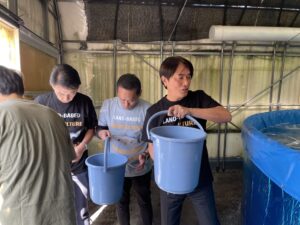
魚べいや元気Sushiを率いるゲンキGDCが仕掛ける国産養殖網プロジェクトが開始
いま、Sushi業界が抱える大きな課題のひとつが、国産Salmon Roeの品薄と価格高騰、そしてSalmon·真鯛を含む主要ネタの安定供給リスクだ。 国産Salmon Roeは、秋サケの不漁、世界
Load More
Close