How to Open a Sushi Restaurant Part 1 — Independent or Franchise? Strategy for Independent Sushi Shops

Differences by management form of sushi restaurants
Sushi restaurants come in many forms, but in terms of management categories there are individually owned restaurants, franchise restaurants, chain restaurants, and so on.
In terms of operating style, there are small-scale, high-end-oriented sushi restaurants centered on the counter, more popular sushi restaurants with a certain number of table seats and tatami rooms, conveyor-belt sushi with lower price ranges, takeout-only shops, and so on.
Here, while focusing on these forms of sushi restaurants, let us look at their advantages and disadvantages.
Advantages and disadvantages of an individually owned sushi restaurant
If you have on-site experience at a sushi restaurant, or have a certain degree of knowledge about restaurant management, individual ownership is generally a suitable option.
Advantages of individual ownership
The advantages of individual ownership include not having to pay a franchise headquarters, being able to manage freely without being swayed by headquarters' intentions, and gaining greater returns and joy when you succeed.
Disadvantages of individual ownership
The disadvantage is that you have to prepare everything yourself—advance preparation, capital investment, recruitment, procurement routes, business planning, and so on—all of which you must do yourself, so it is tough without a certain amount of experience.
Even if you have on-site experience and high ability as a craftsman, management is a separate skill, so you will need to constantly learn on your own and hone your management ability.
If you want to open a conveyor-belt sushi restaurant
If you want to open a conveyor-belt sushi restaurant, the situation is a bit special.
It is not impossible even with individual ownership, but because conveyor-belt sushi relies heavily on efficient systems, pricing, and procurement power, there are aspects that are quite difficult for an individual operating on the premise of small-scale development.
Labor costs and the FL ratio
When opening a sushi restaurant, you do not necessarily have to become a sushi chef yourself; you can also recruit and hire. In that case, labor costs naturally arise, so you need to pay close attention to the FL ratio.
The FL ratio is the ratio of the combined total of food costs and labor costs divided by sales. For a typical restaurant, 60% or less is generally considered appropriate, and 55% is considered to indicate good management condition, but because sushi restaurants have high costs at around 44%, you add about 10% to this.
Such figures are not always correct, but management that is conscious of the numbers is a necessary element for stable management, not only for restaurants.
Advantages and disadvantages of a franchise restaurant
If you do not have much knowledge about sushi restaurants, joining a franchise may also come up as one option.
Advantages of a franchise restaurant
The advantages include: because the headquarters provides know-how on opening and operation and offers guidance, it is easy to start even for an owner without knowledge; because there is often a certain degree of name recognition and brand power, it is easy to acquire customers from the start; because systems such as procurement routes and equipment are in place from the beginning, the risk of failing during preparation is low; and economies of scale in purchasing and the like are easier to achieve than for an individual shop.
In particular, because conveyor-belt sushi has low unit prices and cost reduction through building efficient systems is essential, if you want to start conveyor-belt sushi, joining a franchise can be said to be the general approach.
Disadvantages of a franchise restaurant
The disadvantage is that you must pay membership fees and royalties to the headquarters, and in many cases costs of 1 to 2 million yen are incurred as support fees and training fees in exchange for the provision of know-how. In many cases the total initial cost becomes high, at 30 million yen to over 100 million yen, which can be said to be a high hurdle for an individual.
In addition, because you are basically swayed by the headquarters' intentions you cannot manage freely; being unable to manage freely reduces the options for management strategy; and the returns and joy upon success tend to be lower than with individual ownership.
Furthermore, because you end up entrusting important parts of management to a third party—the headquarters—you need to be aware that in some cases you may suffer fatal damage. You will need to carefully check the contract terms, including matters after contract renewal, such as how much costs may fluctuate in the future and whether there is a possibility that a directly managed store will be opened near your shop.
Industry conditions of sushi restaurants and market changes
According to Tokyo Shoko Research's "Annual Trend of Sushi Restaurant Bankruptcies," the number of sushi restaurant bankruptcies was about 30 to 50 cases up until 2012, but from 2013 to 2022 it was about 20 to 30 cases, a declining trend.
The same was true during the COVID-19 period, so while other restaurant businesses often recorded their highest number of bankruptcies ever, the sushi industry can be said to have held up relatively well.
Behind this lie factors such as the efforts of sushi restaurants that managed flexibly while thoroughly carrying out infection countermeasures, and government subsidies, but sushi—which also has high demand for takeout and delivery—can also be said to be a business relatively able to adapt to changes in the external environment.
On the other hand, individually owned shops, which made up about 70% in 2001, declined sharply by 2022. Behind this is the expansion of major conveyor-belt sushi chains such as Sushiro and Kura Sushi.
The top four major conveyor-belt sushi chains now account for more than 70% of the current sushi industry's sales—the sushi industry is in a state of oligopoly by major conveyor-belt sushi chains—so it is better to keep this in mind before opening.
What strategies should an individually owned sushi restaurant adopt?
With the sushi industry in a state of oligopoly by major conveyor-belt sushi chains, the strategy that an individually owned sushi restaurant should adopt makes the point of how to differentiate from them important.
Naturally, you cannot win in a battle of price, so you need to fully leverage the advantages that major conveyor-belt sushi chains do not have.
Based on the advantages that major conveyor-belt sushi chains do not have, let us explain the strategies that an individually owned sushi restaurant should adopt.
Improve face-to-face service and the quality of service
The first advantage that major conveyor-belt sushi chains do not have is being able to actively make use of face-to-face service.
Because major conveyor-belt sushi chains focus on how to improve operational efficiency through mechanization, warm, in-person service is hard to provide, and at robot-style major conveyor-belt sushi chains with no chefs, it could be said to be nearly impossible.
For this reason, face-to-face hospitality and service at an individually owned shop become a major advantage.
You will want to actively engage in conversations with regular customers and create a homey, easy-to-visit atmosphere, firmly appealing to customers that yours is a good restaurant for face-to-face service.
Also, while not service per se, keeping bottles on hold to create the feeling of a regular hangout is one way to make use of the advantages of face-to-face service.
Pursue the quality of toppings and rice as a craftsman
Another advantage that major conveyor-belt sushi chains do not have is being able to be particular about quality as sushi.
Most recent major conveyor-belt sushi chains serve sushi processed by robots or part-time workers.
The quality of the seafood itself that becomes the sushi topping may have improved through more efficient sourcing and various ingenuity, but toppings uniformly processed by machines are often felt to be lacking by adults and connoisseurs.
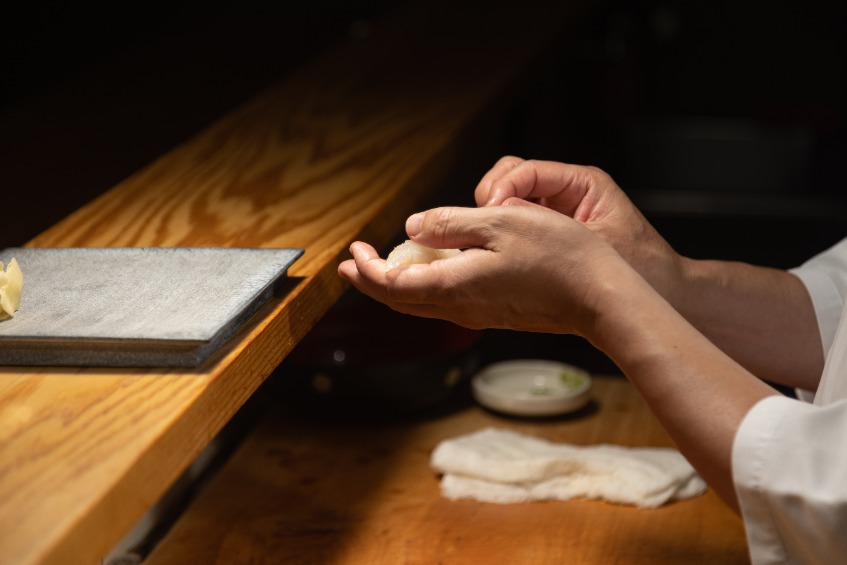
Also, although the rice shaped by robots has evolved compared to before, overly uniform rice is still unnatural, and compared to a craftsman's rice firmly shaped by human hands, it can be said there is still a difference in quality.
For this reason, firmly pursuing the quality of toppings and rice as a sushi craftsman can be said to be an important point for surviving in competition with major conveyor-belt sushi chains.
Clear differentiation of the main target
Even if you make use of the advantages of an individually owned shop listed above, there are cases where you simply cannot win. That is when you set the wrong target and overlap with the main target demographic of major conveyor-belt sushi chains.
In particular, if you make families with children or people who like inexpensive sushi your main target, you will completely overlap, so it is easy to predict that it will be a tough battle.
No matter how much you improve service and quality, you cannot easily beat major conveyor-belt sushi chains with these two demographics, so it is better to exclude them from your target.
Even if you can survive now because there are no major conveyor-belt sushi chains nearby, you will surely suffer fatal damage if one opens near you.
Conversely, it is best to pursue things that are hard for major conveyor-belt sushi chains—which target families with children—to do, such as creating an atmosphere where it is easy to drink alcohol, pursuing aspects different from what the main target demographic of major conveyor-belt sushi chains seeks, and thereby achieving differentiation.
Acquiring overseas customers
This is something necessary not only for individual ownership but also for franchise restaurants: with the COVID-19 pandemic having subsided, it is anticipated that many foreign visitors will come to Japan.
Because many foreigners who visit Japan love sushi, you can expand profits by capturing these foreign visitors.
Speaking of foreigners, sushi is hugely popular not only among Westerners but also among Asian foreigners such as those from the Chinese-speaking world.
In particular, many Asian foreigners who come to Japan are wealthy, and they tend to spend on sushi more lavishly than Western foreigners.
If you want foreigners to visit your shop, not only quality but also presentation becomes a major point.
Foreigners tend to like visual flashiness and a sense of Japaneseness, so a Japanese-style storefront, sushi-making experiences, and tuna-cutting shows can become good appeal points.
Also, such efforts have the advantage of being easy to spread on social media.
It is also effective to actively broadcast such efforts on the shop's social media, YouTube, website, and the like, and to firmly build your brand.
Because such customized attempts are hard to carry out at a franchise restaurant, they become a strength of an individually owned shop.
They also lead to differentiation from other shops, so it is good to actively try various things.
One point of caution is that management centered on overseas customers carries risk.
It cannot be said there is no possibility that foreign customers will suddenly stop coming due to the COVID-19 pandemic or some other factor, so with that in mind, risk hedging such as diversifying your customer base is also a necessary element for stable management.
Individually owned sushi restaurants have a chance too!
When opening an individually owned sushi restaurant, a strategy of differentiation from major conveyor-belt sushi chains becomes a must, but by firmly differentiating through face-to-face service and hospitality unique to individual ownership, a commitment to high-quality sushi made by human hands, and customized, free management, you can build a shop that can hold its own even against major conveyor-belt sushi chains.
Also, sushi is hugely popular overseas.Not only capturing foreign visitors to Japan, but also opening a second shop overseas or even opening overseas from the start, can be said to be attractive options.
Sushi, popular both in Japan and abroad, is a business in which, depending on the approach, you may obtain large returns.
If you are interested in opening a sushi restaurant, please take on the challenge of building a beloved sushi restaurant while firmly drawing up a business plan and preparing to open.