The Path to Becoming a Sushi Chef Part 1 — Three Ways to Become a Sushi Chef
Method 1: Work as an apprentice at a sushi restaurant
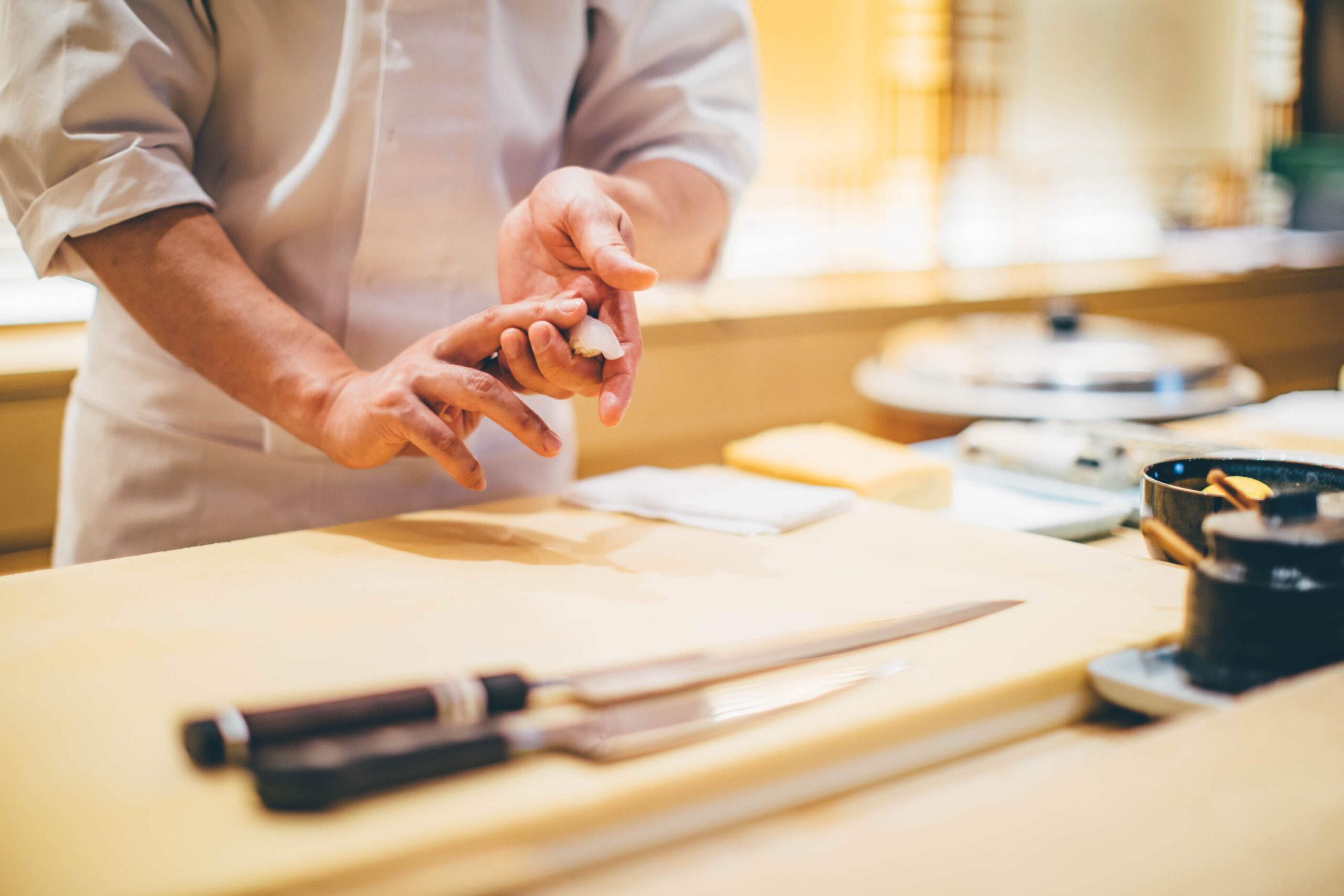
It is a method many people think of, but working as an apprentice at a sushi restaurant could be called the most orthodox approach.
Even among sushi restaurants, there are individually owned shops and large chain stores, and the business styles vary widely, from high-end sushi to conveyor-belt sushi and home-delivery sushi. Prices also differ from shop to shop, so it is difficult to say categorically which kind of shop is best suited for training.
Generally, it is said that training at a high-end shop is best. The more high-end the shop, the more you can learn advanced techniques and how to handle precious ingredients. However, you must keep in mind that the more advanced the technique, the longer it takes to master, and getting hired in the first place becomes more difficult as well.
The conditions required to work depend on the shop, so to find out whether the conditions suit you, it is a good idea to look at restaurant job-listing sites or inquire directly at the shop.
Advantages of training at a sushi restaurant
- You can learn the craft while earning a salary
- You can learn not only the techniques but also the know-how of actually running a shop
- It is easier to develop awareness as a professional
- You can learn how to serve customers
The greatest advantage of working at a sushi restaurant is, after all, that you can be taught various things while earning a salary.
Even if you are not taught step by step, simply being able to see the whole flow from the inside—purchasing, preparation, customer service, and how the shop operates—is valuable enough.
At a first-class shop, what you learn there carries brand value in itself, so it works to your advantage when you open your own shop. Also, if your relationship is good, you may receive support in the form of a "noren-wake" (branch-off) arrangement when you become independent.
The information you gain by working at such a sushi restaurant is extremely difficult to be taught afterward, so those who intend to open a sushi restaurant are advised to study thoroughly—for example, by taking detailed notes while at the shop.
The key is not to fixate on salary. As with anything, but especially in skilled trades, the starting salary is low in every profession, so the most important thing is to focus on what you can learn.
Disadvantages of training at a sushi restaurant
- It takes a long period to learn the techniques
- It is hard to find time for yourself
- You may feel a physical or mental burden
The training period will be discussed later, but you will not become able to make sushi in front of customers right away in one or two years.
The more high-end the shop, the more hardships there tend to be in various respects; you start with menial chores, and it is not uncommon for it to take several years just to be allowed to properly handle the ingredients. This is true not only of the sushi world but of skilled trades in general—many shops have a strict hierarchy and a strong "sports-team" atmosphere, so those who are not used to it are likely to struggle considerably before becoming fully fledged.
Points to watch when choosing a shop to work at
- Working conditions
- What kinds of sushi and side dishes you can learn
- What kind of people the head chef and senior staff are
The craftsman's world is harsh. Although entering the path is easy, it is said that only a very few people become fully fledged.
Passion is important to become fully fledged, but it is meaningless if you cannot continue at your own pace. The key is to work at a shop where you feel you can keep going even a little longer.
Method 2: Attend a sushi vocational school
Besides training at a sushi restaurant, there is the method of attending a vocational school for sushi chefs. It suits people who want to become able to make sushi as soon as possible and work overseas, open their own shop, or work efficiently at a large chain store.
In the past, attending a vocational school to become a sushi chef was not an option, but now, with the passage of time, the number of vocational schools has increased, and you can receive high-quality lessons. Most instructors are experienced people or active professionals, so you can learn practical skills.
Advantages of attending a sushi vocational school
- It does not take long to graduate
- You can practice making sushi from the very start
- An environment with many peers, making it easy to spur each other on
- Advantageous for finding employment
- You are less likely to be scolded
Because the lessons are set in advance and proceed according to a curriculum, you tend to feel less pressure than working on the job. The lessons mainly focus on becoming able to make sushi, so you can learn the techniques rationally. Another good point is that the school supports you in acquiring skills and in finding a job.
Also, although policies differ somewhat from school to school, basically you pay money to be taught, so compared with learning while working, you are rarely scolded, which makes it considerably easier mentally.
After graduation, famous shops may be tough, but you become more likely to be hired at major chain stores or conveyor-belt sushi restaurants, so one option is to work at an actual shop for a while after studying at school, then open your own shop.
Disadvantages of attending a sushi vocational school
- Tuition is required
- You will not be ready to perform immediately after graduation
Since you attend a school, tuition naturally costs money. The going rate for vocational school tuition is said to be around 500,000 yen for an approximately three-month course.
Also, as with other vocational schools, paying tuition and studying does not mean you immediately become a professional.Some schools offer placement assistance to sushi restaurants, but even after graduating, you have only learned basic techniques and knowledge, so to actually get a job or open a shop, you need to go through trial and error on your own.
Method 3: Learn sushi by self-study
"What, self-study sushi??" Many people probably think this, but in fact, overseas this method is used quite often.
In the past, it was very difficult to obtain information on becoming a sushi chef, but nowadays, starting with YouTube, there are various videos on the internet showing how to form sushi and how to fillet fish,so you can learn carefully while actually watching the techniques. There are also quite a few books on sushi techniques, so we now live in an age where you can learn to a certain extent through self-study.
In fact, the author also went to a highly rated sushi restaurant in Asia, and when I asked where the chef had trained, he said he studied on YouTube and then visited various high-end Japanese restaurants to research the taste and what was needed. That person was a local,and I remember being surprised that the taste was as delicious as its reputation. This pattern seems especially common at small, individually owned sushi restaurants overseas.
This means that you can do anything if you have motivation and a research-minded spirit; with the arrival of the age of video media as well, this can be called one option for people with talent who can carve out their own path.
Advantages of learning sushi by self-study
- It costs no money
- Free in terms of time and place
- You can practice carefully while watching videos and the like
- No bother of dealing with interpersonal relationships
You do need to buy tools and the like, but since you study on your own, the cost is overwhelmingly lower than going to school.
Since you are not going anywhere, being able to choose your place and time is also a major advantage,and being able to learn carefully while watching videos is another good point.
Also, even at school there are teachers, so you need to be considerate to some extent, but when learning on your own, you naturally need no such consideration, so it also suits people who are not good at bowing their heads and being taught by someone. However, sushi chefs, who often work at the counter, generally need a certain amount of customer-service ability, so unless you specialize purely in management, you could say that at least some degree of communication skill is necessary.
In any case, since you can basically cut out everything unnecessary, this method can be said to suit people who can keep researching and moving forward on their own—what kind of taste is good, what kind of business works well, and so on.
Disadvantages of learning sushi by self-study
- Since no one teaches you, it is hard to know what is correct
- It is difficult to maintain motivation
- A certain amount of talent is required
Not limited to sushi, self-study is difficult. You will need to study and practice by watching various videos and books, and visit many shops to do research. Also, the freedom of having to decide everything yourself can be a cause that makes continuing difficult for many people.
Also, while saying "talent" leaves nothing more to be said, you will likely need various talents, such as a strong will to absolutely want to open a sushi restaurant, a sense for discerning taste, the ability to research things you do not know, and management ability to think about opening strategy.
That said, even so, overseas the definition of sushi is vague to begin with, so for those who have a strong will and a certain amount of talent and want to open a shop abroad, this method can also be called one option.
The training period to become a sushi chef
So, how long does it take to learn sushi depending on the method?
Taking time is not necessarily a bad thing, but first let's compare each method!
Working at a sushi restaurant: about 10 years
In the sushi industry there is a saying: "Three years to cook the rice, five years to mix it, a lifetime to form the sushi." If you add filleting fish and handling ingredients, it takes 10 years. Depending on the shop, you may be able to debut as a chef in less than 10 years, but even so, you should expect it to take at least five years.
At first, it is a world where it is taken for granted that you come to work earlier than your seniors to clean and prepare for opening, and during business hours you mainly wash dishes. You are not easily allowed to handle the ingredients. However, by learning from the basics, you can acquire skills you can use for a lifetime as a craftsman.
Also, even if you are not taught the techniques right away, by working at a sushi restaurant you come to know the whole flow with your body, which will be a great weapon when you open your own sushi restaurant. If you learn at a first-class shop, being from that shop works to your advantage when opening, and you may also receive backing for your independence.
Thus, while training at a sushi restaurant is hard, it has the strength of building solid ability, so although you need to recognize that it takes time, it cannot be said unconditionally that this is a minus, and care is needed. If you work hard with a sense of purpose, you can gain a plus that exceeds the effort you put in.
Attending a vocational school: a few months
There is variation depending on the vocational school's course, but most schools graduate students in roughly a few weeks to a few months. Unlike training at a sushi restaurant, almost nothing is done beyond acquiring the technique of forming sushi. Apart from the forming technique, this includes judging the quality of fish, filleting, hygiene, and so on. Because you practice forming sushi from the start, the period is short.
People who have studied at a sushi vocational school often, after graduating, open a sushi restaurant overseas, work at a large chain store that does not require high-level skills, or begin paying their dues at an actual shop. Being able to obtain the techniques you want efficiently and in a short period, more so than working at a sushi restaurant, is a major plus, but you need to research the atmosphere of an actual shop and the know-how of opening one yourself.
Self-study depends on you, but it depends on where you open
Needless to say, the time self-study takes is entirely up to you. However, the required level differs greatly depending on where you open. If you open in Japan, Japanese people know sushi well, so the difficulty becomes very high, and opening through self-study alone may be tough.
Conversely, if you open overseas in a place full of sushi restaurants run by locals where there are few sushi restaurants, to put it in extreme terms, you can start as long as it takes shape. Setting aside whether that is good or not, you will be required to have management sense, including branding—what kind of sushi the people of that country prefer, what kind of performance is well received, and so on.
What kind of person is suited to being a sushi chef?
Up to here we have introduced the methods of becoming a sushi chef.
Finally, let's look at what kind of person is actually suited to being a sushi chef.
People with physical stamina
A sushi chef's work is done standing. There are not a few days spent standing all day long. To keep the freshness of the fish and the condition of the rice, you are required to work speedily.
With early-morning preparation, force-requiring rice cutting, and cleaning up and practicing until late at night, it takes considerable stamina. Also, days off are irregular and the number of days off itself may be small, so self-management ability will be tested.
People who want to delight customers through sushi
A sushi chef's job is to serve sushi to customers. However, if your only reason is that you like sushi, you may end up having a hard time. You like sushi and, through sushi, you delight your customers. It is important that both chef and customer can feel happy.
Also, since sushi chefs often stand at the counter, you will struggle without a certain amount of communication ability.
People who can practice with a positive attitude
Skilled trades are always required to learn something. Even after becoming fully fledged, there is no end to learning. People who are not satisfied with their current level and can keep learning new things are suited. At first, you will likely learn while being scolded by your seniors a lot. The key is whether, in such times, you can avoid getting discouraged and put the experience of being scolded to good use.
If you want to become a sushi chef, find the method that suits you!
"I want to have my own shop," "I want to work overseas"—the reasons for wanting to become a sushi chef differ from person to person. What is important in aiming to become a sushi chef is having a clear vision: "What kind of sushi chef do I want to become, what kind of shop do I want to open, and where do I want to open it?" Accordingly, think about the method of becoming a sushi chef that suits you!